
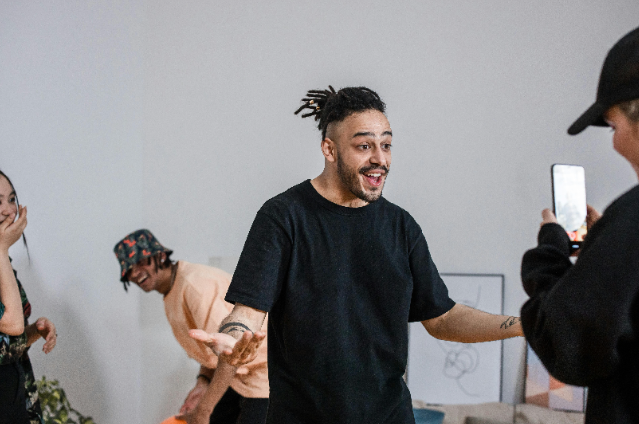
There was a time when moments were allowed to end quietly.
When laughter didn’t need proof, and happiness didn’t require an audience.
Somewhere in the middle of all this, life has become something we learned to document before we even learned to feel through it. We started living with an audience who isn’t there, trying to show expressions, our words, as though someone was always watching.
Social media promised connection. What it delivered, for many of us, was performance. A version of life where presence is often controlled by visibility, and worth is often seen with engagement.
This constant state of always being seen has reshaped our perception of how we relate to ourselves, and to the very truth of our emotions.
Over the last decade, social media has been transformed from simple communication tools into powerful social stages for most individuals. Profiles have become personal brands. Stories and posts have turned daily life into redefined narratives. Even vulnerability, once private, is now often captioned and shared for public consumption.
This shift has made a blur in the line between authentic expression and performance. We are narrating and presenting them so that they seem to be legible to an audience. In this environment, being offline can feel like complete erasure, and being unseen can feel like failure.
Being constantly connected through social media does not synonymously equate with being emotionally close. In fact, the way we see connection can sometimes be replaced with real intimacy. We know what people are doing, but not how they are coping through life. We see faces every day, but rarely sit with them in their silence.
Social media promotes a version of closeness that is fast and performative — likes, reactions, quick replies. Emotional closeness requires slowness. It requires listening to one another without an audience, and presence without proof.
The danger is not just seen in social media itself, but the way it makes us equate being seen with being known.
Sherry Turkle’s work is very powerful because it does not just see technology as an enemy, but as one that reflects our deepest emotional habits and insecurities within us. Through decades of interviews with students and professionals, she has acknowledged a slow transition, which is unsettling, where people were talking more, yet saying less.
In her Research concerning this issue, Turkle also noticed that digital spaces allow most individuals to control how they are seen emotionally. This control makes a sense of safety, but it also makes the discussions about that of spontaneity and vulnerability. Face-to-face interaction and emotional risk, begins to feel overwhelming by comparison.
One of Turkle’s most cited examples is seen in the people who increasingly prefer texting to talking because it is easier to manage. A text can be curated. A conversation demands presence. As a result, emotional exchanges become more transactional than relational. People remain “connected” while avoiding the messiness of real intimacy.
Turkle also talks about how social media curates self-identity. When individuals grow in a way that seems rather constructed for an audience, they begin to internalize that gaze. Even in sacred moments, they may feel watched and evaluated constantly, which makes self-consciousness seem to cause vulnerability around the ability to sit with one’s thoughts, which tends to lead to discomfort when faced with silence and solitude. As time goes on, solitude, which was once an essential for emotional growth, is now seen to feel like loneliness.
What makes Turkle’s work especially important today is her stance on the fact that technology does not just change how we communicate; it changes our very perception of what we expect from relationships around us. We start expecting immediate availability, instant responses, and emotional validation without depth. When real relationships fail to meet our expectations, we are now disappointed, and not because people often seem to care less, but because the standards for connection have shifted radically.
Her research as a whole stands on the note that a central irony of digital life is that we turn to screens to feel less alone. The problem, Turkle argues, is not just connection in itself, but connection without conversation, presence without attention, and intimacy without vulnerability or weakness.
What unsettles me most is not how much we share, but how little space we leave for unperformed life. The moments where no one is watching, where we grieve quietly, think slowly, and exist without explanation, are becoming rare.
When life is seen as a stage, authenticity becomes a high risk. And yet, it is in the moments we don’t notice that we often meet ourselves more honestly.
Perhaps the question is not whether we should disconnect fully, but whether we still know how to be fully in touch without performing it. True connection asks for less visibility and more close attention to detail, more listening.
Honestly speaking, social media did not take intimacy away from us. But it shifted the rules. In a world that constantly watches, choosing to live quietly and sincerely may be the most life-changing act of all.
. . .
REFERENCES: