
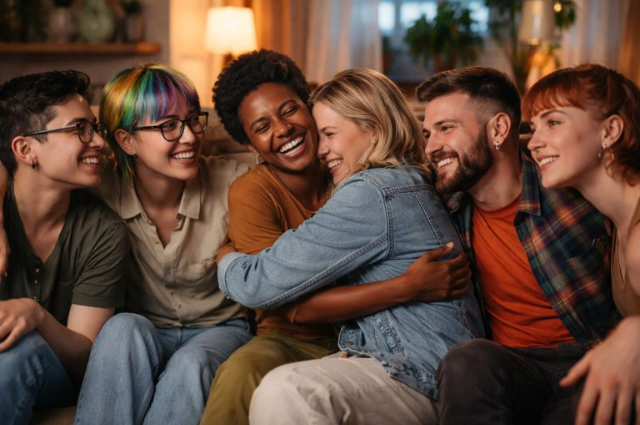
There comes a moment in many lives when you realise that love doesn’t always come from where you were told it would. For some people, family is safety, acceptance, and home.
For others — especially many LGBTQ+ individuals — family can be silence, distance, or conditions placed on love. And when belonging is seen to be in bondage, the human heart does what it is known to do: it finds another way to live.
This is where the idea of chosen family is brought into the knowing.
Not out of dismissal, but out of necessity. Not to replace blood, but to preserve the self.
Chosen family is when people who decide to support, care, and loyalty matter more than just genetics. It is the quiet determination of building home in friendships, partners, communities, and shared understanding — especially for those in a world that often asks people to shrink, hide, or explain their existence.
For many LGBTQ+ individuals, the concept of “family” is often misunderstood. Traditional families — which are made by the expectation, culture, or belief — can sometimes be conditional, or even hostile.
Studies centered around mental health reports all depict one thing that lack of familial acceptance often coincides strongly with higher rates of depression, anxiety, and suicidal ideation common among LGBTQ+ people. In strong response, communities have discovered new alternative sources of support: which is called chosen family. The very reason why queer people experience a disparity in the mental health challenges that they are in the space with relative to their straight/cis counterparts is relatively well known, but we don’t often speak about why this occurs. Many queer people struggle with high rates of depression and anxiety, and this can largely be traced back to the way they are treated by society as a whole. The discrimination, rejection, and even hatred they encounter can be incredibly damaging, and it can lead to feelings of internalized homophobia or transphobia.
Chosen family is a lifeline and it’s not just seen as a social convenience. It helps to provides emotional safety, practical support, and a space to fully surround oneself authentically without any judgment. It is a proof to the human need for always being together— a need that cannot be neglected, even when traditions with family tend to fail
The rise of chosen families showcases a particular trend which is broader in terms of cultural shift: people are actively talking about the structures that bring about their mental health, rather than depending on inherited social norms.
In my regard, the most spectacular part of chosen family is how it turns emotional weight carried into mutual care — where support is intentional and free from the authority. Unlike conventional family, these bonds are built on constant creation of a space where love and safety are earned and freely given.
One intriguing example comes from the life of Lea, a young queer woman in India.
Lea was rejected by her biological family after coming out as a bisexual individual. Without support, she hard a stuff Time with depression and isolation. But over time, she formed her own “family” — a close group of friends, and coworkers who helped her with emotional guidance, celebrated milestones, and help in creating a sense of home she had never known before.
Through this chosen family, Lea gained the confidence to follow her career, advocate for herself in social spaces, and even reconnect with parts of her biological family on her own terms. She describes them as “the family I know I always needed, but never had.”
This story showcases how the chosen family doesn’t just fill an empty space; it actively enforces resilience and mental well-being.
I genuinely believe that chosen families are impactful. They tend to challenge the notion that blood is the only valid provider of care. They show us that love is not inherited but rather it is intentional.
For LGBTQ+ individuals, creating this network is often an act of survival, yes — but also an act of new affirmation. It says: “I am worthy of everything I desire including love and belonging, even if the people I was born to couldn’t see it.”
By focusing on the chosen family, we also equip ourselves with a lesson for everyone: that the most impactful relationships are not dictated by tradition, but by respect and presence
Family is not defined not only by DNA; it is defined by real care.
Emotional support is important for mental health — sometimes, you have to give yourself permission to make it happen yourself.
Chosen families show how intentional communities can help us build and thrive, especially in harsh environments.
Chosen family make us remember that belonging is a human right, not a privilege. For many LGBTQ+ individuals, it is the difference basic difference between isolation and flourishing.
Whether it’s in the friends we have who celebrate your milestones, or partners who just protect your heart, or mentors who help direct your path, the family we choose can be the family that saves us by the end of the day.
In a world that sometimes says “you don’t belong,” chosen family says, simply and solidly: “You already do.”
References: