
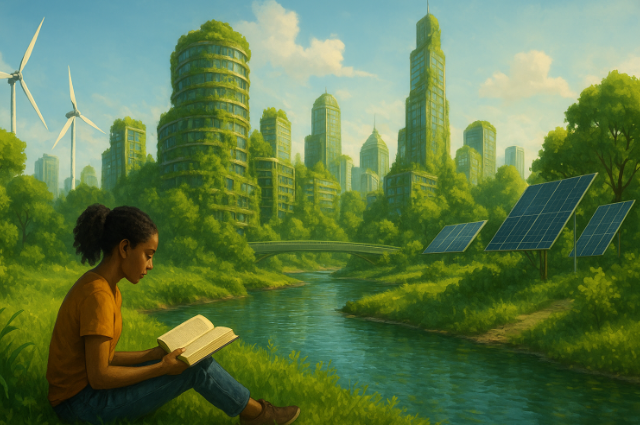
There was a time I presumed the future was a phase that only happened to other people — a set of statistics on the news I could scroll past the majority of the time. Climate change became a story I read through; I never lived it.
Then I opened a book that imagined a city underwater, a world struggling to breathe, a society forced to rethink everything. And for the first time, the future felt deeply personal.
I soon realised that fiction has an odd kind of power: it doesn’t just entertain people. It teaches us to feel, to imagine the possible, and to ground our choices that seem to echo far beyond our very existence.
Climate fiction, otherwise called Cli-Fi, isn’t all about despair. It’s more about hope and the immediate idea that even in the idea of crisis, it is possible to imagine better worlds. And sometimes, imagining them is the first step to actually building them.
Climate fiction, or Cli-Fi, is a genre that seems to imagine the very ways in which our planet might change — and how we as humans may respond. It doesn’t just caution us about disaster; rather, it asks us to feel, to step into possible futures and to consider in the best possible ways what we can do differently today.
Historically, many Cli-Fi stories seemed to contain warnings of rising seas, unbreathable air, and societal collapse. They were cautionary tales that showed the disadvantages of inaction.
But of recent, a shift has come about. Writers are exploring positive, and more problem-solving futures — which is now regarded as the solarpunk. These stories envision cities that are powered by renewable energy and technology that are in sync with nature. The message is simple: the future can be beautiful, only when we act in a way that is conscious of bettering our lives.
What seems to captivate me most is how Cli-Fi is no longer solely just about warning us; now it’s about showcasing to us what could be, and giving us something to hope for, that the future ensuring the future doesn’t have to be bleak.
In the solarpunk and optimistic Cli-Fi, most cities are green, the communities are connected, and technology associates itself with nature; it is not against it. These stories don’t just talk about problems; they seem to discover solutions, whether small, human, and tangible. They make readers imagine the possibility of a world shaped by collaboration, creativity, and care.
I am intrigued by how these narratives engage the imagination in different ways compared to the news articles. Instead of dry statistics, we now experience reality.
This shift is important because it makes hope to initiate action. Fear alone doesn’t change behaviour. When readers can envision futures that thrive, they’re being inspired to act on their decision even today— whether or not it’s through personal choices, community projects, or supporting climate initiatives.
One of the most captivating examples of Cli-Fi influencing real life is magnificently talked about in Kim Stanley Robinson’s New York 2140. This novel imagines a flooded New York City decades from now, analysing how people were able to adapt, restructure, and survive in an ever-changing environment.
What’s amazing is that urban planners and policy think tanks have used this story to simulate potential futures. By stepping into the scenarios Robinson imagines, they can explore questions like:
How do communities respond to rising seas?
Which infrastructure choices help protect vulnerable populations?
What strategies for sustainable urban design are most effective?
Reading this, I realised that fiction doesn’t just tell us what could go wrong — it shows us how we might respond. It turns imagination into insight. My personal opinion is this is the magic of Cli-Fi: it transforms a story into a tool for foresight, planning, and action.
Cli-Fi isn’t just a regular genre; it’s more like a connection between what we see as imagination and responsibility. Reading a story like New York 2140, it makes climate change seem rather tangible and not as a mere concept, but as a world we could feel, and all dwell in like our home. Fiction has this quiet power attached to it: it permits us to step into futures that might never be real, but yet feel so real.
What shocks me the majority of the time is how hope can change a lot of things. Early climate stories were warnings — urgent, bleak, sometimes paralysing. But solarpunk and optimistic Cli-Fi remind us that action matters. They show communities adapting, innovating, and finding joy and meaning even in crisis. I find that deeply human. Because as I had the chance to read through these stories, I had no place for fear — It was more of a world filled with endless possibilities. I feel that my own choices, no matter how small, matter.
I’ve also noticed that younger readers respond differently to these narratives. They pause, they imagine, and they discuss. A flooded city on a page can be seen as a classroom, a workshop, a spark. And that’s why, for me, Cli-Fi is more than any literature; it’s a power through empathy. It guides us to care because it makes the consequences real and personal.
Fiction seems to bring about foresight: Imagining futures helps us prepare for them.
Hope accelerates action: Stories of survival and solutions spark engagement far more than fear alone.
Small actions ripple out: When we see communities respond creatively, we’re reminded that individual and collective choices often tend to shape outcomes.
Stories make change accessible: Not everyone reads reports, but many will read a novel and make its lessons practical. Cli-Fi assures us that stories can shape reality. They often make us remember that while the future may be uncertain as at now, our choices hold weight. When we open up our minds to endless possibilities, we educate ourselves to thrive and to build better worlds.
And here’s the truth I’d share with you today: the worlds we imagine in fiction aren’t just mere imaginations; they are the very blueprints for our very existence.
So pick up a Cli-Fi novel today. Let it make you think and act. Let it remind you that even in uncertainty, possibility is abundant— and sometimes just imagining is the first step toward creating it.
References: