
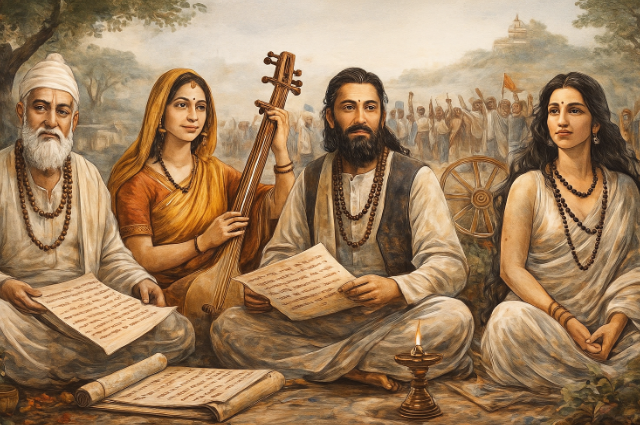
There are moments in history where ordinary people rise with nothing but their voice, their conviction, and their faith — and somehow, they end up shifting an entire society.
That is what the Bhakti movement has always felt like to me.
Long before the language of “activism” or “social justice” existed, these poets and mystics were already challenging the rules that held people apart. They questioned caste. They rejected untouchability. They broke gender restrictions. And they articulated themselves in a tone everyone could comprehend, not the language of control.
As I started learning about the Bhakti saints, something shocked me in the best way:
Their rebellion was rooted in devotion, but their impact was social.
They didn’t fight with swords — they fought with words, songs, and truth.
And as of right now, centuries later, India is now realising the echoes of their voices in modern social movements. It feels like the same spirit is being brought to life— in conversations about equality, human dignity, and the right to be seen.
The Bhakti movement began between the 7th and 12th centuries and eventually spread across India as a devotional wave that rejected the rigid structures of caste, gender hierarchy, and ritual privilege. What made Bhakti different was not only its poetry, but its politics — even when it wasn’t described that way.
Instead of worship confined to temples or priests, Bhakti saints insisted on a direct, personal relationship with the divine. And in making God accessible to everyone, they also made society question who “deserved” dignity. Saints such as Kabir, Mirabai, Ravidas, and Akkamahadevi articulated themselves in tones the ordinary people comprehend: songs, couplets, metaphors, and raw questioning.
Their words seemed to have gone farther in ways many laws ever could reach.
The more I study them, the clearer it all is:
Bhakti wasn’t just known for a spiritual movement — it was an equalising effect socially
And this is exactly why modern thinkers, activists, and reformers return to Bhakti today. They see in it a historical example of resistance that did not require violence, privilege, or institutional power — just truth spoken with courage.
What comes as a shock to me about the Bhakti movement is how personal its energy feels today. If you take away the centuries, the message still sounds clear, like what modern activists are basically fighting for: their dignity that has no conditions, equality with no permission, and humanity with no hierarchy.
Many modern Indian social justice activities — especially those addressing women’s rights and access to public spaces — often talk about the same questions Bhakti saints raised before.
Questions like:
Who decides who is “pure” or “impure”?
Why should birth determine a person’s worth?
Why should devotion or identity be mediated by someone else’s authority?
Just like Kabir challenged Brahminical dominance, Dalit movements today quote Ravidas to demand fairness and equality.
And just like Bhakti poets used local languages to reach ordinary people, activists of today use social media, street art, Instagram poetry, and public occasions to speak without hiding any more information.
What I find powerful is this:
The Bhakti movement democratized devotion — and modern movements aim to democratize dignity.
Both are grounded in the same belief that no one should stand between a person and their right to exist fully.
This revival isn’t accidental. It’s proof that centuries later, India still draws strength from voices who dared to imagine a society different from the one they inherited.
The most powerful examples of Bhakti’s enduring impact remain that of Ravidas, a saint born into a disadvantaged caste. His verses encapsulated a world where birth had no chance to determine worth, and where devotion was worldwide. For him, society’s rules were never divine — they were man-made barriers to justice and equality.
Today, his words are not just poetry; they are a tool for advocacy. Dalit movements frequently cite Ravidas’ vision of Begampura — a casteless, just society — to challenge systemic discrimination. By establishing this, they are engaging the same spirit of dissent and moral courage that Bhakti saints lived by centuries ago.
Writing on this, I can’t help but mention that I see the direct link from past to present. What startles me most is that these lessons are rather timeless — they’re as fundamental today as they were when Ravidas first spoke about them.
Bhakti, for me, is profound because it is not just the devotion, but the unwavering strength it comprises. These saints not only sang to God — they sang to the call of humanity and to equality. Their rebellion was seen as gentle but was strategic: it asked society to see the people differently and to treat them in the world with dignity.
Looking at modern movements, I see the same fire. Activists quoting Bhakti poetry, students learning about Mirabai, and campaigns invoking Kabir — it’s all proof that change can be nurtured through words, culture, and ideas, not only through protests or laws.
To me, Bhakti teaches that quiet conviction can shift centuries of injustice, and that even a single voice, when courageous and consistent, can ripple through time.
Bhakti wasn’t just religious — it was radical social philosophy.
Its teachings are alive in modern social justice movements.
Words, devotion, and art can challenge inequality as effectively as laws.
Courage sometimes whispers through poetry and devotion.
The Bhakti movement makes us look at history and how it is alive in our present struggles. Its saints showed that both equality and dignity could be pursued long before modern activism ever came into place. Today, their legacy encourages us as individuals and communities to fight against gender and social hierarchies, which proves to us that a whisper of truth can echo through centuries.
As I look back on the impact of Bhakti, it reminds me that the tools for justice are very simple — it could be a song, a poem or a voice that refuses to be quiet. And that’s all it takes to change the world.
References: