
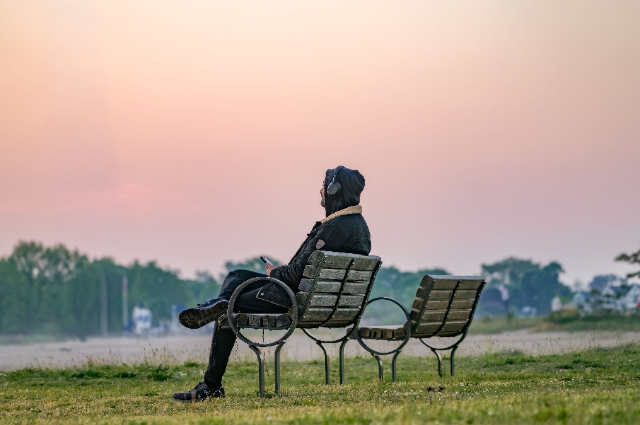
It's 7:14 in the morning, and the phone is already in your hand before your feet touch the floor. Fourteen notifications. Three are work emails that could have waited. One is a sale on shoes you don't need. Somewhere in there, buried under the noise, might be a message from someone who actually matters, but you won't get to it yet, because you're already thinking about the meeting at nine, the report that's due Friday, the argument you had with your sister that you haven't resolved, the number in your bank account that never seems to grow the way you want it to.
You get dressed. You make coffee, or you don't have time to. You're out the door, and the day has already started running ahead of you, and you are simply trying to keep up with it.
This is not a dramatic life. It's an ordinary one. It's most of our lives, in fact, in one form or another, whether you're in Lagos or London or Manila or a small town nobody's heard of. We wake up, and we move, and the moving feels urgent, even when, if you stopped to examine it, very little of it actually is.
So here's a question. I'm not going to answer it for you, and I'm not going to answer it quickly, because it doesn't deserve a quick answer.
If today were your last day, would your priorities remain the same?
Sit with that for a second before you scroll further.
Would you still be worried about the email? Would the sale on shoes still matter? Would you spend your last hours the way you're planning to spend today?
The quiet lie we all agree to live inside
Nobody actually believes they're going to live forever. Ask anyone, and they'll tell you, of course I know I'm going to die. It's obvious. It's biology. It's not controversial.
And yet. Watch how we actually live. Watch how we spend a Tuesday. We plan five years for a promotion but can't plan five minutes to call our mother. We agonise over a stranger's opinion of us online but forget to ask our father how he's really doing, not the surface-level fine, but the real answer. We tell ourselves we'll travel later, forgive later, rest later, say the important thing later.
There's a strange split in the human mind. We know, intellectually, that our time is limited. But we live, practically, as though it isn't. It's not that we're lying to ourselves exactly. It's more like we've made an unspoken agreement with everyone around us to not talk about it too much, because if we did, the whole structure of how we spend our days might start to look a little absurd.
Think about how much of your mental energy this week has gone toward things that, if you were told you had one day left, would simply evaporate. The status update. The comparison with a coworker's promotion. The mild resentment you're carrying toward someone who cut you off in traffic four days ago. None of it survives contact with the question. It's like sunlight on fog.
That's not a criticism of you. It's just what being human, distracted and time-bound, tends to look like. But it's worth noticing.
Ambition isn't the enemy. Forgetting is.
I want to be careful here, because there's a version of this essay that turns into a lecture against ambition, against working hard, against wanting things. That's not what this is. Wanting to build something good, to provide for the people you love, to leave work behind that outlasts you — none of that is shallow. Some of the most meaningful lives have been built by people who worked with tremendous intensity.
The problem isn't ambition. The problem is when ambition becomes the whole story, when it crowds out everything else until you wake up one day, maybe not literally your last day but close enough in feeling, and realise the ladder you climbed was leaning against the wrong wall.
There's an old story, and it doesn't matter which tradition you first heard it in because versions of it exist almost everywhere, about a wealthy man who built bigger barns to hold his growing surplus, congratulating himself that he could finally rest and enjoy his life. And that very night, his life ended. The point was never that wealth is evil. The point was the sentence: he had made plans for a future he didn't actually have a claim on. None of us does, really. We borrow our days. We don't own them outright.
So the question isn't "should I want things." The question is closer to: am I so busy reaching for the next thing that I've stopped noticing what's already in my hands?
What survives the question, and what doesn't
Try this exercise, and I mean actually try it, not just read past it. Make two mental columns.
In the first column, put everything that would still matter to you if you knew, with certainty, that you had twenty-four hours left. In the second, put everything that would suddenly feel pointless.
For most people, the first column is short and specific. A person's face. A conversation you never finished. Forgiveness you never offered, or never asked for. Whatever you believe waits for you after this, and whether you feel ready for it. Gratitude, oddly, tends to show up here too — not gratitude as a performance, but the quiet, almost embarrassed realisation of how much you were actually given.
The second column tends to be long, and a little humiliating, because it's full of the things we spend most of our waking hours on. The argument you're still replaying. The image you're managing for people who will forget you within a generation. The comparison, the score-keeping, the resentment.
This isn't really about death. It's a filter for what's real. Anything that dissolves the moment you imagine your last day was probably never as important as it felt while you were living inside it.
Fear, and what it's actually pointing at
Most of us don't talk about death because it's frightening, and fear, left alone, tends to just sit in the corner of a room making everyone uncomfortable. But fear is not always something to run from. Sometimes it's information.
The fear of dying badly — unresolved, unaccountable, unprepared — is often just the fear of having lived carelessly. And that fear, uncomfortable as it is, can actually be a gift, because it's one of the few things honest enough to interrupt us.
There's a reason reflective traditions across the world have never treated the thought of death as morbid, but as clarifying. In Islamic tradition, the remembrance of death is described almost as medicine — a jolt back to sincerity, a reminder that every soul will taste it and that what a person sends ahead of themselves, in good deeds and honest dealings, is what will actually meet them. In the Psalms, there's a plea to be taught "to number our days, that we may gain a heart of wisdom" — not as despair, but as a request for clearer eyes. Buddhist practice has long used the contemplation of impermanence not to produce anxiety but to loosen our grip on the things we cling to too tightly.
None of these traditions is telling you to be afraid of living. They're telling you that forgetting you will die is what makes people cruel, careless, arrogant, and small. Remembering it, strangely, is what tends to make people kind.
Love, examined honestly
If you knew today was your last, who would you call? Not text. Call.
Notice that the list is probably shorter than your contact list. Notice that some of the people on it are people you haven't properly spoken to in months, maybe longer, not because anything went wrong, just because life got loud and you assumed there would be more time. There always seems to be more time, until the day there isn't.
Love, real love, is strange in how quietly it survives every test the mind throws at it. Wealth doesn't survive the question of the last day. Status doesn't survive it. But love, the specific, unglamorous kind — sitting with someone while they're sick, calling your mother for no reason, telling a friend the truth even when it costs you something — that survives every single time. It's almost the only thing that does.
Which makes you wonder why we don't organise our lives around it more.
Regret, and the honesty it demands
Ask an older person, someone who has genuinely lived a long life and thought about it, what they regret, and pay attention. It's rarely the risk they took. It's almost always the conversation they avoided, the apology they were too proud to offer, the years they spent angry at someone who is now gone and can no longer hear the apology anyway.
Regret has a particular cruelty to it: it usually points backwards at something that was, at the time, entirely fixable. That's the part that stings. Not that life was unfair, but that we had the chance and didn't take it, usually out of pride, or fear, or simple distraction.
If today were your last day, is there someone you'd need to call not to say goodbye, but to say sorry? Or to finally say the thing you've been swallowing for years because it felt easier than the risk of saying it out loud?
You don't have to answer that here. But you already know, don't you? The name probably came to you before you finished reading the sentence.
Accountability, without the theatrics
There's a temptation, when writing about mortality, to either drown the reader in guilt or float everything in vague comfort — "just live your best life," as if that phrase means anything specific at all. I want to avoid both.
Accountability isn't about punishing yourself for being human. It's simply the honest acknowledgement that your choices are not weightless. The way you treated the waiter who got your order wrong. The way you spoke to your child when you were tired. The quiet dishonesty at work that you've told yourself doesn't really count because everyone does it. These things accumulate. They form the actual shape of a life, far more than the résumé does.
Nearly every wisdom tradition insists on this in one way or another: that we will be asked, eventually and in some form, to account for how we treated the people we had power over, however small that power was. Not to terrify you into paralysis, but to hand you back your dignity — the dignity of a life that matters enough to be examined.
Humility, gratitude, and the strange relief of smallness
Here's something almost nobody tells you: thinking about your last day, done honestly rather than dramatically, doesn't usually produce despair. It tends to produce relief.
Because it puts you back in your actual size. You are not the centre of the universe managing an empire of tasks that must all succeed by Friday. You are a person, given a limited, specific, unrepeatable stretch of time, mostly out of your control, and mostly not owed to you in the first place. That's humbling, yes. But it's also, if you let it be, a kind of gift, because it releases you from the exhausting job of pretending to be permanent.
And once you stop pretending to be permanent, gratitude comes almost on its own. The coffee this morning. The fact that your body worked today without you having to think about it. The friend who texted back within the hour. None of this was guaranteed. None of it is small, actually, except that we've trained ourselves to treat it that way.
So, would your priorities remain the same?
I'm not going to tell you the answer, partly because I don't know your life, and partly because the value of the question isn't in the answer — it's in what happens to you while you sit with it honestly.
Maybe your priorities would remain the same, and if that's true, that's a remarkable thing to be able to say. It would mean you're already living close to what matters.
But if you're like most of us, some things would fall away instantly, and a short list of people and unfinished conversations would rise to the surface, urgent in a way they weren't this morning when the notifications started coming in.
The honest thing to do with that isn't to spiral into anxiety about dying. It's to ask a smaller, more workable question: what is one thing, today, that the last-day version of me would want me to do, that the ordinary distracted version of me keeps postponing?
Maybe it's a phone call. Maybe it's an apology. Maybe it's simply sitting still for ten minutes without the phone in your hand, and letting yourself actually feel the day you're in, instead of rushing past it toward the next one.
We don't get to know if today is our last day. That uncertainty is, in its own strange way, mercy — most of us couldn't carry the weight of knowing for certain. But the not-knowing is exactly why the question deserves to be asked now, while there's still time to change the answer.
So I'll leave it with you, honestly, and without trying to push you toward any particular response.
If today were your last day — would your priorities remain the same? And if not, what's stopping you from changing them, starting now, while you still can?