
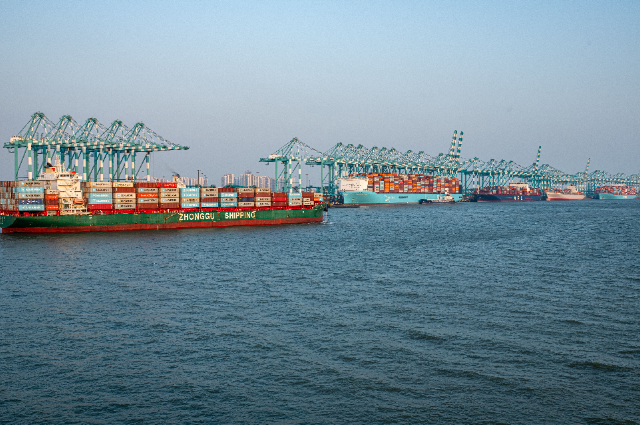
International trade allows countries to exchange goods, services, technology, and raw materials. However, its benefits are not always shared equally. One country may export more than it imports, while another may rely heavily on foreign products. These patterns raise questions about trade deficits, economic dependence, and long-term financial stability. India and China have significant commercial relations. China supplies many of the industrial goods, machinery, electronic components, and chemicals that Indian businesses use. This trade supports Indian industry and consumers, but it also produces a large imbalance. According to the Embassy of India in Beijing, India’s merchandise exports to China were about US$19.47 billion in FY 2025–26, while imports from China were about US$131.63 billion. The resulting bilateral merchandise deficit was about US$112.16 billion (Embassy of India, Beijing, n.d.).
This essay asks whether expanding India–China trade offers an opportunity for development or creates long-term vulnerabilities. It examines the imbalance, India’s dependence on Chinese inputs, the link between trade and currency pressures, and the China+1 strategy as a possible response.
Trade Deficit and Trade Surplus
A trade deficit occurs when a country’s imports of goods exceed its exports of goods over a given period. A trade surplus is the opposite. In bilateral merchandise trade, India runs a deficit with China, and China records a surplus with India. A deficit is not necessarily a sign of weakness. Countries often import machinery, technology, and raw materials to build industries and raise productivity. A persistent deficit becomes more concerning when imports grow faster than exports, domestic production depends on foreign suppliers, and local industries struggle to compete. The key question is therefore not only whether a deficit exists, but what India imports, how much domestic value is created, and whether imports build long-term productive capacity.
The Growing Imbalance
India–China merchandise trade has expanded considerably. Official figures show that India’s exports to China rose sharply in FY 2025–26, reaching about US$19.47 billion, while imports reached about US$131.63 billion (Embassy of India, Beijing, n.d.). Trade has grown, but it has not moved toward balance. China supplies a wide range of manufactured products at competitive prices. Indian firms buy these goods because they are available in large quantities and integrate into global supply chains. At the same time, India’s exports to China remain small relative to its imports. Improving access for Indian products in the Chinese market, strengthening export competitiveness, and diversifying India’s export basket are therefore important objectives.
India’s Dependence on Chinese Inputs
A significant part of India’s imports from China consists of industrial inputs, including electronic components, machinery, chemicals, and pharmaceutical ingredients. Many of these are not consumed directly. Indian manufacturers use them to produce other goods. A company that assembles electronic devices in India, for example, may import components from China before selling the finished product at home or abroad.
This creates a complicated relationship. Manufacturing output may rise while a large share of its inputs still comes from abroad. Domestic manufacturing growth therefore does not automatically reduce import dependence. If supplies are disrupted or prices rise, Indian manufacturers face higher costs and delays, which can affect the availability and price of finished goods. Complete self-sufficiency is neither realistic nor always efficient. International trade allows countries to specialise. India should aim to reduce excessive reliance on a single supplier in strategically important sectors while maintaining access to affordable, reliable imports.
Trade Deficit, the Dollar, and the Rupee
International trade is often priced in US dollars, although contracts and banking arrangements vary. When Indian importers pay for Chinese goods in dollars, they need foreign currency. If overall demand for foreign currency exceeds earnings and other inflows, this can add pressure to the foreign-exchange market. A persistent trade deficit is therefore one factor that can influence the rupee’s value, but it is not the only one. Exchange rates also depend on capital flows, interest rates, inflation, oil prices, global conditions, and monetary policy. The relationship is not automatic.
An illustrative example shows the cost effect. Suppose an Indian company imports machinery worth US$1 million. At an illustrative rate of ₹85 per dollar, the cost is ₹8.5 crore, before additional charges. If the rupee weakens to ₹90 per dollar, the same machinery costs ₹9 crore, an extra ₹50 lakh for the same dollar-priced import. Such increases can raise production costs, which may be passed on to consumers or absorbed as lower profits. A weaker rupee can also make Indian exports cheaper for foreign buyers, depending on market conditions.
The China+1 Strategy
The China+1 strategy means keeping operations in China while diversifying production or sourcing to at least one other country. Companies adopt it to reduce concentration risk, improve supply-chain resilience, and respond to changing costs and geopolitical conditions. India can benefit because of its large domestic market, workforce, expanding infrastructure, and growing manufacturing base. Foreign investment and technology transfer could help build stronger production networks in sectors such as electronics, pharmaceuticals, machinery, and renewable energy.
Investment alone will not eliminate the deficit. Some firms may set up assembly operations in India while still importing most components from China. Domestic output would rise without a matching fall in import dependence. Real gains require local supplier networks, better logistics, research and development, technical skills, and consistent policy. The strategy’s primary aim is diversification, not an end to trade with China.
Policy Recommendations
Reducing the deficit requires a long-term strategy rather than sudden restrictions on imports. First, India should improve export competitiveness through access to modern technology, efficient logistics, skilled labour, affordable finance, and reliable infrastructure. Second, it should build domestic capacity in strategically important sectors such as pharmaceutical ingredients, electronic components, solar manufacturing inputs, and specialised machinery. Third, it should diversify export markets, reducing reliance on a small number of partners. Fourth, it should pursue fair and predictable market access in China, using negotiation to address regulatory and commercial barriers faced by Indian pharmaceuticals, agricultural products, and manufactured goods. Fifth, policymakers should encourage research and value addition, since assembling imported components without developing technical capability leaves a country dependent on external suppliers.
Policymakers should also treat the trade deficit as one indicator among several. Employment, productivity, export quality, currency stability, and domestic value creation are equally important measures of economic progress.
India–China trade shows both the benefits and the challenges of economic interdependence. It gives Indian businesses and consumers access to affordable goods, machinery, and industrial inputs. The large and growing deficit, however, raises serious questions about export competitiveness and dependence on imported products. A persistent imbalance can add external pressure, especially when combined with currency depreciation, rising import costs, or supply disruptions, though it does not automatically cause these problems. The China+1 strategy offers India a chance to attract investment, diversify supply chains, and expand manufacturing. Its success depends on whether India can build competitive domestic industries rather than simply replacing one source of imports with another. The goal is not to eliminate imports or to pursue a surplus at any cost, but to build a balanced and productive economy in which trade supports development.