
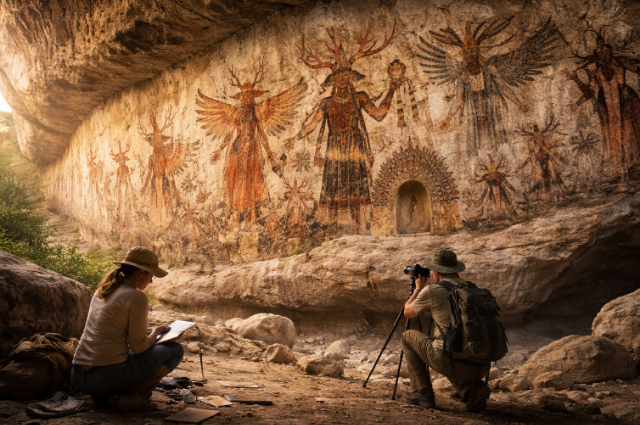
Introduction: A Canyon Library Lost in Time
The limestone canyons of the Pecos River in southwest Texas are places of stark beauty and deep silence. Carved by water over millennia, their pale rock walls rise abruptly from the desert floor, catching the harsh sun by day and dissolving into shadow at dusk. For most visitors, these canyons appear empty—remote landscapes shaped only by geology and time. Yet hidden within shallow rock shelters and along towering cliff faces is one of the most extraordinary artistic legacies in the Americas: vast prehistoric murals painted directly onto stone, some stretching more than a hundred feet in length.
These murals, known collectively as the Pecos River style, confront the viewer with a dense world of imagery—human-like figures crowned with antlers or rabbit-eared headdresses, animals in motion, geometric forms, and strange composite beings that seem to hover between the natural and the supernatural. Their meanings are not immediately obvious. No written records identify their creators. No names survive. For decades, archaeologists could not even agree on when they were painted. The canyon walls thus became a kind of locked archive: visually rich, historically silent, and profoundly enigmatic.
Who were the artists who returned again and again to these canyons? What compelled nomadic hunter-gatherers, often assumed to live precarious lives, to invest such labour and precision into monumental paintings? And why did so many of the images follow the same visual rules, repeating symbols across distant sites and unknown centuries? These questions lingered unresolved for generations of scholars.
Now, a groundbreaking scientific study has begun to unlock this canyon library. By directly dating the organic binders in the paint and the mineral layers surrounding it, researchers have discovered that the Pecos River murals were not the product of a short-lived cultural moment. Instead, they were created over an astonishing span of roughly 4,000 years—from around 3700 BCE to 900 CE—while maintaining a remarkably consistent visual language. The findings reveal not only artistic continuity, but the endurance of a shared metaphysical system: a coherent worldview passed down across nearly 175 generations.
Even more striking, this ancient cosmovision appears to resonate far beyond the Pecos River itself, echoing belief systems later found in Mesoamerican civilisations such as the Olmec, Maya, and Aztec. What once seemed like isolated desert art now emerges as part of a deep, interconnected intellectual history. These canyon walls, long silent, are beginning to speak—telling a story not only of art, but of belief, memory, and humanity’s enduring need to understand its place in the cosmos.
Historical Background of the Lower Pecos Region
The Lower Pecos region of southwest Texas, where the Pecos and Rio Grande rivers converge, has been a corridor of human life for more than 12,000 years. Archaeological evidence—from stone tools and hearths to food remains preserved in dry rock shelters—shows that people occupied this rugged landscape shortly after the end of the last Ice Age. Long before agriculture reshaped much of the Americas, small bands of hunter-gatherers adapted successfully to the region’s arid climate, exploiting its rivers, canyons, and seasonal resources.
These early inhabitants lived highly mobile lives. Rather than permanent villages, they moved cyclically across the landscape, following the availability of game, edible plants, and water. Their diet was diverse and well adapted to desert conditions, including deer, rabbits, fish, turtles, and bison in later periods, as well as mesquite beans, prickly pear, lechuguilla, and other native plants. Rock shelters provided temporary protection from the elements, serving as campsites, storage spaces, and places of ritual activity. The same shelters that preserved organic materials—such as woven fibres, sandals, and tools—also safeguarded the region’s extraordinary rock art.
For much of the twentieth century, archaeologists struggled to interpret the Pecos River murals within this broader cultural framework. The prevailing assumption was that nomadic hunter-gatherers lacked the social complexity needed to produce large, coordinated works of art. As a result, scholars often believed that the murals accumulated gradually, painted by different individuals over long periods without a shared plan or unifying system. The dense layering of images on canyon walls seemed to support this view, reinforcing the idea of visual chaos rather than deliberate composition.
A major obstacle to deeper understanding was the absence of reliable dates. Unlike stone tools or charcoal from hearths, rock paintings were notoriously difficult to date without damaging them. Researchers could describe stylistic similarities, but they could not establish firm timelines or determine whether murals separated by miles—or centuries—were culturally related. This uncertainty left fundamental questions unanswered: Who painted these images? How long did the tradition last? And what role did the murals play in the lives of the people who created them?
Despite these gaps, the Pecos River murals have always mattered profoundly within North American prehistory. Their sheer scale, complexity, and preservation set them apart from most other hunter-gatherer art traditions on the continent. They challenge long-held assumptions about mobility, belief, and intellectual life in ancient societies. Far from being marginal or decorative, the murals hint at a deep symbolic tradition—one that would only begin to come into focus once science found a way to read time itself from the canyon walls.
Discovery and Documentation of Pecos River Style Art
The Pecos River murals entered the archaeological record gradually, first through the observations of explorers, ranchers, and amateur antiquarians in the late nineteenth and early twentieth centuries. Drawn by curiosity rather than scientific method, these early visitors sketched the paintings, photographed them, and recorded their locations in personal journals. While their efforts preserved invaluable visual records—especially of murals that have since deteriorated—they often lacked the tools to analyse the art systematically. As a result, the paintings were viewed more as regional curiosities than as components of a coherent cultural tradition.
By the mid-twentieth century, professional archaeologists began to recognise the uniqueness of the Lower Pecos rock art. Field surveys documented hundreds of painted rock shelters scattered across limestone canyons in southwest Texas and northern Mexico. Scholars noted recurring visual elements and began referring to the tradition as the “Pecos River style,” distinguishing it from other North American rock art forms. Yet documentation remained uneven, constrained by difficult terrain, limited funding, and the fragility of the sites themselves.
What set the Pecos River style apart was its extraordinary monumentality and complexity. Some mural panels stretch more than 100 feet across canyon walls and rise up to 20 feet in height, dwarfing most other prehistoric paintings in North America. The imagery is dominated by anthropomorphic figures—often elaborately adorned with antlers, headdresses, or wing-like appendages—alongside powerful animal forms such as felines and serpents. Interwoven among these figures are geometric devices: dart points, radiating lines, and crenellated arches that appear to frame portals or thresholds. The artists worked with a controlled but striking palette of black, red, yellow, and occasional white, applied in bold, overlapping layers that created visually dense compositions.
Documenting these murals posed immense challenges. Many are located in shallow shelters high above canyon floors, accessible only by steep climbs or narrow ledges. Extreme heat, seasonal flooding, and fragile limestone surfaces limit the time researchers can spend at each site. Moreover, even minimal physical contact risks damaging pigments that have survived for thousands of years. Accurate recording, therefore, required patience, specialised equipment, and non-invasive techniques.
In recent decades, systematic study has advanced dramatically through the work of the Shumla Archaeological Research and Education Centre in collaboration with Texas State University. Using high-resolution digital photography, microscopic pigment analysis, and standardised recording protocols, researchers began to document the murals in unprecedented detail. This careful, methodical approach transformed scattered observations into a comprehensive corpus of data, laying the foundation for the scientific dating and interpretive breakthroughs that would finally reveal the true scope and significance of the Pecos River artistic tradition.
Scientific Breakthrough: Determining the Age of the Murals
Dating rock art has long posed one of archaeology’s most stubborn challenges. Unlike stone tools or bones, pigments on canyon walls cannot simply be carbon-dated in the traditional sense. Over thousands of years, rock surfaces are subject to weathering, erosion, and contamination by organic and inorganic matter, all of which can obscure the original composition of the paint. Additionally, mineral accretions—thin layers of calcium carbonate or oxalate that form naturally on rock surfaces—can either lie above or beneath the painted images, making it difficult to determine whether a date corresponds to the creation of the mural itself or to later geological processes. For decades, these complications meant that the Pecos River murals could be described stylistically but could not be precisely situated within a chronological framework.
The breakthrough came when researchers adopted a two-pronged approach, combining direct and indirect dating techniques to overcome these obstacles. The first method focused on the organic binders within the paint itself. Archaeologists and chemists discovered that the artists had mixed their pigments with naturally occurring organic materials, including fibres from the yucca plant and fatty residues from deer bone marrow. By extracting microgram quantities of carbon from these binders, scientists could perform accelerator mass spectrometry (AMS) radiocarbon dating, yielding a direct estimate of when the paint was applied.
The second method examined calcium oxalate accretions, the thin mineral crusts that sometimes form both beneath and atop the painted surfaces. Because these accretions develop over time from the deposition of microbial and chemical residues, dating them provides minimum and maximum age ranges for the murals. A layer beneath the paint represents the earliest possible date of painting, while a layer above indicates the latest possible date. Together, the two methods created a chronological sandwich that bracketed the murals’ creation with unprecedented precision.
A key innovation in this process was the use of plasma oxidation techniques to extract carbon from extremely small paint samples without damaging the murals. This method allowed researchers to analyse tiny, previously unusable fragments—often just micrograms of pigment—while preserving the integrity of the artwork. Equally critical were control samples taken from unpainted rock nearby, ensuring that any carbon detected originated solely from the paint rather than from later environmental contamination.
The results were nothing short of astonishing. Analysis of multiple mural sites revealed that the Pecos River paintings were produced over a remarkably long span—from approximately 3700 BCE to 900 CE. Even more surprising, radiocarbon dates for individual pictographs within single murals clustered tightly, often statistically indistinguishable from one another. This evidence demonstrates that each mural was executed as a single, coherent event, rather than being accreted gradually over centuries.
Perhaps the most profound revelation was the persistence of a rule-bound artistic system over four millennia. Despite changes in climate, subsistence strategies, and broader cultural developments, the painters consistently followed the same layering sequence—applying black, then red, then yellow pigments—and reused the same symbolic motifs, such as antlered figures, rabbit-eared headdresses, and power bundles. This continuity challenges long-held assumptions that nomadic hunter-gatherers lacked complex, long-term planning or shared symbolic frameworks. Instead, the Pecos River murals testify to a sophisticated and enduring cultural tradition, demonstrating that these early peoples maintained intellectual and spiritual cohesion across nearly 175 generations.
In short, by applying rigorous scientific methods, researchers transformed the Pecos River murals from enigmatic decorations into a well-dated, deeply meaningful chronicle of human creativity and belief—a 4,000-year testament to the artistic and metaphysical sophistication of ancient North American societies.
Iconography and Symbolism: A Shared Cosmic Language
One of the most remarkable aspects of the Pecos River murals is their visual vocabulary—a complex system of recurring symbols and motifs that transcends individual sites and spans thousands of years. Researchers studying over 200 murals identified a set of motifs that appear repeatedly, suggesting a shared symbolic language used to convey stories, rituals, and cosmological ideas. Among the most prevalent are power bundles, speech-breath, rabbit-eared headdresses, antlered anthropomorphic figures, winged beings, stylised dart tips, and crenellated portals. Each of these motifs carries layered meaning, reflecting both the spiritual worldview of the artists and the ritualised processes by which the murals were created.
Power bundles, found in more than 60 per cent of the murals, are often depicted as plant, animal, or human-like shapes extending from a figure’s hand along long, radiating lines. They are believed to represent potent spiritual forces or objects of ritual power, acting as conduits between humans and the supernatural realm. Similarly, speech-breath symbols—depicted as lines or emanations from a figure’s mouth—may encode the transformative power of words or songs in ceremonial contexts, emphasising the interconnectedness of language, action, and spiritual potency.
Figures adorned with rabbit-eared headdresses and antlers appear frequently, suggesting their importance in ceremonial or mythological narratives. Rabbits and deer were common prey in the region, but here they likely serve symbolic functions, linking humans to animal powers or cycles of life and death. Winged beings further reinforce the notion of transcendence, depicting figures capable of movement between earthly and celestial realms. These anthropomorphic forms, often stylised and abstracted, convey not only physical action but metaphysical transformation, indicating a worldview in which humans, animals, and spirits exist within a continuous cycle of interrelation.
Stylised dart tips and other geometric devices may have functioned as markers of ritual action or as cosmological symbols, mapping movement, energy, or sacred space onto the canyon walls. Meanwhile, crenellated portals—arch-like forms with undulating edges—appear repeatedly across sites. In consultation with contemporary Indigenous communities, researchers learned that these arches can represent sacred mountains or thresholds through which spiritual forces, such as the sun, ascend and descend. Such symbols reveal the murals’ function as more than decoration: they encode complex understandings of cosmic order, time, and the cycles of life and death.
The murals’ paint layering sequence—black applied first, followed by red, then yellow, with white or lighter pigments last—also appears ritualised. This deliberate order may have reinforced the symbolic hierarchy of colours, mirroring the structured cosmology represented in the imagery. Rather than a casual choice, this sequence emphasises that the act of painting itself was a ceremonial procedure, imbued with spiritual significance.
Taken together, these motifs and techniques create large-scale compositions that function as visual manuscripts. The murals are not merely collections of figures and patterns; they are interconnected narratives, where each element relates to others according to a shared grammar of symbols. Figures overlap and interact, lines connect distant images, and repeated motifs create thematic cohesion across hundreds of feet of rock surface. Through this sophisticated composition, the murals convey narratives about creation, transformation, and the cycles of life and death, revealing a cosmology in which the human, natural, and supernatural realms are inseparably intertwined.
In essence, the Pecos River murals are a language of the sacred, a system of visual storytelling that communicates centuries of knowledge, belief, and ritual practice. By decoding these motifs, modern researchers and Indigenous communities alike are beginning to understand the cosmic worldview that guided ancient painters—a worldview that conceptualised existence not as a series of isolated events but as an interconnected web of life, power, and spiritual transformation, preserved meticulously across millennia.
Cultural Continuity Across 4,000 Years
The Pecos River murals reveal an extraordinary level of cultural continuity, one that challenges long-held assumptions about the impermanence of nomadic hunter-gatherer societies. Across roughly 4,000 years—from approximately 3700 BCE to 900 CE—pictographs in the region adhered to consistent rules of composition, layering, and symbolic representation. The same colour sequence of black, red, yellow, and occasionally white pigments was applied in a prescribed order; motifs such as power bundles, speech-breath, antlered figures, and crenellated portals recurred with remarkable regularity. This disciplined adherence to stylistic and symbolic conventions demonstrates a shared visual language maintained across nearly 175 human generations, a striking testament to the persistence of collective memory and cultural practice over millennia.
What makes this continuity especially notable is that it endured despite significant environmental and societal changes. During the 4,000-year period, the Lower Pecos region experienced shifts in climate, from wetter intervals that supported diverse flora and fauna to arid phases that limited resources. Hunting practices evolved as bison and other large game appeared or declined, and human groups adjusted their mobility patterns and subsistence strategies. Even in the face of these fluctuations, the murals remained remarkably consistent in both form and content, indicating a stability of ideology and ritual that transcended ecological pressures.
The transmission of this knowledge likely required deliberate social structures. The complexity and precision of the murals suggest the presence of ritual specialists or designated artists who were responsible for maintaining the artistic and symbolic canon. Skills, motifs, and painting techniques would have been taught intergenerationally, with elders instructing younger members on both the technical aspects of paint application and the metaphysical significance of each symbol. These lessons may have occurred in the context of ceremonial gatherings, where storytelling, ritual enactment, and hands-on practice reinforced the communal understanding of sacred cosmology. The murals themselves, spread across multiple shelters and canyon walls, functioned as both teaching tools and repositories of collective knowledge, preserving ideas that could otherwise have been lost in a nomadic lifestyle.
Oral traditions, intimately tied to the murals, would have complemented the visual instruction. Stories of transformation, creation, and ancestral beings may have been recited while observing or contributing to the murals, reinforcing the connection between narrative, ritual, and material expression. In this way, the art was not only symbolic but performative, a living tradition that united artistic, spiritual, and social practices into a cohesive cultural system.
Comparisons to other long-lived artistic traditions underscore the exceptional nature of the Pecos River continuity. For example, Australian Aboriginal Dreaming paintings convey ancestral stories and cosmological principles over tens of thousands of years, maintaining stylistic and thematic coherence across generations. Similarly, San rock art in southern Africa demonstrates a persistent symbolic repertoire linked to ritual and social knowledge. Like these traditions, the Pecos murals show that mobility or subsistence strategies do not preclude deeply structured, enduring symbolic systems.
Ultimately, the Pecos River murals testify to the durability of cultural identity in a hunter-gatherer society. They provide clear evidence that symbolic knowledge, ritual practice, and artistic technique were carefully preserved, transmitted, and adapted over thousands of years, creating a continuous thread that binds generations together. Far from ephemeral or isolated, these works illustrate how early North American peoples negotiated change while maintaining a stable, shared cosmology, leaving behind a visual archive of human belief and creativity that continues to speak across the millennia.
Indigenous Knowledge and Modern Interpretations
While archaeological study provides the chronological and stylistic framework for understanding the Pecos River murals, contemporary Indigenous perspectives offer crucial insight into their spiritual and cultural significance. For Native communities across North America and Mexico, these murals are not merely historical artefacts—they are living embodiments of ancestral knowledge and cosmic forces, carrying meanings that continue to resonate today. Engaging with Indigenous interpretations allows researchers to move beyond purely academic descriptions, situating the murals within a broader framework of ritual, mythology, and cultural continuity.
Among the most informative collaborations has been with the Huichol people of western Mexico. Elders recognised several recurring motifs in the Pecos murals, particularly the crenellated arch, as symbolically representing the sacred mountain. This portal is understood to serve as a threshold through which spiritual forces traverse the universe. According to Huichol tradition, the undulating edges of the portal function as a solar ladder, enabling the sun to ascend each morning and descend each evening, maintaining the rhythm of cosmic order. Such interpretations suggest that the murals encode cosmological principles and celestial cycles, offering a visual language that guided ritual knowledge and worldview.
Many Indigenous communities view the murals themselves as sentient and active participants in creation. Figures depicted on the canyon walls are often described as ancestral deities or spirits, whose presence continues to influence the physical and spiritual world. In this context, painting was not merely an artistic expression but an act of ongoing cosmological engagement, a means by which human communities maintained balance with spiritual forces. Understanding the murals as living entities underscores the depth of meaning embedded in their composition, scale, and placement.
Beyond the Huichol, recurring themes found in the Pecos River murals—such as portals, anthropomorphic figures, and cycles of transformation—echo patterns observed in Native American cosmology across North America. These motifs reflect a shared conceptual framework emphasising ancestral guidance, the continuity of life and death, and the interconnection of natural and supernatural realms. The persistence of these themes over thousands of years demonstrates how early peoples encoded cultural values, ethical norms, and metaphysical understanding into visual media.
Indigenous collaboration has become essential to archaeological interpretation, not only for providing symbolic insights but also for ensuring ethical engagement with cultural heritage. Researchers increasingly recognise that Indigenous knowledge complements scientific methods, offering interpretive depth that radiocarbon dates or pigment analysis alone cannot achieve. Working together, archaeologists and Indigenous communities can better appreciate the murals as living cultural landscapes, respecting their sacredness while situating them within broader human history.
In integrating Indigenous perspectives, the Pecos River murals emerge not merely as prehistoric paintings but as dynamic cultural texts, bridging past and present. They reveal a worldview in which humans, spirits, and the cosmos are inseparable, and they demonstrate that these desert canyons are not silent remnants of antiquity but vital nodes of enduring spiritual and cultural memory, still informing identity, ritual, and cosmology among Native peoples today.
Connections to Mesoamerican Civilisations
The Pecos River murals are more than an isolated expression of local culture; they suggest the presence of a pan-North American “ancient cosmovision” that may have influenced later Mesoamerican civilisations. Scholars have noted striking parallels between the symbols and motifs found in the Pecos River rock art and the religious and cosmological frameworks of the Olmec, Maya, and Aztec peoples, raising questions about cultural diffusion, continuity, and the transmission of spiritual ideas across time and geography.
One of the most compelling points of comparison is the concept of world layers. In the murals, human and animal figures are often positioned within spatial hierarchies, sometimes separated by lines or portals, which may represent the layering of the cosmos—heaven, earth, and underworld. Similar constructs appear in Mesoamerican belief systems, where the universe is divided into multiple levels, each inhabited by distinct spiritual entities and governed by specific rules. The repetition of portals and threshold motifs in both traditions further reinforces the idea of intermediary spaces, through which humans and deities interact and cosmic energy flows.
The Pecos murals also depict transformation beings—hybrid forms combining human, animal, and supernatural features. This resonates with Mesoamerican practices, where shamans and deities are often associated with transformative power, shape-shifting, and the mediation between physical and spiritual realms. Likewise, the representation of sacred mountains in the murals, particularly through crenellated arches, echoes the centrality of mountains in Mesoamerican cosmology as sources of life, ritual, and spiritual ascent. These connections extend to celestial cycles, such as the sun’s daily journey, which is visualised in both Pecos and Mesoamerican traditions as a cyclical passage through cosmic thresholds, linking creation, renewal, and the maintenance of order.
Scholars hypothesise that these motifs may reflect an intellectual and spiritual network in which ideas migrated from nomadic hunter-gatherer societies of the Lower Pecos into early agricultural communities farther south. Trade, migration, and ritual exchange could have facilitated the diffusion of symbolic systems, embedding ancient cosmologies into the emerging complex societies of Mesoamerica. The persistence of core motifs over millennia suggests that these visual and metaphysical principles were both robust and adaptable, capable of informing new social, economic, and religious contexts.
This perspective challenges traditional models of cultural development in the Americas, which often portray early hunter-gatherer groups as socially and intellectually peripheral to later civilisations. The Pecos murals reveal that even mobile foraging communities developed sophisticated symbolic and ritual systems, which may have laid the groundwork for the rich cosmologies of the Olmec, Maya, and Aztec. Recognising these links expands our understanding of pre-Columbian knowledge networks, highlighting the continuity, exchange, and complexity of human thought long before the rise of centralised states.
In essence, the Pecos River murals are not only regional treasures but also key pieces in a continental puzzle, illuminating the deep roots of Mesoamerican cosmology and underscoring the interconnectedness of ancient North American spiritual landscapes
Significance for Archaeology and Human History
The Pecos River murals provide profound insights into ancient human creativity, cognition, and symbolic thought. Their scale, complexity, and continuity demonstrate that nomadic hunter-gatherer societies were far more intellectually sophisticated than earlier models suggested. For thousands of years, these communities maintained a highly structured visual language, encoding metaphysical ideas, ritual knowledge, and social norms into their monumental paintings. This challenges outdated assumptions that mobile groups lacked the organisational, cognitive, or artistic capacity to produce enduring cultural legacies.
Viewed collectively, the murals function as a “library” of myth, identity, and cosmology, preserving the beliefs and narratives of 175 generations. They provide a continuous record of ritual practices, spiritual concepts, and communal values, illustrating how visual storytelling reinforced group cohesion and transmitted knowledge across centuries. In this sense, the murals are not merely artistic expressions; they are an active medium for encoding and communicating a complex worldview.
From a broader archaeological perspective, the Pecos murals contribute to our understanding of human cognitive evolution. The ability to develop consistent symbolism, maintain visual and ritual conventions over millennia, and integrate art with cosmology reflects advanced abstract thinking, long-term planning, and social learning. These insights illuminate the development of ritual, identity, and narrative expression in early North American societies, providing parallels with other long-lived traditions worldwide, such as Australian Aboriginal Dreaming or San rock art.
Moreover, the study of these murals underscores the importance of preservation. The limestone canyon walls, while durable, are subject to natural erosion, flooding, and the effects of climate change. Human threats, including vandalism or inadvertent damage by visitors, also endanger these irreplaceable cultural records. Protecting these sites is not only a matter of conserving art; it is essential for maintaining access to a rich archive of human thought and creativity, one that continues to inform both Indigenous communities and the broader field of human history.
Ultimately, the Pecos River murals bridge past and present, revealing a legacy of intellectual sophistication, ritual complexity, and symbolic mastery. They remind us that the story of human creativity is not confined to urban centres or agricultural societies; it has deep roots in mobile, resourceful communities whose artistic vision continues to inspire, inform, and challenge our understanding of humanity.
Conclusion: The Enduring Voices on the Canyon Walls
The Pecos River murals stand as a testament to human creativity, continuity, and belief, stretching across a remarkable 4,000-year span. They teach us that even mobile hunter-gatherer societies were capable of sustaining complex symbolic traditions over centuries, transmitting knowledge, ritual practice, and artistic skill across generations. Through their careful layering of pigments, repeated motifs, and consistent compositional rules, these murals reveal a profound understanding of cosmology, the cycles of life and death, and humanity’s place within the natural and spiritual worlds.
Beyond their technical and aesthetic brilliance, the murals function as voices of the past—messages from ancestors speaking across millennia. They convey a worldview in which humans, animals, and supernatural forces are interconnected, where portals, power bundles, and transformation beings are not merely artistic motifs but active components of a shared cosmology. Even today, Indigenous communities recognise these symbols and continue to engage with them as living embodiments of ancestral knowledge, affirming the murals’ enduring cultural and spiritual significance.
On a global scale, the Pecos River murals are a masterpiece of human expression, comparable to the long-lived artistic traditions of Australia, Africa, and Mesoamerica. Their longevity, sophistication, and coherence challenge narrow definitions of civilisation and highlight the intellectual and spiritual capacities of early North American peoples. They remind us that monumental art, symbolic thought, and the pursuit of meaning are universal human endeavours, not confined to urban or agrarian contexts.
Yet these invaluable cultural treasures face ongoing threats from erosion, climate change, and human activity. Protecting them requires a commitment to conservation, careful documentation, and ongoing collaboration with Indigenous communities, whose knowledge and stewardship are essential for understanding and preserving the murals’ full significance.
In the end, the Pecos River murals are far more than static images on stone. They are living chronicles, recording the aspirations, beliefs, and artistry of generations long gone, yet still resonant today. As researchers, Indigenous partners, and the wider public engage with these canyon walls, we are reminded that the human story is as much about continuity and connection as it is about change—and that the voices of our ancestors, captured in pigment and stone, still have much to teach us about art, culture, and the cosmos.
References
- Texas State University News — research on Pecos River rock art and its depth, continuity, and possible influence on Mesoamerican cosmology
- Smithsonian Magazine — description of the recent Science Advances findings on the age and symbolism of the Pecos murals
- Texas Parks & Wildlife Magazine — overview of the Pecos River style, its age, imagery, and links to Indigenous cosmologies
- Phys.org — explanation of the advanced radiocarbon and dating methods used and their broader significance