
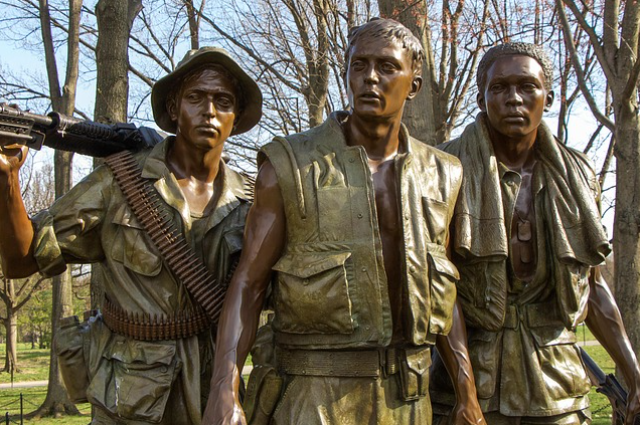
Image by Dennis Larsen from Pixabay
A War That Defied Expectations
The Vietnam War was not supposed to unfold the way it did. What began as a post-colonial struggle in Southeast Asia evolved into one of the most consequential and divisive conflicts of the twentieth century. Fought between 1955 and 1975, the war pitted communist North Vietnam and its southern allies against South Vietnam and its principal supporter, the United States. For Washington, Vietnam became a test of Cold War resolve — a frontline in the global effort to contain communism. For Vietnamese revolutionaries, it was a continuation of a decades-long fight for national reunification and independence from foreign influence.
By the late 1960s, the United States had committed more than half a million troops, possessed overwhelming technological superiority, and insisted publicly that victory was within reach. Yet beneath official optimism, the war was grinding into a costly stalemate. Rural insurgency persisted, American casualties mounted, and public support at home began to erode. The battlefield told one story; political reality told another.
Then came the Tet Offensive in January 1968 — a coordinated wave of surprise attacks by North Vietnamese and Viet Cong forces on cities, military bases, and political centres across South Vietnam. Militarily, the offensive was a disaster for the communists. They failed to hold territory, suffered enormous casualties, and did not spark the mass uprising they had hoped for. But in another sense, Tet achieved something far more powerful. The scale and audacity of the attacks shattered the perception that the United States was winning the war. Televised images of fighting inside the U.S. Embassy compound in Saigon stunned the American public and widened the credibility gap between official statements and battlefield reality.
The Tet Offensive proved a defining paradox: a battlefield setback that became a strategic and psychological turning point, reshaping the war’s trajectory and altering the course of American and Vietnamese history alike.
Vietnam Before Tet — Roots of a Divided Nation
To understand the shock of the Tet Offensive in 1968, it is essential to look back at the forces that divided Vietnam long before American combat troops arrived. The roots of the conflict stretch into the colonial era, when Vietnam was part of French Indochina. French rule, established in the late nineteenth century, reshaped the country’s economy and politics but also fostered deep resentment. Land was concentrated in the hands of elites, heavy taxes burdened peasants, and nationalist movements were suppressed. Among the most prominent nationalist leaders to emerge from this period was Ho Chi Minh, a communist revolutionary who combined anti-colonial nationalism with Marxist ideology.
During World War II, Japanese occupation weakened French authority, and Ho’s Viet Minh movement expanded its influence by resisting both Japanese and French control. After Japan’s surrender in 1945, Ho declared Vietnam’s independence. France, however, sought to reclaim its colony, leading to the First Indochina War (1946–1954) between French forces and the Viet Minh. The conflict ended with the decisive Vietnamese victory at Dien Bien Phu in 1954, a battle that signalled the collapse of French colonial power in Indochina.
The war’s end brought not peace, but division. The Geneva Accords of 1954 temporarily split Vietnam at the 17th parallel, creating a communist-led North Vietnam and a non-communist South Vietnam. Nationwide elections were scheduled for 1956 to reunify the country, but they were never held. The United States and South Vietnamese leader Ngo Dinh Diem feared that Ho Chi Minh would win overwhelmingly. Instead, the division hardened into two rival states, each claiming legitimacy over all of Vietnam.
In the North, Ho Chi Minh’s government consolidated power, launched land reforms, and built a centralised socialist state with support from the Soviet Union and China. In the South, Diem established an authoritarian regime backed by American economic and military aid. His government struggled with corruption, religious favouritism, and rural unrest, alienating many South Vietnamese peasants.
By the late 1950s, resistance to Diem’s rule coalesced into an organised insurgency. In 1960, southern communist and anti-government forces formed the National Liberation Front (NLF), known to Americans as the Viet Cong. Though rooted in the South, the movement received direction, weapons, and reinforcements from North Vietnam. What began as a scattered rebellion evolved into a coordinated guerrilla war aimed at overthrowing the Saigon government.
U.S. involvement deepened steadily. Initially limited to military advisers and financial support, American commitment expanded as South Vietnam’s stability deteriorated. After Diem’s overthrow and assassination in 1963, political chaos in Saigon further worried Washington. The turning point came in 1965, when the United States began sustained bombing of North Vietnam and deployed large numbers of combat troops. What had once been a post-colonial struggle was now a full-scale international war — setting the stage for the dramatic confrontation that would erupt during Tet in 1968.
The Opposing Forces — Strategy, Structure, and Strength
The Vietnam War was not simply a clash of armies; it was a contest between fundamentally different military systems, political goals, and understandings of how wars are won. Each side brought distinct strengths to the battlefield, shaped as much by ideology and strategy as by weapons and manpower.
On the communist side stood North Vietnam and its southern revolutionary allies. The backbone of the northern war effort was the People’s Army of Vietnam (PAVN), often called the North Vietnamese Army (NVA) by American forces. The PAVN was a disciplined, centrally directed military force built on years of experience fighting both the French and later the South Vietnamese and Americans. It combined conventional military units — including infantry divisions, artillery, and later tanks — with a doctrine that emphasised mobility, endurance, and political motivation.
Supporting and complementing the PAVN was the National Liberation Front (NLF) in the South, whose armed wing was commonly known as the Viet Cong. These southern fighters specialised in guerrilla warfare: ambushes, sabotage, assassination of local officials, and blending into rural populations. Their goal was not just to defeat enemy forces, but to erode the authority of the South Vietnamese government at the village level. Over time, the war evolved into a hybrid conflict, with guerrilla tactics integrated alongside larger, more conventional operations directed by Hanoi.
Sustaining this war effort required an extraordinary logistical system. The Ho Chi Minh Trail — a vast network of roads, footpaths, tunnels, and supply depots running through Laos and Cambodia — allowed North Vietnam to move troops, weapons, and supplies into the South despite intense American bombing. Constantly repaired and expanded, the trail became one of the most remarkable military supply lines of the twentieth century.
North Vietnam also benefited from major international support. The Soviet Union provided advanced weaponry, including surface-to-air missiles, artillery, and aircraft, as well as technical advisers. China supplied small arms, engineering troops, and logistical assistance. Though Moscow and Beijing competed for influence, both saw Vietnam as a critical front in the global Cold War struggle.
Opposing them were South Vietnam and its allies, led by the United States. The primary southern force was the Army of the Republic of Vietnam (ARVN). While ARVN included capable units and soldiers, it struggled with inconsistent leadership, political interference, and uneven morale. Frequent coups and instability in Saigon undermined cohesion at the top.
The United States brought overwhelming technological and firepower advantages: helicopters for rapid troop movement, heavy artillery, jet aircraft, and advanced communications. American strategy centred on a war of attrition — wearing down enemy forces through superior firepower and measuring progress by body counts. Large-scale search-and-destroy missions aimed to locate and eliminate communist units in remote areas. The assumption was that the enemy would eventually be unable to replace its losses.
Yet these strengths came with limitations. U.S. forces were constrained by political considerations, rules of engagement, and the need to maintain domestic support. Advanced weapons could devastate enemy formations, but they were less effective against an opponent who could disappear into jungles or villages and who defined victory in political rather than territorial terms.
The core contrast between the two sides was stark: the United States and South Vietnam relied on military firepower and technological superiority, while North Vietnam relied on political will, endurance, and a strategy designed to outlast a stronger opponent. This imbalance between battlefield success and political sustainability would become central to understanding why events like the Tet Offensive had such far-reaching consequences.
America’s War by 1967 — The Illusion of Progress
By 1967, the United States was fully immersed in a war it believed it could manage, if not outright win. American troop levels in Vietnam had surged past 400,000, and would soon climb even higher. Vast airpower, artillery, and helicopter mobility gave U.S. forces unmatched battlefield dominance. Official briefings in Washington projected confidence. Military leaders argued that communist forces were being steadily worn down and that the war had reached a “crossover point,” where enemy losses exceeded their ability to replace them.
At the centre of this optimism stood General William Westmoreland, commander of U.S. forces in Vietnam. His strategy of attrition aimed to grind down North Vietnamese and Viet Cong units through large-scale search-and-destroy operations. Success was measured statistically — enemy body counts, sorties flown, and villages “secured.” In November 1967, Westmoreland told audiences in the United States that the enemy was losing the war of endurance and that progress, while slow, was undeniable.
Yet beneath the metrics, reality was more complicated. Communist forces avoided decisive battles when possible, choosing instead to strike unexpectedly and then melt away. Areas declared secure often fell back under Viet Cong influence once U.S. troops withdrew. Rural pacification efforts struggled against corruption in South Vietnam and the difficulty of distinguishing civilians from insurgents. Despite heavy casualties, the enemy’s ability to recruit, reinforce, and resupply through the Ho Chi Minh Trail remained intact.
This gap between official optimism and on-the-ground complexity created what critics called a “credibility gap.” American journalists in Vietnam increasingly reported a war that looked stalemated rather than victorious. Graphic television coverage brought the conflict into American living rooms, showing wounded soldiers, burning villages, and confused front lines. Public confidence in the government’s narrative began to erode.
At home, the war was becoming politically divisive. Anti-war protests grew larger and more visible, particularly among students and civil rights activists. Influential voices — including senators, clergy, and academics — began questioning not only the conduct of the war but its moral and strategic foundations. Still, many Americans believed that with enough time and force, the United States would prevail.
In Hanoi, leaders drew a different conclusion. They recognised that while they could not match American firepower, they might break American will. If the United States could be convinced that the war was unwinnable, its military superiority would matter less. By late 1967, North Vietnamese planners were preparing a bold strategy designed not just to win battles, but to shatter the illusion of progress — a nationwide offensive that would bring the war into South Vietnam’s cities and into the political heart of the United States itself.
Planning the Tet Offensive — A High-Risk Gamble
By mid-1967, North Vietnam’s leadership faced a difficult strategic reality. Years of fighting had inflicted heavy casualties, yet the United States continued pouring troops and resources into South Vietnam. A prolonged war of attrition risked exhausting North Vietnam before American resolve weakened. Within Hanoi’s leadership, debate intensified over how to break the stalemate.
Two prominent figures shaped the discussion: Lê Duẩn, the Communist Party’s First Secretary and a strong advocate of aggressive action in the South, and General Võ Nguyên Giáp, the respected military commander who had led the victory over the French at Dien Bien Phu. Giáp favoured caution and protracted struggle, while Lê Duẩn pushed for a bold, nationwide offensive that could decisively shift the war’s political balance. Ultimately, Lê Duẩn’s vision prevailed. The strategy that emerged was both daring and dangerous — a coordinated assault on urban centres across South Vietnam.
The goals went far beyond military victory. Hanoi hoped to spark a general uprising among the South Vietnamese population, particularly in cities where dissatisfaction with the Saigon government was believed to be high. If urban populations rose up, the authority of South Vietnam’s government could collapse rapidly. At the same time, communist leaders aimed to shatter the credibility of American claims that the war was being won. A dramatic, visible blow — especially in cities considered secure — could erode U.S. morale and intensify anti-war pressure in Washington.
The Tet Lunar New Year holiday provided the ideal opportunity. Traditionally, Tet was a time of ceasefire, travel, and family gatherings. Both sides often observed temporary truces, and many South Vietnamese soldiers were granted leave. The holiday’s movement of people and goods also made it easier for communist operatives to infiltrate cities without arousing suspicion. Weapons were smuggled into urban areas, hidden in homes, markets, and cemeteries in preparation for the attacks.
Secrecy was essential. Plans were tightly controlled within the party and military leadership circles. Units received orders in stages, often without knowing the full scope of the operation. In the months leading up to the offensive, thousands of PAVN troops moved south along the Ho Chi Minh Trail, while Viet Cong cells inside cities prepared targets and stockpiled supplies. Coordination on such a scale was extraordinarily complex, involving simultaneous attacks on dozens of provincial capitals, military bases, and government centres.
It was an immense gamble. If the uprising failed to materialise and communist forces suffered heavy losses, the southern revolutionary movement could be crippled. But Hanoi’s leaders calculated that the potential political shock — especially in the United States — justified the risk. The coming offensive would not just test armies, but test the endurance of a superpower.
The Offensive Explodes — January 1968
In the early hours of January 30–31, 1968, the war in Vietnam changed overnight. What had been described as a rural insurgency suddenly erupted into a coordinated assault on the very heart of South Vietnam’s cities. Under the cover of the Tet Lunar New Year ceasefire, communist forces launched one of the most ambitious military operations of the twentieth century.
The attacks began shortly after midnight. Across South Vietnam, rockets, mortars, and small-arms fire shattered the holiday calm. Viet Cong guerrillas and North Vietnamese Army units struck with stunning simultaneity. In total, more than 100 cities, towns, and military installations came under attack, including 36 of South Vietnam’s 44 provincial capitals. For many Americans and South Vietnamese alike, the scale alone was incomprehensible. Cities that had seemed relatively secure were now battlefields.
In Saigon, the capital, fighting broke out in multiple districts. One of the most dramatic episodes unfolded just before 3 a.m. on January 31, when a small Viet Cong sapper unit blew a hole in the outer wall of the U.S. Embassy compound. The attackers killed several American military police and entered the grounds, where they exchanged fire with defenders for hours before being eliminated. Though the embassy building itself was never captured, images of gunfire inside what symbolised American power in Vietnam stunned audiences watching television news. The psychological impact far exceeded the tactical importance of the raid.
Elsewhere in Saigon, communist forces attacked the Presidential Palace, national radio station, and key government offices. The most intense fighting occurred around Tan Son Nhut Air Base, the largest U.S. air installation in the country. Waves of Viet Cong and North Vietnamese troops assaulted the perimeter before dawn, breaching sections of the defences. U.S. Air Force personnel, military police, and reinforcements from nearby units fought fierce battles to hold the base. By daylight, American firepower — including helicopter gunships and armoured vehicles — began to push the attackers back, but the battle raged for days in surrounding areas.
The shock was not confined to the capital. In Da Nang, Nha Trang, Can Tho, and dozens of provincial towns, communist fighters stormed government compounds, radio stations, and military headquarters. In many places, local security forces were caught off guard, and fighting spilt into the streets and neighbourhoods. Civilians woke to gunfire, explosions, and the sudden presence of armed men in areas long considered under government control.
The most dramatic urban struggle unfolded in Huế, the ancient imperial city near the Demilitarised Zone. There, thousands of North Vietnamese and Viet Cong troops seized much of the city within hours, raising revolutionary flags over the Citadel and government buildings. Unlike in many other locations, communist forces held large sections of Huế for nearly a month, forcing U.S. Marines and South Vietnamese troops into a grinding, house-to-house counteroffensive.
For American commanders, the offensive shattered key assumptions. U.S. strategy had focused on engaging enemy forces in remote jungles and border regions. The idea that the communists could infiltrate major cities in such strength — and coordinate attacks nationwide — had been widely discounted. Yet Tet demonstrated that the enemy retained both the capability and the will to strike almost anywhere.
Within days, U.S. and South Vietnamese forces began regaining control in most areas. Superior firepower and rapid reinforcements overwhelmed many of the attacking units, which suffered heavy casualties. But the damage was done in another sense. The sight of urban warfare — firefights near embassies, burning neighbourhoods, refugees fleeing city streets — contradicted years of official assurances that progress was steady and that the enemy was weakening.
The Tet Offensive’s first phase lasted only weeks, but its opening days delivered a profound shock. It was not just the intensity of the fighting that mattered; it was where it happened. The war had burst into cities Americans believed were safe, and in doing so, it forced a global audience to reconsider everything they thought they knew about Vietnam.
The Battle of Huế — The War in a City
Among all the clashes of the Tet Offensive, none better captured the war’s intensity and tragedy than the Battle of Huế. Once the imperial capital of Vietnam and a cultural and religious centre, Huế became the site of the longest and bloodiest urban battle of the war.
In the early hours of January 31, 1968, thousands of North Vietnamese Army (PAVN) and Viet Cong troops launched a coordinated assault on the city. They quickly overran much of Huế, including the ancient Citadel — a vast, walled fortress that had symbolised imperial authority for centuries. South Vietnamese government offices were seized, and communist flags were raised over key buildings. Unlike in many other cities attacked during Tet, communist forces in Huế managed to hold their ground for weeks.
The response was slow and costly. U.S. and Army of the Republic of Vietnam (ARVN) units had to fight their way back into a densely populated city filled with civilians and historic structures. American forces, particularly U.S. Marines, were trained primarily for jungle warfare, not urban combat. They faced snipers hidden in houses, machine-gun nests in stone buildings, and enemy troops who knew the terrain well. Progress was measured block by block, sometimes house by house.
Heavy weapons were eventually brought in, including artillery and air support, but their use came at a devastating price. Much of Huế was reduced to rubble. Historic temples, homes, and markets were destroyed in the crossfire. By the time allied forces recaptured the city in late February, large sections of it lay in ruins — a powerful symbol of how the war was consuming not only armies but entire communities.
The human toll extended far beyond battlefield casualties. During their occupation, communist forces carried out systematic executions of civilians they accused of collaborating with the South Vietnamese government or the Americans. Victims included civil servants, teachers, religious leaders, and ordinary residents. After the battle, mass graves were discovered around the city, containing the remains of thousands of civilians. These killings became one of the darkest episodes of the war and fueled deep bitterness.
The Battle of Huế revealed the brutal complexity of the conflict. It was not simply a clash of soldiers, but a struggle that entangled civilians, culture, and history. Urban warfare blurred the lines between military targets and civilian life, while political ideology turned neighbours into enemies. In Huế, the Vietnam War showed its most devastating face — a war where victory meant destruction, and where the cost was measured not only in territory gained, but in lives and heritage lost.
Military Results — Victory or Disaster?
When the smoke cleared from the first waves of the Tet Offensive, the military picture looked starkly different from the psychological and political shock it had produced. On the battlefield, communist forces had suffered enormous losses. Thousands of Viet Cong guerrillas and North Vietnamese Army (PAVN) troops were killed in assaults on heavily defended cities and bases. Many experienced southern Viet Cong units were effectively destroyed, a blow from which the insurgency in the South never fully recovered.
Despite the scale and surprise of the attacks, U.S. and Army of the Republic of Vietnam (ARVN) forces eventually retook every major position seized during the offensive. Saigon remained under government control, the U.S. Embassy was secured within hours, and key military installations such as Tan Son Nhut Air Base continued operating. Even in Huế, where communist forces held out the longest, allied troops regained the city after weeks of bitter fighting. In purely territorial terms, the offensive failed to produce lasting gains for Hanoi.
Just as significant was the failure to spark a mass uprising. North Vietnamese planners had hoped that urban populations would rise against the Saigon government once communist forces appeared in strength. That widespread revolt never materialised. While there were isolated instances of support or cooperation, most civilians focused on survival amid the chaos. The South Vietnamese state, though shaken, did not collapse.
From a conventional military perspective, the Tet Offensive was therefore a tactical defeat for Hanoi. The gamble had cost tens of thousands of lives and severely weakened the Viet Cong’s ability to operate as an independent southern force. In the months that followed, North Vietnam increasingly relied on regular PAVN units rather than local guerrillas to carry the fight in the South.
Yet the scale of these losses did not end the war. Hanoi’s leaders had accepted the possibility of heavy casualties in exchange for a potential political breakthrough. While their forces failed to hold territory or ignite revolution, they had demonstrated that they could strike anywhere, including the heart of supposedly secure cities. The paradox of Tet lies here: militarily repelled, but strategically transformative. On the battlefield, the offensive was a costly setback. In the broader struggle over perception and political will, however, its impact was only beginning to unfold.
Psychological Shock — The War Comes into American Living Rooms
If the Tet Offensive was a military shock in Vietnam, it was a psychological earthquake in the United States. For the first time, millions of Americans watched a war unfold not through distant headlines but through vivid, nightly television images. The fighting in January and February 1968 entered American homes with an immediacy that no previous conflict had matched.
Television coverage showed scenes that directly contradicted years of official optimism. Viewers saw gun battles in the streets of Saigon, smoke rising from urban neighbourhoods, and wounded civilians fleeing destruction. Perhaps most jarring were the images from the U.S. Embassy compound, long presented as one of the safest and most secure symbols of American presence in South Vietnam. Even though the attackers never seized the building itself, the fact that Viet Cong fighters had penetrated the compound at all shattered assumptions about control and security.
This visual shock intensified what had already been called the “credibility gap” — the growing divide between government statements and battlefield reality. For months, U.S. officials had emphasised progress, claiming the enemy was losing strength and that victory, while distant, was achievable. Tet suggested the opposite: if the communists were so weakened, how could they mount coordinated attacks on cities across the country?
One of the most influential moments came in late February 1968, when respected CBS news anchor Walter Cronkite delivered a rare personal commentary after visiting Vietnam. Known as a cautious and trusted journalist, Cronkite concluded that the war appeared to be stalemated and that negotiations might be the only realistic path forward. His words carried enormous weight with the American public. President Lyndon B. Johnson reportedly remarked that if he had “lost Cronkite,” he had lost middle America — a reflection of how deeply public confidence was shifting.
The impact extended beyond individual broadcasts. Graphic reporting — including footage of close-quarters combat, civilian suffering, and even the summary execution of a Viet Cong prisoner in Saigon — made the war feel chaotic and morally troubling. The sense that events were spiralling beyond official control fueled doubt, anger, and grief among families with loved ones serving overseas.
As a result, the long-standing narrative that the United States was gradually winning the war collapsed. Support for the conflict declined sharply, and anti-war protests grew in size and intensity. Trust in government leadership, already strained by earlier controversies, fell further. Tet did not simply change opinions about military strategy; it altered how Americans viewed their leaders and the credibility of official information.
Globally, the images also signalled that even a superpower could be shaken by a determined, less technologically advanced opponent. The psychological effects of Tet rippled far beyond Vietnam’s borders, reinforcing a lesson that would shape future conflicts: in modern war, perception can be as powerful as firepower.
Political Earthquake in the United States
The shockwaves from the Tet Offensive did not stop at the battlefield; they reverberated through the highest levels of American politics. What had been framed as a war of steady progress suddenly looked uncertain, costly, and open-ended. The result was a rapid shift in policy and leadership that reshaped the direction of U.S. involvement in Vietnam.
In March 1968, President Lyndon B. Johnson announced a significant change in strategy: a partial halt to the bombing of North Vietnam. This decision marked a clear departure from earlier escalation and signalled a willingness to pursue a negotiated settlement. It was an acknowledgement that military pressure alone had not produced the expected results and that political solutions would have to be explored.
Even more dramatic was Johnson’s personal decision regarding the presidency. On March 31, 1968, in a nationally televised address, he declared that he would not seek nor accept his party’s nomination for another term. The announcement stunned the country. Although Johnson cited the need to focus fully on peace efforts, it was widely understood that the war — and the growing public disillusionment intensified by Tet — had made his political position increasingly untenable. The conflict that had once been presented as a defence of freedom abroad had become a source of deep division at home.
The administration’s shift opened the door to diplomacy. Peace talks began in Paris in May 1968, bringing representatives of the United States, North Vietnam, South Vietnam, and later the Viet Cong to the negotiating table. While the talks would drag on for years without immediate resolution, their very existence marked a turning point: the war was no longer seen solely as a military contest to be won on the battlefield.
Together, these developments signalled the beginning of gradual U.S. disengagement. Although fighting would continue and American troop levels would rise briefly again, the long-term trajectory had changed. Tet did not end the war in 1968, but it fundamentally altered the political landscape, making eventual withdrawal not just possible, but increasingly inevitable.
Tet and the Wider Cold War
The Tet Offensive resonated far beyond Vietnam, becoming a moment of global significance within the broader Cold War. For the Soviet Union and China, both of whom had supported North Vietnam with weapons, training, and logistical aid, the offensive appeared to validate their strategy of backing revolutionary movements against Western-aligned governments. Even though communist forces suffered heavy battlefield losses, they had demonstrated that a determined, well-supported insurgency could challenge the military power of the United States.
At the same time, Tet raised serious questions about American credibility as a superpower. The United States had committed vast resources to defending South Vietnam, yet televised images showed enemy forces striking at the heart of its presence there. Allies around the world watched closely, wondering whether U.S. guarantees of protection could withstand prolonged, politically costly conflicts. Adversaries, meanwhile, saw evidence that American military superiority did not automatically translate into political success.
The offensive also influenced revolutionary and insurgent movements elsewhere. Groups in Latin America, Africa, and the Middle East drew lessons from Vietnam about the power of protracted struggle and the importance of political warfare alongside military action. The idea that a weaker force could outlast a stronger one by targeting public opinion and morale gained new prominence.
Military strategists worldwide studied Tet as a case of the limits of conventional power against hybrid warfare. The offensive underscored a lesson that would echo through later conflicts: in the Cold War and beyond, wars were not won by firepower alone, but by endurance, legitimacy, and control of the political narrative.
The Long Road to 1975 — From Tet to the Fall of Saigon
The Tet Offensive marked a turning point, not an endpoint. While the United States and South Vietnamese forces regained control of the cities attacked, the psychological and political consequences set the stage for the eventual winding down of American involvement. In response, the U.S. began pursuing a policy of Vietnamization, aimed at gradually transferring combat responsibility to the Army of the Republic of Vietnam (ARVN) while reducing American troop presence. The strategy sought to maintain South Vietnam’s defence capability without requiring the United States to remain fully engaged in combat indefinitely.
Throughout the late 1960s and early 1970s, fighting continued, often with brutal intensity, but U.S. ground forces were steadily withdrawn. Air power and advisors remained, but the war increasingly relied on South Vietnamese troops and local forces. Tet had proven that even limited enemy forces could strike anywhere, and sustaining a prolonged U.S. presence had become politically and socially untenable at home.
Diplomatic efforts gained momentum. After years of negotiation, the Paris Peace Accords were signed in January 1973, establishing a ceasefire, U.S. troop withdrawal, and the release of prisoners of war. While the accords temporarily reduced hostilities and provided hope for a stable South Vietnam, they did not end the conflict. Fighting continued between North and South Vietnamese forces, with the North gradually building strength for a final push.
That push came in April 1975, when North Vietnamese forces launched a decisive offensive, capturing Saigon with remarkable speed. The fall of the South Vietnamese capital marked the end of the Vietnam War and the formal reunification of the country under communist control. By 1976, the Socialist Republic of Vietnam was officially established, completing a transformation that had begun decades earlier under French colonialism, survived the First Indochina War, and been fiercely contested during America’s intervention.
Tet had foreshadowed this outcome: a turning point where battlefield victories could be overshadowed by political and strategic realities, ultimately reshaping the war and the nation itself.
Legacy of the Tet Offensive
The Tet Offensive left a profound and enduring legacy on warfare, politics, and public perception. Its central lesson was that perception could outweigh battlefield success. Though communist forces suffered devastating casualties and failed to hold territory, the dramatic scale and audacity of the attacks shattered American confidence in official reports of progress. Tet demonstrated that psychological impact, amplified by media coverage, could have consequences as decisive as physical control of land. In essence, it redefined the nature of victory in modern conflict.
In the United States, Tet reshaped the relationship between the military, the media, and the public. Television coverage had shown that even technically controlled cities could appear vulnerable. Journalists gained unprecedented influence, as public trust increasingly depended on independent reporting rather than official statements. The resulting “credibility gap”—the disparity between government claims and observable reality—became a central political challenge. Leaders could no longer rely solely on metrics or body counts to justify strategy; public perception now had to be actively managed, a lesson that reverberated through later U.S. conflicts, from Iraq to Afghanistan.
Tet also influenced U.S. military doctrine, highlighting the limits of conventional firepower against guerrilla and insurgent strategies. Urban warfare, civilian entanglement, and decentralised command networks proved that technologically superior forces could be outmanoeuvred politically and strategically. Military planners studied Tet as a case study in counterinsurgency, emphasising the need for intelligence, population security, and understanding the political dimension of conflict, not just battlefield metrics.
Globally, Tet provided a blueprint for other insurgent movements, showing how a smaller force could leverage surprise, timing, and media attention to achieve strategic impact. It remains a reference point in military education, illustrating both the risks and potential of asymmetric warfare.
Ultimately, the Tet Offensive is remembered not for who held the ground, but for how it changed the rules of modern war. It reshaped American politics, influenced international perception of U.S. power, and forced a reconsideration of how military success, public opinion, and political objectives interact. Nearly six decades later, Tet is still studied in military academies and political science programs as a case study in the power of strategy, surprise, and the human dimension of conflict.
Conclusion — The Offensive That Changed the War
The Tet Offensive stands as one of the most striking paradoxes in modern military history. On the battlefield, it was a costly defeat for the communist forces—Viet Cong units were decimated, and all major objectives were eventually recaptured by U.S. and South Vietnamese troops. Yet its strategic and psychological impact transcended the immediate tactical results. Tet shattered the perception that the United States was winning, eroded public confidence, and forced a profound reassessment of American involvement in Vietnam.
Tet demonstrated that wars are fought as much in the minds of populations and leaders as on battlefields. Images of urban combat, attacks on supposedly secure areas, and widespread destruction reached living rooms across the United States and the world, altering perceptions of strength, resolve, and legitimacy. Its effects rippled through politics, media, and military doctrine, underscoring the importance of morale, perception, and political will in shaping the course of conflict.
In history, the Tet Offensive occupies a pivotal place—not only as a turning point in the Vietnam War but as a lesson in modern warfare and politics. It reminds us that even a numerically weaker or technically outmatched force can achieve profound influence through strategy, surprise, and psychological impact. Tet’s legacy endures as a cautionary tale, highlighting the complex interplay of military action, public perception, and political consequence.
References
- https://www.britannica.com
- https://www.history.com
- https://history.state.gov/
- https://www.history.com
- https://www.intel.gov
- https://en.wikipedia.org
- https://en.wikipedia.org
. . .