
A Song You Leave With
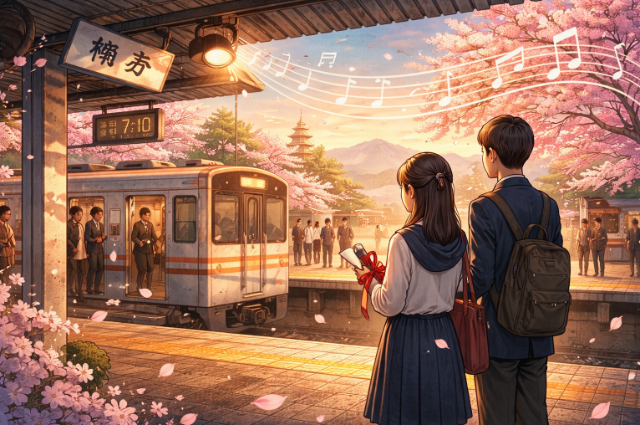
A train waits at the platform, doors open, passengers shuffling inside with the quiet efficiency of routine. Overhead announcements echo briefly, then fade. In their place, a gentle melody begins to play — soft, choral in feeling, even when rendered through station speakers. It floats above the low murmur of conversation and the hum of the tracks, delicate but unmistakably emotional. For a moment, the station feels less like a transit point and more like a threshold.
To most travellers, it is simply a pleasant tune signalling departure. But to many Japanese listeners, the melody carries a different weight. It is instantly recognisable as “Tabidachi no Hi ni” (旅立ちの日に) — “On the Day of Departure” — one of Japan’s most beloved graduation songs. For decades, students across the country have sung it at the end of their school years, voices trembling with the mixture of pride, gratitude, and sadness that comes with saying goodbye to classmates and stepping into an unknown future.
Hearing that same song in a train station reframes the ordinary act of travel. The daily commute, a weekend trip, a farewell at the platform — all begin to echo the emotional landscape of graduation day. A physical departure becomes quietly linked to life’s larger transitions: growing up, moving on, starting over.
This unexpected crossover between a school anthem and a railway departure melody reveals something distinctive about Japan’s relationship with public space. Infrastructure here is not always emotionally neutral. Train stations, parks, and streets often carry layers of local identity, memory, and feeling woven into their design. Sound, in particular, is used not just for function but for atmosphere — to calm, to guide, and sometimes, to stir the heart.
The story of Tabidachi no Hi ni moving from school halls to train platforms is more than charming trivia. It is about how music travels with people, how memory can be embedded in everyday environments, and how departures — whether from a classroom or a city — share the same quiet mix of endings and beginnings.
The Birth of “Tabidachi no Hi ni” (旅立ちの日に)
In 1991, at a junior high school tucked into the mountains of Chichibu in Saitama Prefecture, a song was written for a single graduating class. No one involved could have predicted that it would go on to become one of the most widely sung graduation songs in Japan, or that decades later its melody would echo across railway platforms. Yet that is exactly the journey of “Tabidachi no Hi ni” — On the Day of Departure.
The song was born at Kagemori Junior High School, where then-principal Noboru Kojima felt a growing concern about the emotional atmosphere of school life. Like many educators, he wanted graduation to be more than a formal ceremony; he hoped it would become a meaningful moment of reflection and encouragement for students about to step into a new phase of life. Kojima wrote the lyrics himself, pouring into them the feelings he wished to convey: gratitude for shared time, recognition of growth, and hope for the future.
For the music, he turned to Hiromi Takahashi, a teacher at the school with a background in music education. Takahashi composed a melody that matched the emotional tone of Kojima’s words — gentle but uplifting, simple enough for students to sing in chorus, yet powerful in its gradual build. The collaboration between principal and teacher was deeply rooted in the everyday life of the school, making the song feel personal rather than institutional.
The title, “Tabidachi no Hi ni,” translates directly as “On the Day of Departure.” In Japanese, tabidachi suggests not just leaving a place but embarking on a journey — physical, emotional, and symbolic. It is a word often used for life milestones: graduation, moving away, and starting a career. The title alone captures the emotional threshold that graduation represents, poised between the comfort of the familiar and the uncertainty of what lies ahead.
Originally, the song was written specifically for the graduating class of 1991 at Kagemori Junior High School. It was first performed at their graduation ceremony, sung by students as a farewell to their teachers, underclassmen, and one another. The lyrics speak of shared memories, the passage of seasons, and the courage to walk separate paths while carrying the bonds of friendship forward. Rather than focusing on sadness alone, the song balances nostalgia with optimism — a recognition that endings are also beginnings.
What makes “Tabidachi no Hi ni” remarkable is how quickly it spread beyond its place of origin. Word of the song travelled through music teachers, educational networks, and choral communities. Copies of the sheet music were shared between schools, and performances began appearing at other graduation ceremonies throughout Saitama and eventually across Japan. Its accessible melody and emotionally resonant lyrics made it easy for school choirs to adopt.
By the late 1990s and early 2000s, “Tabidachi no Hi ni” had become a national graduation standard, sung by millions of students. For many, it became inseparable from memories of their final days at school — of tearful classmates, proud parents, and the uncertain excitement of growing up. A song that began as a heartfelt gift to one group of students had transformed into a shared cultural ritual, carried from one generation to the next through voices raised in farewell.
Graduation Songs in Japanese Culture
To understand why “Tabidachi no Hi ni” resonates so deeply, it helps to understand the role graduation ceremonies play in Japan. These events are not casual milestones but carefully structured, emotionally charged rites of passage. From elementary school through university, graduation marks a clear turning point — not just academically, but socially and personally. Students leave behind a tightly knit class group, teachers they have seen daily for years, and a familiar rhythm of life. The ceremony becomes a formal moment to acknowledge that shared journey.
Music is central to this ritual. Choral singing is a longstanding tradition in Japanese schools, where group performance is often emphasised over solo expression. From a young age, students regularly sing together at assemblies and school events, learning to listen, harmonise, and move as a collective. By graduation, this shared musical culture reaches its emotional peak. Entire classes rehearse songs for weeks, sometimes months, preparing to sing as one voice on their final day together.
The emotional tone of these songs is distinctive. Rather than being purely celebratory, Japanese graduation music often carries a bittersweet quality — a blend of gratitude, nostalgia, and quiet hope. Lyrics frequently mention changing seasons, shared memories, and the courage to step into the future. There is an acceptance that sadness is part of growth. This reflects a broader cultural sensitivity to fleeting moments, where beauty is found in things that do not last.
Because these songs are sung at such a heightened emotional moment, they become powerful memory triggers. Years later, hearing a familiar graduation melody can instantly transport someone back to their teenage self: the feel of the school gymnasium, the sight of classmates trying not to cry, the weight of an uncertain future. Music ties memory to feeling, and graduation songs, in particular, are linked to one of life’s first major transitions.
In comparison, Western graduation ceremonies often focus more on speeches, individual achievements, and celebratory music chosen for inspiration or energy. While songs are certainly present — and can be meaningful — the strong tradition of collective choral performance at the centre of the ceremony is less universal than in Japan. Japanese graduations tend to highlight the class as a group that has journeyed together, and the music reinforces that shared identity.
Within this cultural setting, “Tabidachi no Hi ni” rose to prominence because it captured the emotional core of graduation perfectly. Its melody is gentle and memorable, accessible to student choirs, and structured to build toward a moving climax. The lyrics balance farewell with encouragement, acknowledging the sadness of parting while affirming that new paths await. Over time, as more schools adopted it, the song became woven into the collective memory of multiple generations. Today, for many Japanese people, just a few opening notes are enough to recall the day they stood in their school uniform, singing goodbye to childhood.
Japan’s Unique Railway Departure Melodies (発車メロディ)
In many countries, the sound that signals a train’s departure is a harsh buzzer or a brief electronic chime. In Japan, however, that moment is often accompanied by music. Known as hassha merodi (発車メロディ), or departure melodies, these short tunes have become a distinctive feature of Japanese railway culture — blending function, design, and emotion in a way that turns an ordinary commute into a subtly curated experience.
A departure melody is typically a brief musical phrase, usually lasting only a few seconds, played just before a train leaves the platform. Once the train doors close, the melody sounds to indicate that departure is imminent. Each platform may have its own tune, and the melody often stops the moment the train begins to move. Though short and repetitive, these melodies are carefully designed to be pleasant, recognisable, and calming rather than jarring.
The widespread use of musical departure signals began in the late 20th century, as railway companies looked for ways to improve the passenger experience in increasingly busy urban networks. Japan’s major stations handle enormous daily crowds, and operators realised that sound could be used not just as a warning but as a behavioural cue. A gentle melody encourages passengers to board promptly without creating panic. Compared to loud alarms, music helps maintain order while reducing stress.
From a practical perspective, departure melodies serve several purposes. They signal timing clearly, helping both passengers and staff coordinate movement. They support safety by discouraging last-second rushing once the tune begins. They also help visually impaired passengers identify when a train is about to leave. Over time, the melodies became part of the subtle choreography that keeps Japan’s famously punctual rail system running smoothly.
But the role of these melodies goes beyond logistics. Railway companies discovered that sound shapes emotional atmosphere. Stations can be noisy, crowded, and overwhelming, especially during rush hour. Soft, melodic signals help create a calmer environment, easing tension and making travel feel less mechanical. In this sense, departure melodies are a form of urban sound design, contributing to the mood of public space.
Another uniquely Japanese aspect is the use of local identity in station melodies. Rather than using the same generic tone everywhere, many stations choose music connected to their region. This might include folk songs, well-known pop melodies, or themes associated with local landmarks, sports teams, or historical figures. The melody becomes a small sonic signature, giving each station a sense of place.
There are many notable examples. Some stations use tunes linked to famous anime set in the area, while others adopt traditional songs tied to local festivals. In certain regions, children’s songs or school anthems are used, creating a sense of familiarity and warmth. These choices often become a point of pride for residents and a charming discovery for visitors.
Within this broader culture of meaningful railway music, the use of “Tabidachi no Hi ni” as a departure melody fits naturally. It reflects a system where even a few seconds of sound can carry memory, identity, and emotion — transforming the act of boarding a train into something that quietly resonates with life’s larger journeys.
The Moment Music Met Movement: Adoption at Seibu-Chichibu Station
In November 2016, a familiar melody found a new home — not in a school gymnasium filled with students in uniforms, but on a railway platform in the mountains of Saitama Prefecture. That was when Seibu-Chichibu Station adopted “Tabidachi no Hi ni” as its official departure melody, turning a beloved graduation song into the soundtrack of everyday journeys.
Seibu-Chichibu Station sits at the western end of the Seibu Ikebukuro Line, serving as a gateway between the city and the scenic Chichibu region. Surrounded by forested hills and known for its shrines, festivals, and slower pace of life, Chichibu has long held a strong sense of local identity. It is also the place where “Tabidachi no Hi ni” was born, first sung at Kagemori Junior High School in 1991. Choosing this particular song for this particular station was therefore more than a musical decision — it was an act of regional storytelling.
The melody was introduced on November 27, 2016, as part of efforts to highlight Chichibu’s cultural heritage and strengthen its image as a destination with a distinct emotional character. Railway stations in Japan often act as ambassadors for their communities, and Seibu Railway leaned into the area’s pride in its musical legacy. By selecting a song that originated locally and later spread across the nation, the station linked Chichibu to a piece of shared Japanese memory.
For residents, the connection felt personal. A tune once sung by students in a modest school setting had grown into a nationwide graduation anthem, and now it returned home in a new form. Local media covered the change, and the story was shared with a tone of quiet celebration. It was not framed as a grand spectacle, but as something warm and meaningful — a small gesture that honoured the town’s contribution to Japan’s cultural life.
When the melody plays at the station, it lasts only a few seconds, yet it subtly transforms the atmosphere. Unlike the echoing chorus of a school performance, the version heard on the platform is instrumental, arranged to fit the brief window between door closure and departure. Still, its character remains recognisable. The opening notes carry a gentle lift, followed by a phrase that feels both reflective and forward-looking. Against the sounds of rolling luggage, murmured goodbyes, and the low hum of the train, the music adds a soft emotional layer to the moment.
For commuters, it may fade into the background over time. But for others — former students, visiting families, or those who recognise the tune — it can trigger a flicker of memory. The melody that once accompanied the end of childhood now accompanies departures from the town itself: students leaving for high school in the city, workers heading to Tokyo, travellers returning home after a visit. The station becomes a stage where personal and collective journeys overlap.
The symbolism is almost poetic. Graduation is one of life’s first major departures, a step away from the familiar toward an uncertain future. A train leaving the platform carries a similar emotional shape, even if on a smaller scale: the brief pause before movement, the separation from those staying behind, the sense of transition. By using “Tabidachi no Hi ni,” Seibu-Chichibu Station quietly aligns these experiences. The daily act of travel echoes a deeper human rhythm of leaving and becoming.
In this way, the station does more than move passengers. It tells a story — about a town proud of its roots, about a song that outgrew its classroom, and about how even a short melody can turn an ordinary departure into a moment touched by memory and meaning.
Why This Song Fits a Train Station So Perfectly
At first glance, using a graduation song as a railway departure melody might seem like a charming coincidence. In reality, the pairing feels almost inevitable. Both the song “Tabidachi no Hi ni” and the act of boarding a train revolve around the same central idea: departure — not just as physical movement, but as a step into the unknown.
Graduation is one of life’s first major transitions. It marks the end of a shared chapter and the beginning of separate paths. Similarly, a train station is a space defined by thresholds. People gather there not to stay, but to leave — for work, for study, for home, for somewhere new. Each departure is small in scale, yet emotionally layered: reunions and farewells, routine and possibility, comfort and uncertainty. A song written for a moment of life transition naturally resonates in a place built for physical ones.
In Japanese culture, trains carry particularly strong symbolic weight. The country’s railways are not just infrastructure; they are deeply woven into everyday life and storytelling. Countless films, novels, and songs use trains as metaphors for change, distance, and the passage of time. A platform scene often signals an emotional turning point — a goodbye, a new beginning, or a journey that changes someone’s life. Placing “Tabidachi no Hi ni” in this setting amplifies those associations, linking personal memory with a broader cultural language of movement.
There is also a psychological dimension. Music and memory are closely connected in the human brain. Songs heard during emotionally intense moments — like graduation ceremonies — become strongly encoded with feeling. Years later, just a few notes can bring back vivid sensory details and emotions. When that familiar melody appears unexpectedly in a train station, it can collapse time, merging past and present in an instant.
For local commuters, the effect may be subtle but persistent. Even if they hear the tune daily, its tone is softer and more reflective than a standard alert. It can make routine travel feel a little more human, a reminder that even ordinary departures are part of larger life journeys. For some, especially those who grew up in the region, the song may carry a quiet sense of hometown pride.
For former students who once sang the song at their own graduation, the impact can be more direct. Hearing it on a platform might stir memories of classmates, teachers, and youthful hopes. The station becomes a place where personal history unexpectedly surfaces — a public environment triggering a deeply private recollection.
Meanwhile, tourists who do not recognise the melody still experience its emotional tone. The music sounds gentle and slightly wistful, shaping the atmosphere even without cultural context. It may leave an impression of warmth or poignancy, subtly influencing how they feel about the place.
In this way, the station becomes a space where public design carries private emotion. A short melody, played for practical reasons, opens a channel to memory, identity, and shared human experience. The result is a rare moment when infrastructure speaks softly to the heart.
Public and Media Reactions
When Seibu-Chichibu Station adopted “Tabidachi no Hi ni” as its departure melody, the response was not explosive or sensational — it was something more fitting to the song itself: warm, nostalgic, and quietly proud. For many in Chichibu, the change felt like a recognition of the town’s cultural contribution. A song that began in a local junior high school had grown into a nationwide graduation anthem, and now its melody returned home in a new, highly visible form. Residents saw it as a small but meaningful tribute to the area’s identity.
Local media outlets covered the melody change with a tone of gentle celebration. Articles highlighted the song’s origins at Kagemori Junior High School and explained why it was a natural fit for the station. The story was framed less as a novelty and more as a point of regional pride — an example of how something created by teachers and students had become woven into Japan’s broader cultural fabric. For Chichibu, it reinforced a sense that even a rural community could leave a lasting mark on national memory.
On social media, reactions tended to be personal and emotional. People who recognised the tune often shared their surprise at hearing a graduation song in a railway setting. Some described being momentarily transported back to their own school days, recalling the faces of classmates or the feeling of standing in a gymnasium singing through tears. Others wrote about the bittersweet sensation of hearing a song about life’s departures while physically leaving a town or returning home after a visit.
There were also comments from travellers who encountered the melody unexpectedly. For those familiar with the song, the experience could feel almost cinematic — an ordinary train departure suddenly infused with the emotional weight of youth and memory. A few described it as “unexpectedly moving,” noting how the gentle notes softened the usually hurried atmosphere of boarding a train.
Over time, the melody also became a small point of curiosity for visitors. Railway fans and travellers interested in Japan’s unique station melodies sometimes made note of Seibu-Chichibu’s connection to the famous graduation song. While not a major tourist attraction on its own, the story added another layer to the area’s charm, alongside its nature, festivals, and local traditions.
In the end, the public reaction mirrored the song’s character: understated but heartfelt. The melody did not just signal departures — it quietly connected people to shared memories, turning a functional sound into a source of reflection and local pride.
Other Stations and the Broader Trend of Emotional Soundscapes
Seibu-Chichibu Station is not alone in turning a practical audio signal into something emotionally resonant. Across Japan, many railway stations use melodies with local or cultural meaning, creating a broader pattern in which transportation spaces double as carriers of memory and identity. These choices transform what could be a purely functional sound into a small but meaningful expression of place.
Some stations play tunes tied to local history or folklore, while others use melodies from popular culture, such as songs from well-known television dramas or anime set in the area. In coastal towns, departure melodies may echo regional folk songs, while in urban neighbourhoods, music may be chosen that is associated with famous artists who grew up nearby. These selections become sonic landmarks — as recognisable to regular passengers as signs or architecture.
This reflects a wider trend of regional identity in railway music. Japan’s rail network is vast and heavily used, but operators often seek ways to keep stations from feeling anonymous. By embedding local references into departure melodies, they give each stop a subtle personality. For residents, this can foster pride and familiarity; for visitors, it offers a small cultural clue about where they are.
Underlying this practice is Japan’s thoughtful approach to sound environmental design. Noise in public spaces is not treated as an afterthought but as something that shapes mood and behaviour. Railway companies, urban planners, and designers consider how sound can guide movement, reduce stress, and create atmosphere. Music, in this context, becomes part of the architecture of experience.
The difference between functional sound and emotional sound is key. A buzzer simply commands attention; a melody can invite feeling. Departure tunes still serve a practical purpose — signalling that a train is about to leave — but they also soften the moment, adding warmth to an otherwise mechanical process. In doing so, stations become more than transit points: they become spaces where everyday life is quietly accompanied by culture and memory.
Music, Memory, and Movement in Modern Japan
The story of “Tabidachi no Hi ni” at a train station reflects a broader characteristic of Japanese design: a deep sensitivity to atmosphere in public space. In Japan, environments are often shaped not only for efficiency but also for feeling. Lighting, seasonal decorations, textures, and especially sound are used to influence how a place is experienced. A station is not just a transit hub; it is a daily stage where millions of small human moments unfold.
This attention to mood connects to a long-standing cultural idea often described as mono no aware — an awareness of the gentle sadness and beauty found in things that pass. Cherry blossoms falling, the end of summer, a final day of school — such moments are valued not despite their transience, but because of it. Departure melodies like “Tabidachi no Hi ni” echo this sensibility. They accompany brief, everyday partings, giving them a soft emotional contour rather than leaving them as purely mechanical events.
In this way, everyday spaces carry emotional storytelling. A commuter may not consciously analyse the music playing on a platform, yet it shapes the emotional tone of departure. Over time, these small sensory details accumulate into personal memory: the sound of a familiar station, the melody associated with coming home or leaving for something new. Public infrastructure becomes intertwined with private experience.
What makes this especially striking is the blending of tradition and modern infrastructure. Japan’s railways are symbols of technological precision and urban efficiency, yet within that system, there is room for a school graduation song born in a rural town. A melody rooted in communal singing and youthful memory travels through speakers mounted on concrete platforms, carried by one of the most advanced transportation networks in the world.
The result is a uniquely layered experience of modern life. Movement is fast, schedules are tight, and cities are dense — yet moments of quiet reflection are woven into the journey. Through music, even a routine train departure can resonate with themes of change, memory, and the passage of time, reminding travellers that every trip, no matter how ordinary, is part of a larger human story.
Conclusion – Every Departure Carries a Beginning
The train doors slide shut, and once again the melody drifts across the platform — soft, familiar, and full of feeling. Passengers step back, someone offers a final wave, and the train begins to move. It is an ordinary scene, repeated countless times each day, yet the music gives it a quiet emotional depth.
Departures are universal. We leave classrooms, hometowns, jobs, and stages of life just as often as we leave train stations. Each goodbye carries a mixture of memory and possibility, an ending that is also a beginning. “Tabidachi no Hi ni” captures that delicate balance, which is why it feels so natural in a place built around movement.
Through a simple melody, routine travel becomes something more reflective — a reminder that every journey, no matter how small, is part of the long, unfolding passage of time and memory.
References:
- https://en.wikipedia.org
- https://pt.wikipedia.org
- https://saitama-en.mytabi.net
- https://w.atwiki.jp/
- https://en.wikipedia.org