
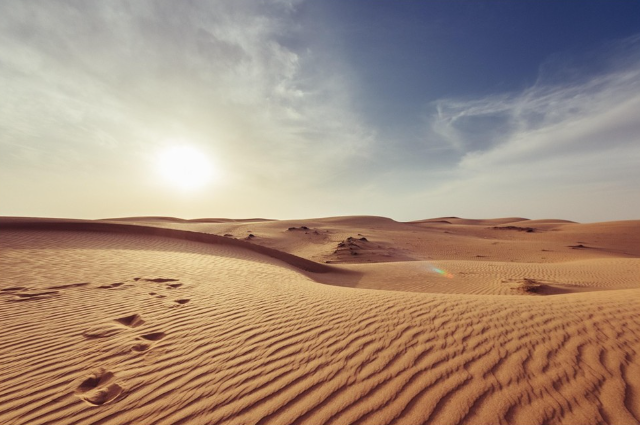
Image by Pexels from Pixabay
The Desert and the Spirituality of Silence
Throughout human history, deserts have occupied a unique place in the spiritual imagination of civilisations. At first glance, a desert appears to be a barren and lifeless expanse, characterised by harsh climates, rocky landscapes, and an absence of the comforts associated with human settlement. Yet, for countless seekers, prophets, monks, and mystics, the desert has represented something far more profound: a place of encounter with the self, with nature, and ultimately with the divine. Its vast emptiness strips away distractions and invites deep reflection, making it one of the most powerful symbols of spiritual transformation.
Among the world's significant desert regions, the Judean Desert stands out for its historical and religious importance. Located between Jerusalem and the Dead Sea, this rugged wilderness has witnessed centuries of spiritual activity. Its dramatic cliffs, caves, and valleys have served as places of refuge and contemplation for individuals seeking a life devoted to prayer and self-discipline. The region occupies a central place in the religious histories of Judaism, Christianity, and Islam, each of which associates the desert with revelation, testing, and spiritual growth.
The connection between solitude, silence, sacrifice, and spirituality is deeply rooted in human experience. In an environment with minimal external distractions, individuals are often confronted with their inner thoughts, fears, and aspirations. The silence of the desert encourages self-examination, while its harsh conditions demand perseverance and sacrifice. For many religious traditions, these challenges are not obstacles but pathways to greater wisdom and spiritual maturity. The desert becomes a classroom where humility, patience, and faith are cultivated.
Across major world religions, deserts carry powerful symbolic meanings. In Judaism, the wilderness recalls the Israelites' journey toward the Promised Land. In Christianity, it evokes the experiences of Jesus and the early Desert Fathers who sought holiness through ascetic living. In Islam, the desert landscape is closely linked to the origins of the faith and the spiritual experiences of the Prophet Muhammad. Thus, the desert transcends geography and becomes a universal symbol of spiritual searching.
This article explores the historical, cultural, and spiritual significance of the Judean Desert through the lens of Mar Saba Monastery, one of the world's oldest continuously inhabited monasteries. By examining its history, traditions, and enduring relevance, the article seeks to understand why the silence of the desert continues to inspire humanity in an increasingly noisy and distracted age.
The Judean Desert: Geography and Historical Background
The Judean Desert is one of the most historically and spiritually significant desert regions in the world. Situated in the eastern part of the Judean Mountains, it stretches from the outskirts of Jerusalem down to the western shores of the Dead Sea. Covering an area of rugged hills, deep ravines, and barren plateaus, the desert forms a dramatic transition between the fertile highlands of central Palestine and the lowest point on Earth, the Dead Sea. Despite its harsh environment, the region has played a vital role in the religious, cultural, and political history of the Middle East for thousands of years.
The climate of the Judean Desert is extremely arid. Annual rainfall is minimal, and temperatures can vary significantly between day and night. Summers are intensely hot, while winters can be surprisingly cold. Water sources are scarce, and much of the landscape consists of rocky cliffs, dry valleys known as wadis, and steep canyons carved by seasonal floods. These challenging conditions have limited large-scale settlement throughout history, yet they have also contributed to the desert's unique character as a place of isolation and contemplation.
Despite its inhospitable environment, the Judean Desert occupied an important position along ancient trade routes connecting Jerusalem, Jericho, the Dead Sea region, and neighbouring territories. Merchants, travellers, pilgrims, and armies frequently crossed the area, making it a corridor of cultural exchange. The famous route from Jerusalem to Jericho, mentioned in biblical narratives, passed through this wilderness and became one of the most well-known roads in the ancient world. Pilgrims visiting sacred sites also travelled through the desert, strengthening its religious significance.
The region holds immense importance in the histories of Judaism, Christianity, and Islam. For the Jewish people, the desert is closely associated with themes of exile, purification, and divine guidance. Numerous biblical events are linked to the wilderness areas surrounding Judea. King David is believed to have sought refuge in these deserts while fleeing from King Saul. The caves of the region also became shelters for communities during periods of conflict and persecution.
In Christian tradition, the Judean Desert is especially revered as the setting for the ministry of John the Baptist and the forty days of fasting and temptation experienced by Jesus before the beginning of his public mission. These events transformed the desert into a sacred landscape and inspired generations of monks and hermits to seek spiritual renewal there. Islamic history likewise recognises the broader region as part of the sacred geography of the Holy Land, revered by Muslims for centuries.
The combination of physical isolation, harsh conditions, and profound religious associations made the Judean Desert an ideal environment for spiritual practice. Removed from the distractions of urban life, individuals seeking deeper communion with God found in the desert a place for prayer, meditation, fasting, and self-discipline. As a result, the region evolved into one of the most influential centres of monastic and ascetic traditions, shaping religious thought and practice for centuries.
The Origin of Mar Saba Monastery
Among the many ancient monasteries that emerged in the deserts of the Middle East, Mar Saba Monastery stands as one of the most remarkable examples of enduring faith and monastic devotion. Perched dramatically on the cliffs of the Kidron Valley in the Judean Desert, the monastery has survived for more than fifteen centuries and remains an active centre of Orthodox Christian spirituality. Its history is closely connected to the life of Saint Sabbas, one of the most influential figures in Eastern Christian monasticism.
Saint Sabbas, known in Arabic as Mar Saba and in Greek as Sabbas the Sanctified, was born in Cappadocia (modern-day Turkey) in AD 439. From an early age, he was drawn to a life of prayer, discipline, and spiritual devotion. As a young man, he travelled to Palestine, where he became associated with the growing monastic communities that had begun to flourish in the deserts surrounding Jerusalem. Through his dedication, wisdom, and leadership, Sabbas gained widespread respect among monks and church leaders. He became known not only for his personal holiness but also for his ability to organise and guide monastic communities.
The fifth century was a period of remarkable growth in Christian monasticism. Inspired by earlier desert ascetics in Egypt and Syria, many Christians sought to withdraw from cities and settlements to pursue a life centred on prayer, fasting, and contemplation. The deserts of Palestine became important centres of this movement. Monks established isolated caves, hermitages, and monasteries, creating communities that balanced solitude with communal worship. Within this broader monastic revival, Saint Sabbas emerged as one of the most important leaders.
In AD 483, Sabbas founded the monastery that would later bear his name. Built in the rugged cliffs overlooking the Kidron Valley, the monastery was carefully designed to blend with its natural surroundings. Its location offered both protection and isolation, qualities highly valued by monks seeking to dedicate themselves fully to spiritual life. Over time, additional structures were added, transforming the site into a large monastic complex that could accommodate hundreds of monks.
Mar Saba soon became one of the most influential monasteries in the Eastern Christian world. Within the Greek Orthodox tradition, it gained special importance as a centre of theological learning, liturgical development, and spiritual formation. Many prominent church leaders and scholars were associated with the monastery, and its traditions helped shape Orthodox worship practices that continue to this day.
Architecturally, the monastery is a striking example of human adaptation to a challenging environment. Its stone buildings appear to emerge directly from the cliffs, creating a dramatic visual contrast against the barren desert landscape. Narrow pathways, chapels, towers, and living quarters are integrated into the mountainside, reflecting both practical necessity and spiritual symbolism. The design emphasises simplicity, humility, and separation from worldly distractions.
Throughout its long history, Mar Saba has faced numerous challenges, including invasions, political upheavals, and periods of regional conflict. The monastery survived Persian invasions in the seventh century, changing empires, and centuries of instability in the Holy Land. Despite these hardships, the monastic community persevered, preserving its religious traditions and spiritual mission.
One of the most remarkable aspects of Mar Saba is the continuity of its ancient way of life. Even today, monks continue to follow routines of prayer, fasting, manual labour, and contemplation that closely resemble those practised by their predecessors centuries ago. This unbroken tradition makes Mar Saba not only a historical monument but also a living witness to one of Christianity's oldest spiritual legacies.
The Desert Monastic Tradition
The history of Christian monasticism is deeply connected to the deserts of the Middle East, where generations of men and women sought to dedicate their lives entirely to God. Emerging during the third and fourth centuries AD, Christian monasticism developed as a response to a growing desire for spiritual discipline, simplicity, and devotion. While Christianity was spreading rapidly throughout the Roman Empire, some believers felt that the comforts and distractions of ordinary society made it difficult to pursue a life of complete faith. As a result, many chose to withdraw from cities and settlements, seeking solitude in deserts and remote wilderness areas where they could focus on prayer and spiritual growth.
The earliest and most influential monastic traditions emerged in Egypt. Figures such as Saint Anthony the Great abandoned worldly life and settled in the desert, where they devoted themselves to prayer, fasting, and contemplation. Their example inspired countless others, leading to the formation of communities of monks who shared similar spiritual goals. From Egypt, monastic ideals spread northward to Syria and Palestine, where unique forms of desert spirituality developed. While Egyptian monks often lived in isolated hermitages, Syrian and Palestinian monastic communities frequently combined solitary practices with communal worship and organised monastic life.
Within these early movements arose a group of spiritual pioneers known as the “Desert Fathers.” These were monks, hermits, and ascetics who lived in harsh desert environments and became renowned for their wisdom, discipline, and devotion. Their teachings, sayings, and personal examples profoundly influenced Christian spirituality. The Desert Fathers believed that the desert was not merely a physical location but also a spiritual battlefield where individuals confronted temptation, pride, fear, and weakness. Through this struggle, they sought a deeper relationship with God and a greater understanding of themselves.
A defining characteristic of desert monasticism was the renunciation of worldly life. Monks voluntarily gave up wealth, social status, possessions, and often family ties to pursue spiritual purity. This renunciation was not viewed as a rejection of the world itself but as a means of removing distractions that could hinder spiritual growth. By embracing simplicity and self-discipline, monks hoped to cultivate humility, obedience, and inner peace.
The daily practices of desert monks reflected these ideals. Fasting was an essential discipline, helping individuals develop self-control and focus on spiritual rather than physical desires. Prayer occupied a central place in monastic life, with many monks spending hours each day in worship and meditation. Silence was highly valued because it encouraged reflection and reduced unnecessary distractions. Solitude allowed monks to examine their thoughts honestly and strengthen their relationship with God. Together, these practices created an environment that fostered spiritual awareness and personal transformation.
Although individual monasteries varied in their customs, most followed a disciplined daily routine. Monks typically rose before dawn for prayer, participated in communal worship, engaged in manual labour, studied sacred texts, and observed periods of silence throughout the day. These routines provided structure and reinforced the values of dedication, humility, and perseverance. Communities such as Mar Saba Monastery preserved many of these traditions, maintaining practices that have continued for centuries.
At its heart, the desert monastic tradition reflects a universal aspect of human experience: the search for meaning amid life's struggles. The Desert Fathers recognised that every person faces internal conflicts, doubts, fears, and desires. Rather than avoiding these challenges, they confronted them directly through prayer, reflection, and self-discipline. Their legacy demonstrates that spiritual growth often emerges not from comfort and ease, but from perseverance, sacrifice, and the courage to face one's inner self. Through their example, the deserts of Egypt, Syria, and Palestine became enduring symbols of humanity's quest for wisdom, peace, and spiritual fulfilment.
Spirituality and Human Psychology
The relationship between spirituality and human psychology has attracted increasing attention from scholars, religious thinkers, and mental health professionals. Throughout history, people have sought ways to understand their inner lives, cope with emotional struggles, and find meaning beyond material existence. One of the most powerful tools in this search has been silence. In places such as the Judean Desert, silence is not merely the absence of sound but a profound psychological and spiritual experience that allows individuals to engage more deeply with themselves and their beliefs.
Silence has significant psychological effects on the human mind. Modern life constantly exposes people to information, conversations, notifications, and various forms of stimulation. Continuous noise exposure can lead to mental fatigue, reduced concentration, and increased stress levels. In contrast, periods of silence provide the brain with an opportunity to rest and process experiences. Research in psychology suggests that quiet environments can improve focus, encourage creativity, and promote emotional balance. For desert monks, silence became a pathway to greater self-awareness and spiritual insight.
Closely related to silence is the experience of solitude. While loneliness is often associated with feelings of isolation and distress, solitude can serve as a valuable opportunity for self-reflection. In solitude, individuals are free from many external pressures and expectations, allowing them to examine their thoughts, emotions, and actions honestly. The monks of the Judean Desert viewed solitude as an essential element of spiritual growth. By withdrawing from the distractions of society, they sought to understand their strengths, weaknesses, fears, and aspirations more clearly. This process of self-examination often led to personal transformation and a deeper sense of purpose.
The relevance of these practices is particularly evident in modern society. Today's world is characterised by constant connectivity, rapid communication, and a culture of productivity. Smartphones, social media, and twenty-four-hour access to information have created environments where moments of genuine quietness are increasingly rare. While technology offers many benefits, it can also contribute to stress, anxiety, and mental exhaustion. Many people struggle to find time for reflection amid the demands of daily life, resulting in a growing sense of emotional and spiritual fatigue.
The desert environment offers an alternative perspective. Its simplicity, vastness, and isolation encourage individuals to slow down and focus on what truly matters. The absence of distractions creates conditions that support spiritual growth, patience, and mindfulness. Desert monks discovered that inner peace often emerges when people learn to live with simplicity and develop a greater awareness of their thoughts and emotions.
Prayer, meditation, and contemplation have long been central practices within this tradition. These disciplines help individuals cultivate concentration, emotional resilience, and a sense of connection to something greater than themselves. Modern psychological studies have similarly highlighted the benefits of contemplative practices in reducing stress and improving overall well-being.
For contemporary individuals, the lessons of the desert remain highly relevant. In a world dominated by noise and distraction, the values of silence, reflection, and mindful living offer important pathways toward mental health and personal fulfilment. The experience of the desert reminds us that genuine growth often begins not with external achievements, but with the courage to listen to the quiet voice within.
Mar Saba Monastery: Architecture and Cultural Heritage
Mar Saba Monastery is not only a centre of spiritual devotion but also one of the most remarkable architectural and cultural treasures of the Christian world. Nestled within the rugged cliffs of the Kidron Valley in the Judean Desert, the monastery presents a striking image of human ingenuity adapting to a harsh natural environment. For more than fifteen centuries, it has stood as a symbol of faith, endurance, and artistic achievement, attracting historians, architects, pilgrims, and scholars from around the world.
One of the most distinctive features of Mar Saba is its unique architectural design. Unlike many monasteries built on open land, Mar Saba appears to emerge directly from the rocky cliffs that surround it. Its buildings are arranged on steep slopes overlooking a deep valley, creating a dramatic and visually impressive landscape. Stone walls, narrow pathways, terraces, towers, chapels, and residential quarters are integrated into the natural contours of the mountainside. This design reflects both practical and spiritual considerations. The cliffs protected the monastery from potential invaders while also offering the isolation desired by monks seeking a life of prayer and contemplation.
The monastery's architecture bears the strong influence of Byzantine traditions, which shaped much of Eastern Christian art and construction between the fourth and fifteenth centuries. Byzantine architecture emphasised religious symbolism, simplicity, and durability. At Mar Saba, these characteristics are evident in its stone structures, domed chapels, arched entrances, and carefully designed worship spaces. While the monastery lacks the grandeur of large urban cathedrals, its beauty lies in its harmony with the surrounding desert landscape and its ability to inspire a sense of reverence and humility.
A remarkable aspect of Mar Saba is the way it blends with nature rather than dominating it. The monastery's builders adapted their structures to the terrain, using locally available stone and incorporating natural features into the design. This harmony between human construction and the environment reflects the monastic ideal of living simply and respectfully within God's creation. The result is an architectural masterpiece that appears almost inseparable from the desert itself.
Beyond its physical structures, Mar Saba has long been a centre of learning and cultural preservation. Throughout the centuries, the monastery maintained libraries containing valuable manuscripts, theological writings, liturgical texts, and historical records. Monks carefully copied and preserved these documents, helping to safeguard important aspects of Christian thought and history. Such collections have provided scholars with invaluable insights into the religious and cultural life of the Byzantine and medieval periods.
The monastery is also home to sacred relics and important places of worship. Chapels, prayer halls, and shrines dedicated to saints and religious events contribute to its spiritual significance. Among its most revered treasures are relics associated with Saint Sabbas and other notable monastic figures, which continue to attract pilgrims seeking spiritual inspiration.
The artistic and cultural importance of Mar Saba extends far beyond its religious function. It represents a living connection to ancient monastic traditions and serves as a testament to the cultural exchanges that shaped the history of the Holy Land. Its architecture, manuscripts, liturgical heritage, and spiritual traditions collectively form a unique cultural legacy.
In an era when many historic sites face threats from conflict, environmental change, and neglect, Mar Saba highlights the importance of preserving world heritage. Protecting such monuments is not merely a matter of conserving buildings; it is an effort to safeguard humanity's shared history, cultural memory, and spiritual achievements for future generations. As one of the oldest continuously inhabited monasteries in the world, Mar Saba remains a powerful reminder of the enduring relationship between faith, culture, and human creativity.
Restrictions on Women's Entry: Debates and Interpretations
One of the most discussed aspects of Mar Saba Monastery is its long-standing restriction on women's entry into the monastic complex. This policy, which has existed for centuries, has attracted both support and criticism, making it a subject of debate among religious scholars, historians, human rights advocates, and visitors. Understanding this issue requires examining its historical origins, religious foundations, and contemporary implications.
The restriction dates back to the early centuries of the monastery's existence. According to monastic tradition, Saint Sabbas established strict rules to preserve the spiritual discipline and secluded character of the community. Like several other ancient monastic institutions in the Eastern Christian world, Mar Saba was designed as a male monastic environment where monks could devote themselves entirely to prayer, contemplation, and communal religious life. Over time, the prohibition on women entering the monastery became an established part of its identity and tradition.
Supporters of the restriction argue that it is rooted in religious customs rather than discrimination. They maintain that the rule reflects a centuries-old monastic practice intended to minimise distractions and maintain the unique spiritual atmosphere of the monastery. Within this perspective, the restriction is viewed as an internal religious discipline that should be understood within the context of monastic life rather than through modern social standards. Similar practices can be found in certain monastic communities and sacred sites across different religious traditions.
However, the policy has also become a subject of criticism in the modern era. Advocates of gender equality and human rights question whether restrictions based on gender can be justified in contemporary society. Critics argue that such policies conflict with modern principles of equal access and inclusivity. They contend that historical traditions should be re-evaluated when they appear inconsistent with current understandings of equality and individual rights.
This debate reflects a broader tension between religious customs and contemporary values. Many societies today emphasise equal treatment regardless of gender, while religious institutions often seek to preserve practices that have defined their identity for centuries. Balancing respect for religious freedom with concerns about equality remains a complex challenge that extends far beyond Mar Saba itself.
Local perspectives on the issue are diverse. Some members of the surrounding communities view the restriction as an important aspect of the monastery's heritage and spiritual authenticity. Others believe that greater accessibility would better reflect modern social expectations and encourage broader engagement with the site's cultural significance.
The discussion surrounding women's entry to Mar Saba illustrates the ongoing dialogue between tradition and change. Supporters emphasise the preservation of a unique religious legacy, while critics highlight the importance of inclusivity and equal access. Regardless of one's position, the debate provides valuable insight into how ancient institutions navigate the challenges of remaining faithful to their traditions in a rapidly changing world.
Spirituality in a Region of Political Conflict
The Judean Desert and the wider Holy Land occupy a unique place in world history, serving as a meeting point of religions, cultures, and civilisations. At the same time, the region has long been marked by political tensions and conflicts, particularly those associated with the Israeli–Palestinian dispute. Within this complex environment, religious sites such as Mar Saba Monastery continue to function as places of worship, reflection, and pilgrimage. Their survival demonstrates the enduring power of spirituality even amid uncertainty and division.
The Israeli–Palestinian conflict is one of the most enduring and sensitive political issues of the modern era. Rooted in historical, territorial, national, and religious factors, the conflict has shaped the social and political landscape of the region for decades. Communities living in and around the Holy Land often experience the effects of political instability, security concerns, and changing administrative controls. Religious institutions are not isolated from these realities and must continuously adapt to evolving circumstances.
Religious heritage sites located in conflict zones face numerous challenges. Physical preservation becomes more difficult when resources are limited or when political tensions disrupt conservation efforts. Historic buildings may suffer from neglect, environmental damage, or restricted access for maintenance and restoration. In addition, fluctuations in tourism and pilgrimage can affect the economic sustainability of these sites. For institutions that depend on visitors and donations, prolonged periods of instability can create significant difficulties.
Pilgrimage has always been an important aspect of religious life in the Holy Land. Thousands of believers from around the world travel to visit sacred locations associated with biblical events and religious traditions. However, security concerns and access restrictions can complicate these journeys. Checkpoints, travel regulations, and regional tensions may limit the movement of pilgrims and visitors. As a result, spiritual centres such as Mar Saba must balance their religious mission with practical concerns related to safety and accessibility.
Despite these obstacles, Mar Saba Monastery has demonstrated remarkable resilience. For more than fifteen centuries, it has survived invasions, political transitions, wars, and periods of social upheaval. The monks who reside there continue to maintain their daily routines of prayer, worship, and service, preserving traditions that have endured through changing empires and governments. Their perseverance reflects the broader ability of spiritual institutions to provide continuity and stability in times of uncertainty.
The relationship between religion and politics in the Holy Land is complex. Religious sites often hold deep cultural and historical significance for different communities, making them important symbols within broader political discussions. While religion can sometimes become intertwined with conflict, it can also serve as a source of reconciliation and mutual understanding. Many religious leaders and institutions advocate peace, dialogue, and respect among diverse groups.
In this context, Mar Saba stands as a powerful symbol of peace, endurance, and coexistence. Rising above the rugged cliffs of the Judean Desert, the monastery has witnessed centuries of human conflict while remaining dedicated to spiritual values. Its continued existence reminds visitors that faith, reflection, and the pursuit of inner peace can endure even in regions marked by division. As both a historical monument and a living spiritual community, Mar Saba offers a message of hope that transcends political boundaries and speaks to humanity's shared desire for harmony and understanding.
The Message of the Desert in the Modern World
The modern world is defined by unprecedented technological advancement and constant connectivity. Smartphones, social media platforms, instant messaging, and digital networks have transformed the way people communicate, work, and interact. While these innovations have brought remarkable convenience and opportunities, they have also created a culture in which individuals are rarely disconnected from information and external demands. In such an environment, moments of genuine silence and solitude have become increasingly rare.
One of the most significant consequences of this technological age is the gradual disappearance of silence from everyday life. Many people begin and end their days surrounded by screens, notifications, and continuous streams of information. Even periods of rest are often filled with digital distractions. As a result, individuals may find little time to reflect, process their experiences, or simply be alone with their thoughts. The constant stimulation of modern life can contribute to mental fatigue, reduced attention spans, and a growing sense of restlessness.
Alongside these challenges, many societies are witnessing rising levels of stress, anxiety, and emotional exhaustion. Despite material progress and technological convenience, people often struggle with feelings of isolation, lack of purpose, and spiritual emptiness. The pursuit of success, productivity, and social validation can leave individuals disconnected from deeper questions about meaning, identity, and personal fulfilment. In this context, the ancient wisdom of the desert offers a valuable alternative perspective.
Places such as Mar Saba Monastery demonstrate the enduring importance of silence, simplicity, and contemplation. For centuries, monks have chosen to live in remote desert environments, not because they reject the world, but because they seek clarity and spiritual focus. The desert teaches that growth often occurs in stillness rather than constant activity. Its vast landscapes encourage humility, patience, and a deeper awareness of both oneself and the surrounding world.
In recent years, this message has gained renewed relevance through movements such as slow living, mindfulness, and self-reflection. Many people are intentionally reducing distractions, spending time in nature, practising meditation, and seeking healthier balances between work and personal life. These practices reflect values that desert spiritual traditions have emphasised for centuries: attentiveness, simplicity, and inner peace.
For today's youth, the wisdom of the desert holds particular significance. Growing up in a digital age presents opportunities as well as challenges, including information overload and constant social comparison. The desert's message encourages young people to cultivate self-awareness, resilience, and meaningful reflection. It reminds them that true fulfilment is not found solely in external achievements or online recognition but also in understanding themselves and their purpose. In a fast-moving world, the enduring lesson of the desert is that silence can be a source of strength, wisdom, and renewal.
Conclusion
The story of the Judean Desert and Mar Saba Monastery reveals a remarkable intersection of geography, history, spirituality, and human resilience. Throughout this article, the Judean Desert has been examined not merely as a harsh and barren landscape, but as a place that has profoundly shaped religious traditions and spiritual practices for centuries. Its isolation, silence, and challenging environment attracted monks, hermits, and seekers who believed that withdrawing from worldly distractions could lead to deeper self-understanding and a closer relationship with the divine.
The history of Mar Saba Monastery illustrates the enduring strength of this spiritual vision. Founded by Saint Sabbas in the fifth century, the monastery has survived political upheavals, invasions, and social transformations while preserving its ancient traditions. Its unique architecture, rich cultural heritage, and continuous monastic life make it one of the most significant religious institutions in the Christian world. More than a historical monument, Mar Saba remains a living symbol of faith, discipline, and dedication.
The desert itself challenges common assumptions about emptiness. What appears barren from a distance has, for countless individuals, become a place of discovery. In its silence, people have found wisdom; in its solitude, they have encountered themselves; and in its hardships, they have discovered spiritual strength. The lessons of the desert continue to resonate in the modern world, where constant noise and distraction often leave little room for reflection.
Ultimately, the enduring message of Mar Saba and the Judean Desert is one of peace, contemplation, and inner awareness. They remind us that genuine fulfilment cannot always be found in material success or external achievements. Instead, meaning often emerges through reflection, self-examination, and the search for deeper truths. As humanity continues to navigate an increasingly complex and fast-paced world, the silent deserts of the past still offer a timeless invitation: to pause, to listen, and to explore the deeper dimensions of our existence.
References
- https://marsaba.org
- https://whc.unesco.org
- https://www.britannica.com/place/Judaean-Desert
- https://www.britannica.com/biography/Saint-Sabas
- https://www.britannica.com/topic/monasticism
- https://www.britannica.com/topic/Christianity
- https://www.britannica.com/topic/Eastern-Orthodoxy
- https://www.newadvent.org/cathen/13295a.htm
- https://www.newadvent.org/cathen/10459a.htm
- https://www.ancient.eu/Monasticism
- https://www.bibleodyssey.org
- https://www.biblicalarchaeology.org
- https://www.jewishvirtuallibrary.org
- https://www.britannica.com/place/
- https://www.britannica.com
- https://www.britannica.com/
- https://www.oca.org
- https://orthodoxwiki.org
- https://www.loc.gov/
- https://www.icomos.org
- https://www.un.org
- https://www.unesco.org
- https://www.who.int
- https://www.apa.org
- https://www.nationalgeographic.com
- https://www.britannica.com
- https://www.britannica.com
- https://www.britannica.com
- https://www.cfr.org
- https://www.un.org/unispal
- https://www.pewresearch.org
- https://www.history.com
- https://www.cambridge.org
- https://academic.oup.com
- https://www.jstor.org
- https://www.researchgate.net
- https://www.taylorfrancis.com
- https://link.springer.com
- https://www.sciencedirect.com
- https://scholar.google.com
- https://www.worldhistory.org
- https://www.bbc.com/travel
- https://www.lonelyplanet.com
- https://www.middleeasteye.net
- https://www.aljazeera.com
- https://www.nature.com
- https://www.frontiersin.org
- https://www.psychologytoday.com
- https://plato.stanford.edu
- https://www.encyclopedia.com