
Are Kim Taehyung, Kim Namjoon, Kim Seokjin, and Kim Jenni half-Indian? Strange question, right? But this question didn’t just pop out of nowhere. Over the years, numerous researchers have highlighted surprising connections between Korea and India.
Research conducted by Prof. Kim Byung-Mo, a national archaeologist from Korea, reveals a genetic connection between Korea and India. His findings connected a relation between India and Korea beyond K-pop and K-dramas.
A 13th-century Korean book called Samguk Yusa (Memorabilia of the Three Kingdoms). It was written by a Buddhist monk named Iryeon, who collected legends, history, and folklore from ancient Korea. Among all the stories he recorded, one stands out: the tale of a foreign princess who travelled across the sea to marry a Korean king.
According to the legend, almost 2000 years ago, elderly people of the Gaya Kingdom (now part of modern-day Korea) were looking for a leader who was strong, intelligent, fearless and had no past legacy and would rule their Kingdom. The elders prayed for months, offering rituals and asking the heavens for someone who could protect their land. One day, they found a young boy who seemed different from everyone else. His presence felt calm, strong, and almost divine. The people believed he carried a golden aura, a sign that he wasn’t an ordinary child.
The boy was then named as Kim Suro. He was then trained and was equipped with all the abilities a king possesses: strength, governance, strategy, and spiritual learning. Over the years, he proved himself brave, fair, and thoughtful. When he finally took the throne, he became King Suro, the first king of the Gaya Kingdom.
Time passed, and like every kingdom, Gaya needed an heir. He was asked to get married and take the legacy forward to but he refused to marry an ordinary girl. He believed that if he was chosen by heaven, his partner should be someone equally unique.
At the same time, far away in a place called Ayuta, a kingdom many people associate with ancient India, something unusual happened. The King had a dream. In the dream, the gods told him that his daughter, Princess Suriratna, must marry a king named Suro in a distant land. This marriage would bring prosperity to both kingdoms.
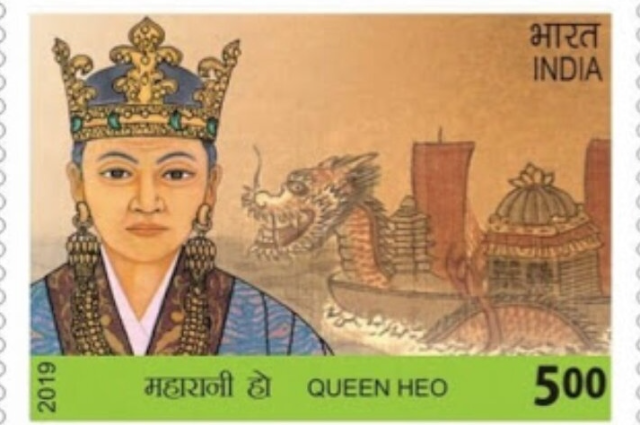
The dream was so vivid and meaningful that they decided to take action on it. They prepared a ship filled with gifts, gold, silk, and cultural offerings, and stones to balance the ship. And the princess was sent on a long journey across the sea. After weeks of travelling, her ship finally reached the shores of Gaya.
When King Suro heard about her arrival, he went to welcome her himself. The two met, and according to the legend, he immediately felt she was the one he had been waiting for.
They married soon after, and she was given a Korean name:
Heo Hwang-ok
Their union wasn’t just a royal marriage; it became a symbol of two cultures meeting for the first time. King Suro was the first in Korea to do an international marriage.
They had ten children, and their descendants later formed one of the biggest family lineages in Korea, known as the Gimhae Kims.
Of course, like any ancient story, historians still debate how much is fact and how much is folklore. Some researchers believe the story is real and is a beautiful exchange of culture. Others think it might be a mix of history and folklore, passed down for centuries.
What is more beautiful is that many families in South Korea still visit the tomb of Queen Heo Hwang-ok in Gimhae. She is not just a Queen to them, but a mother who established and nurtured the community.
The Indo-Korean Relationship
This relationship, initiated by the couple, has now grown into a special bond. Today, Ayodhya in India is also a special place for many Koreans, as they consider India their maternal home. Every year, hundreds of Koreans visit Ayodhya to pay tribute to Queen Huh Hwang-ok.
Beyond ancient legends, India and Korea now share real-life connections in education, travel and culture. Every year, dozens of Indian students head to Korean universities under the “Study in Korea” programme.
In other words, the story of a princess travelling across seas has a modern echo; young people from India and Korea literally travel and study in each other’s countries, becoming part of that shared heritage.
Queen Heo Hwang-ok’s story is still taught in South Korean schools, so the bond created by the king and the queen isn’t forgotten by the younger generation.
Today, the bond between India and Korea is not just historical, it’s deeply cultural. India has become one of the biggest fans of K-pop in the world. From fan dance covers to webtoon content, India’s love for Korean culture is building real bridges. The princess’s journey from ancient legend may have sparked the connection, but K-pop and Korean culture are making it stronger than ever.