
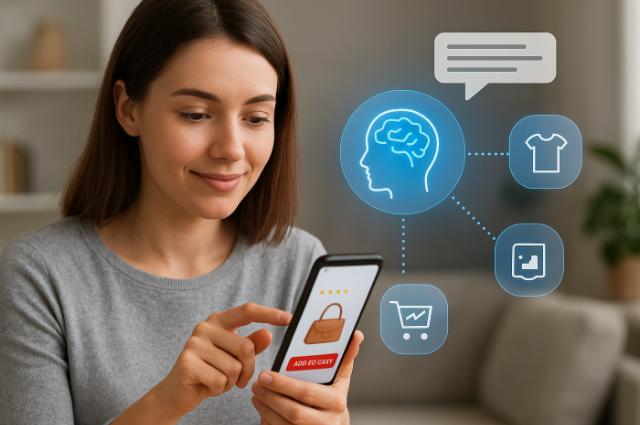
Am I the only one who feels like shopping apps are a little too good at guessing what I want? Sometimes it feels like they heard a thought I never even said out loud.
Here’s the twist, though: it isn’t mind-reading. It’s data. And a whole lot of AI is quietly working in the background.
Every time we scroll, pause, like, compare, or share a product with a friend, we’re dropping tiny clues. Half the time, we don’t even realise we’re doing it. But the system does. It watches those signals, learns our patterns, and uses them to build a picture of what we might want next.
So the recommendations we see aren’t coincidences. They’re the result of smart algorithms studying our behaviour in real time.
Traditionally, e-commerce focused on location and demographics. But today it’s all about data and personalisation. AI has slipped into e-commerce, changing how products are marketed and sold. Now the data gets recorded in real time, giving brands a far more accurate customer avatar.
No more guesswork. Only precise targeting
Big e-commerce giants like Amazon, Nykaa, Flipkart, and many others have shifted their retail strategy completely. They’re not just selling products anymore; they’re studying customer behaviour and predicting what the next purchase will be.
Every click, share, like, and pause helps them build a buyer persona, which allows them to push relevant products in the future. And all of this is powered by machine learning and AI.
AI focuses on micro-movements. Your mood, clicks, searches, and even the weather, accordingly, push product recommendations. This precision data-driven marketing helps in increased sales.
There are several ways to analyse consumer behaviour:
Search query analysis
Here, the data captured is based on the search queries the user did in the past 90 days or so. The number may vary as per the product. Analysing search queries can provide insights into a user’s interests and preferences, allowing businesses to create targeted recommendations. For example, if a user frequently searches for vegan recipes, the system can recommend vegan cookbooks or ingredients.Time spent on the website
This involves negotiating the path the user takes while on the website. It includes- how much time they stayed on a particular product page, the pages they skipped, did they reached the checkout page or left in between. This information helps in retargeting potential customers.Purchase history analysis
By studying a user’s past purchases, businesses can identify clear buying patterns: what they like, how often they buy, and the categories they revisit. For instance, if someone regularly purchases fitness equipment, the system can recommend related products such as workout apparel, resistance bands, or even supplements.Social media activity
It’s not just product activity that gets tracked. Social signals matter too. If a user likes or interacts with a reel about a skincare product, they’ll likely see recommendations for that exact brand or similar ones within minutes. That’s how fast these algorithms react to real-time behaviour.The power of machine learning algorithms
Once all that user data is collected, it doesn’t just sit there. It gets fed into AI models that make sense of it. And these platforms aren’t relying on just one system. Behind the scenes, most of the heavy lifting is done by multiple algorithms of machine learning.
Collaborative filters
This algorithm uses the data and analyses the similar purchasing patterns of the customers and uses them to recommend products. If Customer A and Customer B buy the same product, the system assumes they may like similar things. So it recommends items that Customer A bought to Customer B, and vice versa. It’s basically learning from the crowd.
Content-based filtering
This one focuses on product attributes like price, brand, size, colour, or category. If a customer has a tendency to buy in a particular price range and a specific brand, the algorithm will suggest the products in the same line.
Both these systems are combined into one called a hybrid model. By leveraging the strengths of both approaches, businesses can deliver highly personalised product suggestions that cater to a wide range of customer preferences and behaviours.
How Spotify aced the personalisation game:
Spotify’s recommendation engine is a prime example of how AI can be used to deliver personalised content.
The platform’s algorithm takes into account a user’s listening history and preferences to recommend familiar content, while also introducing them to new artists and genres they might enjoy. This is achieved by combining collaborative and content-based filtering systems.
According to a study by Spotify, their recommendation engine is able to increase user engagement by up to 25% and drive a 20% increase in music discovery.
With the help of generative AI, Spotify generates personalised playlists for its users. In this process, factors like time of the day, season, frequently played songs, and artists and genres liked are considered.
As companies like Spotify continue to push the boundaries of what’s possible with AI-generated content, we can expect to see even more innovative applications of recommendation engines in the future.
By embracing the potential of AI, businesses can be ahead of the curve in 2025 and beyond. It’s high time that traditional businesses should take advantage of this technological advancement and start exploring the potential of AI recommendation engines today, and discover the impact they can have on their business.