
When we think of waste, we usually think of plastic, food scraps, or garbage dumps. Rarely do we think of farms. Yet agriculture produces some of the largest volumes of waste on the planet, most of it ignored, burned, or left to rot.
But one young innovator, Jinali Mody, chose to look closer. She noticed the waste most people overlook, the thick stems of banana plants that are discarded after harvest. What others saw as useless farm residue, she saw as potential.
Imagine a banana farm after harvest. The fruit is taken away. The job is done. But the plant itself, especially the thick stem, is left behind.
Here’s the part most people don’t know: a banana plant fruits only once. After that, the stem has no further agricultural use. Farmers are left with massive piles of fibrous biomass that they usually burn or allow to decompose.
The scale of this problem is staggering.
For every 1 kilogram of bananas consumed, nearly 10 kilograms of agricultural waste are generated. In a country like India, one of the world’s largest banana producers, this adds up fast.
When these stems rot, they release methane, a greenhouse gas far more potent than carbon dioxide. When they’re burned, they contribute to air pollution. Either way, the environment pays the price.
And this is the gap that was noticed byJinali.
Valuable Banana Stems
Jinali Mody comes from a background rooted in science and sustainability. Instead of seeing banana stems as useless leftovers, she saw their structure. These stems are packed with strong natural fibres, similar in strength to materials already used in textiles.
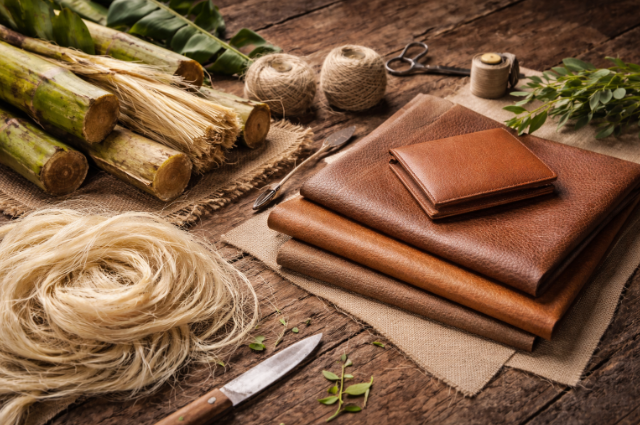
Through her company, Banofi Leather, she helped develop a process that transforms this waste into a high-quality, leather-like material.
First, fibres are extracted from banana stems that would otherwise be discarded. These fibres are long, durable, and flexible.
Next, they are cleaned and combined with natural binders, such as tree gums and starches. Unlike animal leather, this process avoids toxic chemicals like chromium and lead, which are commonly used in tanning.
Finally, the material is pressed into sheets and finished with natural dyes. The result looks, feels, and even smells like premium leather, without harming animals or the planet.
What sounds like magic is actually good material science paired with thoughtful design. Why Banana Leather Is a Win-Win-Win
For the environment, the benefits are huge. Traditional animal leather requires more than 10,000 litres of water to produce a single bag. Banana leather uses around 500 litres. It creates zero toxic wastewater, unlike conventional leather tanning, which pollutes rivers and groundwater.
For farmers, this innovation creates a new income stream. Instead of paying to dispose of banana stems, farmers can sell them. This adds an estimated 30 per cent bonus income, turning agricultural waste into a valuable resource.
For fashion, banana leather offers a real alternative. Most “vegan leather” today is plastic-based, which means it eventually breaks down into microplastics. Banana leather is plant-based, biodegradable, and cruelty-free, without relying on fossil fuels.
No More “Leather”
Leather has long been associated with luxury, durability, and status. But it has also come with hidden costs: animal cruelty, water pollution, and hazardous chemicals.
Banana leather challenges the idea that luxury must come at such a high price. It shows that innovation doesn’t always mean inventing something new. Sometimes it means rethinking what we already have.
This is why global platforms like the United Nations Environment Programme recognised Jinali Mody’s work. Her solution aligns directly with larger goals, such as climate action, sustainable production, and ecosystem restoration.
She is part of a broader generation of innovators proving that climate solutions don’t have to be abstract or expensive. They can be practical, local, and scalable.
What makes Jinali Mody’s work powerful isn’t just banana leather. It’s the mindset behind it.
She didn’t start with a product. She began with a problem that farmers and the environment were already facing. She listened, observed, and applied science where it mattered most.
In a world overwhelmed by waste, her work sends a clear message: solutions don’t always come from labs or boardrooms. Sometimes they come from fields, farms, and the parts of the system we’ve learned to ignore.
Banana leather reminds us that sustainability isn’t about sacrifice. It’s about smarter choices.