
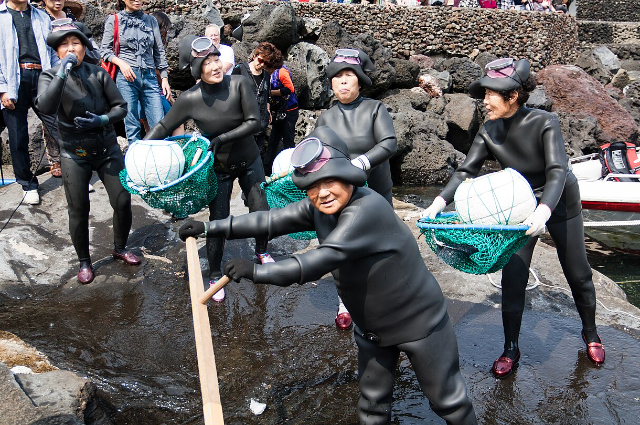
Jeju Island of South Korea is known for its beautiful beaches and natural habitats. But Jeju is more than just beaches. What gives the island its character isn’t just the lava cliffs or the clear water. It’s South Korea’s legendary female free divers.
Who are these women?
Jeju was historically a poor island, and many men spent months away at sea or in the military. So the women stepped in as the primary earners. Over time, they formed a community of divers who went into the ocean to collect abalone, sea urchins, octopus, and seaweed. They did all this without oxygen tanks or modern gear, just a breath of air, a knife, and the skill to survive underwater.
And these women are known as The Haenyeo, or ‘women of the sea’. Jeju women are accustomed to the ocean from an early age due to the island's environment. In their early teens, they practice swimming and diving in the sea. In their mid-teens, they make their debut as a Haenyeo, and by their late teens, they gain the experience to become a real Haenyeo, equipping them with economic power.
What makes their dives so remarkable?
Haenyeo can hold their breath for over two minutes and dive as deep as 10 to 20 meters, fighting cold currents and rough waves. Each descent is a calculated risk. Their workday isn’t a gentle stroll into the sea. They dive for hours, sometimes in freezing temperatures, wearing nothing but a thin wetsuit and pure determination. The ocean is their workplace, but it’s also unpredictable.
The increasing interest in Korean culture gave Haenyeo women an opportunity to share their story with the world. Tourists now visit Jeju not just for the beaches, but to watch these divers step into the sea with the same confidence they’ve carried for generations. Some villages even offer Haenyeo demonstrations and small workshops where visitors learn about their tools, their techniques, and the meaning behind their work.
Younger women rarely take up the profession because it’s demanding, risky, and requires years of training. Still, a few in their 20s and 30s are trying to keep the legacy alive, often out of pride rather than necessity.
A look into their real lives
To understand the heart behind this tradition, you only need to hear the voices of the women themselves. One of the most touching accounts comes from an interview published by Visit Jeju with Grandma Kwon Young-hee, the oldest Haenyeo in Jongdal-ri at the time of her retirement.
She spent 80 years of her life diving. She learned the craft at age 10, began earning at 15, and continued working until she was 89. For her, the sea wasn’t a workplace. It was a companion. “There wasn’t a single day I didn’t want to go out to the sea,” she recalled. “You make money by going out to sea. The water raised my children and sent them to college.”
She spoke about harsh winters, when the cold cuts through the wetsuit in minutes, and how the Haenyeo gathered in the bulteok—stone shelters used to warm their bodies before heading back into the waves. Even then, she said the difficulties never felt like burdens.
Her memories of diving were really mesmerising. She mentioned the incident when she was 25, she surfaced to see a shoal of dolphins passing by. The Haenyeo shouted “bae allo!”: a call asking the dolphins to pass under their boats. And the dolphins used to swim away from them. Grandmothers of the past would say it's okay if dolphins come in groups, but to be careful when a lone dolphin approaches. The lone dolphin they were referring to is a shark that were the real danger to the women. But she never saw a shark in Jeju, while she adorbaly mentioned seeing a turtle in the sea.
Her story captured the mix of pride, resilience, fear, and love that shaped generations of Haenyeo.
Preserving a disappearing legacy
Modern job opportunities mean fewer young women choose this path. The profession is physically demanding and no longer essential for survival. To help protect the tradition, UNESCO recognised the Haenyeo as an Intangible Cultural Heritage in 2016, hoping to preserve their skills and community knowledge.
Yet the worry remains. As Grandma Kwon said,
“One by one, we leave the sea, and the younger ones are not diving.”
. . .
References: