
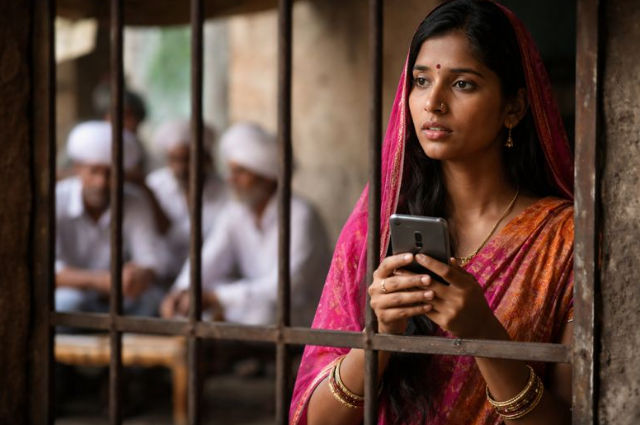
Indian women are doing something remarkable right now. They’re studying more, earning more, starting businesses, leading teams, and shaping conversations that were once closed to them. From rural self-help groups to startup boardrooms, from government exams to global sports stages, women are showing up with confidence and capability. They are not asking for permission anymore. They are building lives.
And yet, alongside this progress, there’s a stubborn contradiction that refuses to disappear.
Even in 2025, women are still expected to live within invisible boundaries set by families, communities, and institutions that believe they know what’s “best” for them. Decisions about education, mobility, clothing, marriage, motherhood, and now even technology, are still being made on their behalf. Not with them. For them.
This gap between women’s growth and society’s control is where the real tension lies. Because while women are moving forward, parts of society are still stuck in the habit of supervision.
Control Disguised as Concern
There’s a pattern we’ve seen again and again. When women gain access to something powerful, such as education, fi nancial independence, or smartphones, the response is rarely celebration. Instead of asking how to support women better, the instinct is to restrict them.
Don’t go out late, don’t talk too much, don’t dress like that, or even don’t laugh. And now, in parts of Rajasthan, it’s: don’t own a smartphone with a camera.
Recently, a caste panchayat in Rajasthan’s Jalore district announced a directive banning young women and daughters-in-law from using smartphones with cameras across multiple villages. Women are allowed only basic keypad phones. No cameras. No smartphones. No access outside the home, even for school-going girls, except for limited educational use indoors.
The rule is expected to be enforced from January 2026. And mind you, this isn’t a suggestion, it’s a social order.
Why the Ban Happened
According to the panchayat leaders, the ban was introduced to address concerns around mobile addiction, children’s screen time, and what they describe as the “misuse” of smartphones.
Their argument is familiar. Smartphones distract women. Phones harm children’s eyesight. Cameras invite moral risk. Social media leads women astray.
Instead of addressing misuse through education, awareness, and shared responsibility, the chosen solution was the easiest one: removing the device from women.
Not men. Not boys. But women.
It’s important to pause here and ask the obvious question. If mobile addiction is the issue, why is the restriction gender-specifi c? If children’s screen time is the concern, why not regulate usage for everyone in the household?
The answer is uncomfortable but clear. This isn’t about phones; it was always about control.
What This Ban Really Does
A smartphone today is not a luxury. It’s a basic need that enables women to access education, apply for jobs, receive government benefits, acquire new skills, manage fi nances, contact healthcare providers, and stay connected to the outside world.
Taking that away doesn’t “protect” them. It isolates them.
This ban limits women’s access to information. It restricts their mobility in a digital economy. It reinforces dependency, where women must rely on male family members to access online services, make calls, or document their own lives.
It also sends a dangerous message. That women cannot be trusted with technology. That surveillance is justifi ed. That freedom must be earned, not assumed. And once a community normalises this level of control, the line keeps moving.
Today, it’s smartphones. Tomorrow it could be education. Or employment. Or movement outside the village.
How Women Are Responding
Many women in these villages are not surprised. They’ve seen this before in different forms. What hurts more is the lack of choice.
Some women have expressed quiet frustration. Others fear social consequences if they speak up. In tightly-knit rural settings, defying a panchayat order doesn’t just invite criticism, it risks isolation. But there is resistance, even if it’s not loud yet.
Activists, educators, and women’s rights groups have called the ban unconstitutional and regressive. Legal experts have pointed out that such directives have no standing under Indian law and violate fundamental rights, including the right to equality and personal liberty.
More importantly, conversations have started. And that matters. Because silence is what allows these decisions to pass as “normal.”
Why This Decision Is Deeply Wrong
This ban places the burden of “social order” entirely on women’s shoulders. It treats women as potential problems rather than equal participants in society. It assumes restriction is easier than education.
A society that truly cares about women would invest in digital literacy, not digital bans. It would teach safe usage, consent, and responsibility, not fear and punishment.
You cannot empower women while controlling their tools. You cannot talk about development while denying half the population access to modern resources. And you certainly cannot claim to protect women while stripping them of agency.
The Bigger Picture
This incident is part of a larger struggle between progress and patriarchy. Between women trying to find their identity and systems trying to erase it. India cannot move forward while dragging its women backwards.
If we want women to contribute fully to society, economically, socially, and intellectually, then we must trust them. Trust their judgment. Trust their autonomy. Trust their right to choose.
Bans like these don’t preserve culture. They preserve fear. And fear has never built a future worth living in.
The solution isn’t to take phones away from women. It’s to stop taking decisions away from them.
. . .
References: