
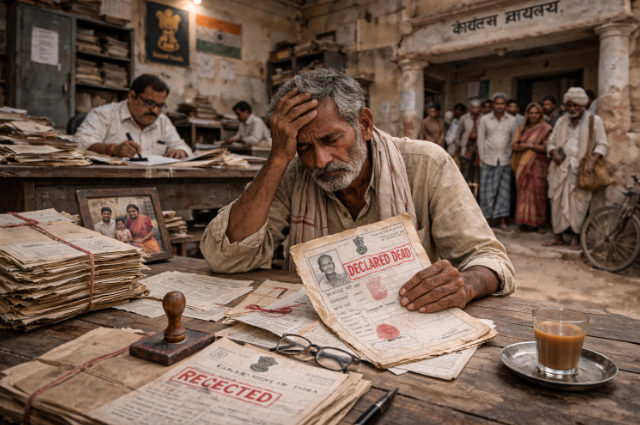
Lal Bihari Mritak was a man who had a tough time. He spent nineteen years of his life trying to prove that Lal Bihari Mritak was alive. Can you imagine that? Lal Bihari Mritak had to fight for a long time to make people believe that he was not dead. It is an amazing story about Lal Bihari Mritak and what he went through.
You walk into a bank feeling hopeful. You are a person who does not have a lot of money, but you want to achieve something good. Maybe you need a loan to make your weaving business a little bigger or to help your family live a better life. You give the bank officer your papers, thinking they will just ask you some questions. But the officer looks at you for a bit too long, then looks at your papers again. Then they say something that sounds crazy: "We cannot give you a loan because you are dead." The bank officer says this to you. It sounds like a bad joke. You are standing there talking to the bank officer. They are telling you that you are dead. This is what they say to you. It is very strange. You might think it is funny for a second. Nobody else is laughing. The room is very serious. The paper says you are dead. It happened months ago. This moment is really confusing. It does not make sense. It was the beginning of a strange problem with the law in India. This was the day Lal Bihari Mritak found out that the government of India thought Lal Bihari Mritak did not exist. Lal Bihari Mritak is a man who weaves clothes, and he is from Azamgarh.
In 1975, Lal Bihari was twenty years old. He was not a rebel; he was not a politician. He was not a criminal but was an ordinary villager trying to survive like millions of other people. Then greed quietly came into Lal Bihari's life. His uncle wanted to take the family's ancestral land; it was barely an acre, but it was precious enough in a rural economy for people to fight for it. By going to the courts or talking to each other, his uncle took a very easy route, a route that was also very shocking. The man paid an amount of money, ₹300, to a local officer called a lekhpal. This amount of money is not even enough to buy dinner nowadays. It was enough to make a person disappear from official records. Lal Bihari was declared dead, which means he was not considered alive by the government anymore. This happened because someone made an entry in the government records. After that, the land that belonged to Lal Bihari became his uncle's land. There was no funeral, and no one was sick. There was no accident. It all happened by writing something on a piece of paper. He was made to seem like he did not exist because of ₹300 and a fake entry, in the records. The state saw a man, who was alive and had a life of his own, as nothing more than a ghost. This young man was a living and breathing person. The state did not treat him that way. The young man felt like he was not seen as a person by the state. The state looked at the man and saw a ghost, not a living and breathing young man.
A lot of people believe that proving you are alive is easy. You just go to an office and show them your face. They fix the mistake. But the system does not care about faces; it only cares about papers. The man's papers said he was dead. So the government people did not listen to him. They just sent him away. Important people even laughed at him. They did not even read his applications. The courts did not hurry to help him. I mean, what a dead man can do, right? Every office he went to told him to go to another office. Every desk he sat at gave him forms to fill out. The man's problem was not getting solved. Proving you are alive is not as simple as it seems. The man had to deal with a lot of trouble because his papers said he was dead. Days turned into months, and months turned into years. The man later said that the system does not really listen to people who are alive, so why would it listen to people who are dead. Slowly, the man started to think of things to do because he was getting desperate. If the system would not pay attention to him in a way the man decided that he would do something to make the system notice him in a loud way. The system was not working for the man, so the man wanted to make the system work for him. The man wanted the system to notice him, the system to listen to him and the system to do something for him.
What this man did next is really hard to believe. It sounds like something you would see in a movie, but it actually happened. He did something; he tried to get the police to arrest him by taking his own cousin, the son of his uncle, who took his land. His idea was weird. It strangely made sense. He thought that if the police put him in jail, they would have to make a record of the case against him, a person who is alive. This would prove that he is a person. This plan did not work either. The police would not arrest him; they said they could not charge a man who was already considered dead. Imagine how crazy it would be to hear someone say that about you. When that did not work, he decided to have a funeral for himself. He walked through the streets like he was dead. He wanted the government to either give him a real funeral or say that he was alive. The people in the village were very confused. Some of them felt bad for him, but he just kept walking. He even asked his wife to ask for money that the government gives to the wives of men. When the officials said no to the application because her husband was there with her, he asked them to put it in writing. He wanted that paper to show what they did. He kept it to remember what happened. The whole thing was very sad but a little funny. The husband had to use humour to deal with the situation. The officials did not like her husband being there, so they said no. This was a problem for him, and he had to find a way to make it work. The husband thought it was crazy that they would say no just because he was standing there with her. He used this situation to make a point, and that was his way of fighting back. The application was important to him. He was not going to give up.
Years went by Lal Bihari did not give up. He thought of something clever to do. He decided to take part in elections not because he wanted to win but just to prove that he existed. When he filled out the papers to take part in the election, the people in charge had to check that Lal Bihari was really alive. He stood against important people like Rajiv Gandhi and V. P. Singh knew that he would not win. The election was like a stage where he could say, "Look at Lal Bihari, Lal Bihari is alive." Democracy was used to survive. The man was really frustrated. He also had a dark sense of humour. So he added the word Mritak, which means deceased, to his name. Mritak means deceased. From that day on, he signed all his letters as Late Lal Bihari Mritak. This was his way of making fun of the situation, protesting against it and showing his pain all at the same time. If the system said Lal Bihari was dead, then Lal Bihari would show them what it means to be dead. He would wear his death like a badge, like it was something to be proud of, which is really sad for Lal Bihari.
This man had to wait nineteen long years. He went through nineteen years of being treated, doing a lot of paperwork, and feeling very tired emotionally. Then a district magistrate finally listened to him and took his case seriously. The facts were very clear. They fixed the records. On June 30 1994, they officially said that he was alive. Think about this for a moment: this man needed the government to say that he was alive. The most surprising thing about this story happened after he won his case. He did not quickly try to punish his uncle or take back the land that he thought was his. He decided to forgive the person. This difficult time had really changed him. It had given him something bigger than anything he owned. A reason to keep going. The struggle had given him a purpose.
This man was fighting a problem. He found out that he was not the one with this issue. In places in India, a lot of poor people, from villages, were said to be dead, but they were really alive. Their family members were doing this so they could get the land or the money that the government gives to people who do not have a lot.
So this man started a group called the Mritak Sangh, which is also known as the Association of Dead People. This group is made up of people who are alive but are said to be dead. They are fighting to prove that they are really alive and to get their names back. The Mritak Sangh has a lot of members now, with tens of thousands of people who are part of the group. This person did something strange that got him noticed. He even got the Ig Nobel Peace Prize in 2003. They gave it to him for something they jokingly called " post-mortem activism". It is funny because he had a time with his travel papers. The problem was that there were issues with his identity. Even when he got this prize, he still had to deal with a lot of paperwork. It just goes to show that even awards, like the Ig Nobel Peace Prize, cannot avoid all the rules and bureaucracy. The Ig Nobel Peace Prize is something he got. It is a pretty big deal.
Lal Bihari is now in his seventies. He still speaks out. He says that India has changed a lot. India used to have paper records. Now it has digital databases and Aadhaar numbers and laws to protect data, so it is harder for people to make someone disappear with paper. Lal Bihari warns that digital identity theft is like the way of making someone disappear, but now it is done with computers. Before, someone could erase a person's identity with a pen. Now they can do it with computer code.
Lal Bihari is talking about identity theft, as the new version of the same old crime. This guy is in the news again because he wants a license for an AK-47. He is not completely serious about it. He is also not totally joking. He says that if people who are alive can have revolvers, then people who are dead need something stronger to protect them from bad people who take land that does not belong to them. It sounds really crazy. Like a lot of things about this guy, there is a good point hidden in there: when the system does not help poor people, they have to make a lot of noise to get anyone to listen. The system is failing people, and this guy is talking about an AK-47 for dead people to make a point.
Lal Bihari's life is really hard to believe. It is sad and funny and frustrating and inspiring all at the same time. If you look past how crazy it sounds, you will see that it is actually very real. The story of Lal Bihari reminds us that who we are can be very fragile when it comes down to papers and documents. It shows us how easy it is for people who do not have power to be forgotten. It shows us how much bravery it takes to fight against something that you cannot see, like a piece of paper in a file. Most people want to make a difference in the world. Lal Bihari spent nineteen years just trying to prove that he existed. He spent nineteen years trying to prove that Lal Bihari was real. And by refusing to disappear, he made sure the world would never forget him.
. . .
REFERENCES: