
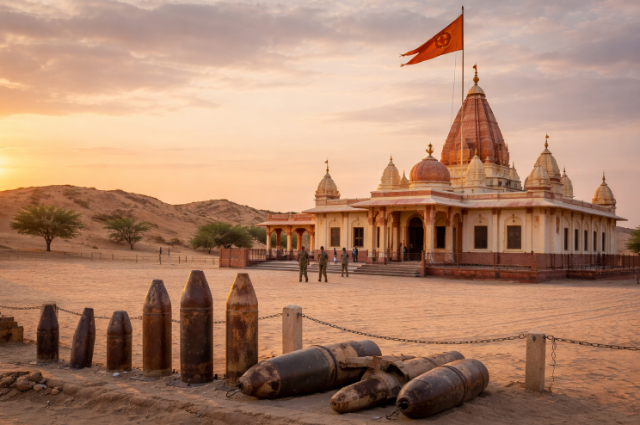
It is about the Saga of Tanot Mata. Tanot Mata is a goddess who did something special. The story of Tanot Mata is about what she did during a war. People still remember what Tanot Mata did. The Unforgettable Saga of Tanot Mata is a story that people will always remember. Tanot Mata stopped tanks from coming to a place. This is why people call her The Goddess Who Stopped Tanks. The story of The Goddess Who Stopped Tanks, Tanot Mata, is very famous. The Thar Desert is a dry and windy place near the India-Pakistan border in Rajasthan's Jaisalmer district.
The Goddess Who Stopped Tanks. The Temple has a lot of stories to tell about war and amazing things that happened. The land around Tanot Mata Temple is dry and dusty, and the temple is still standing even after many big battles took place. It did not get destroyed in the wars that happened there.
Instead Tanot Mata Temple helped people survive and keep their beliefs, in Tanot Mata Temple.
Tanot Mata Temple is a place where people go to pray and remember the amazing things that happened at Tanot Mata Temple. The story of this thing combines the spiritual and the scientific. It is a place that people, like pilgrims, soldiers and storytellers, want to come to over and over. They like the story so much that they return to it time and again to think about the spiritual and the scientific parts of the story. The story is what attracts these people, including pilgrims, soldiers and storytellers, to come to it. It has a long history that goes back over a thousand years. It all started in 828 AD when King Tanu Rao, who was a Bhati Rajput King, put the idol of Tanot Mata in the temple. People in the area believe that Tanot Mata is actually an incarnation of Goddess Hinglaj Mata.
From the beginning, people worshipped Tanot Mata as a protective deity. She was like a mother who protected people during tough times and when they were in danger. Over time, Tanot Mata became a part of the lives of people living in the desert and also of India's soldiers. Tanot Mata was very important to them. The 1965 Artillery Barrage was a big deal. This is when bombs became silent. The 1965 Artillery Barrage is something that people still talk about today. The 1965 Artillery Barrage was very loud at first. Then it became very quiet. People were waiting for the next bomb to fall during the 1965 Artillery Barrage. The 1965 Artillery Barrage just stopped.
The 1965 Artillery Barrage is an important event in history. We can learn a lot from the 1965 Artillery Barrage. It was not just about the bombs; it was about the silence that followed.
The Indo-Pakistan War of 1965 was a big deal for the shrine. It became very famous because of what happened. When the war got worse, the Pakistani Army kept attacking the Indian Army's positions near Tanot. They fired a lot of shells, around 3,000 at the area, including where the temple was. What happened next is really hard to believe. The temple got hit with 450 bombs right in its inner courtyard. The weird thing is that none of them exploded. There were no explosions inside the temple walls, even though there should have been a lot of damage. The Indo-Pakistan War of 1965 and the shrine are still talked about today because of this. The shrine and the Indo-Pakistan War of 1965 are a part of history. The young soldiers who were stationed there, far from home, had to deal with the desert sun and the chaos of war every day. Fear was always with them. Even with all the undetonated shells and the stone idol that nobody had touched, the soldiers found hope. People started talking about the soldiers who had dreams about the goddess. In these dreams, the goddess told them that she would keep them safe if they just stood firm. This idea gave the soldiers something to hold on to when things were really tough. They would talk about it in their tents when they were tired, and around campfires. The Indian soldiers and the idea of the goddess became a part of what kept them going.
The 1971 Battle of Longewala: Courage Under Fire
The desert was a battleground again six years later. This was during the Battle of Longewala in the 1971 Indo-Pakistan War. It happened on a December night. A small group of soldiers were there. They were a company in strength. They had to face a much larger Pakistani force. The Pakistani force had tanks to support them. The situation looked really bad for the soldiers.
The Indian soldiers used tactics. They used the terrain to their advantage. The Indian Air Force helped them at the time. Because of this, the Indian defenders were able to stop the attack. This was a deal. It is one of the most famous battles in the history of the Indian subcontinent. The Battle of Longewala is still remembered today. The Indian soldiers did a job during the 1971 Indo-Pakistan War.
The Tanot Mata Temple was not the place where the fighting happened, but it was still in a lot of danger. There were fights with tanks and guns, and a lot of confusion all around the temple in the sand. Just like what happened in 1965, the Tanot Mata Temple was not hurt.
Tanks would try to drive through the sand. They would get stuck, which made it hard for them to attack and helped the people who were defending the temple. The Tanot Mata Temple was very close to where all the fighting was happening. It was not hurt, which made people think it was very special and had a kind of magic to it. The Tanot Mata Temple is still a mystery to people because of what happened to it.
Unexploded Relics: The Silent Witnesses
Today, you can still see what is left of those two wars in a museum, inside the temple. The museum has shells that did not explode. These shells are just lying there quietly and are still made of iron. They were thrown at the temple a long time ago, but they never went off. Now they are old and rusty. They remind people of things that happened a long time ago. When people see these shells, it is like they are touching something from the past that they do not really understand. It makes them feel amazed. Sometimes it even makes them believe more strongly in their faith. The legacy of those two wars is still remembered because of this museum and the old shells that are there.
Spiritual Conviction vs. Scientific Scepticism
The Tanot Mata Temple is a place that people are really interested in. And they have different opinions about it. What is interesting is what the unexploded bombs at the temple mean to people. For the people who work for the Border Security Force and the locals, the fact that the temple is still standing and the bombs did not explode is a sign that something other than us is protecting the people who come to the temple for help. The soldiers like to take a bit of the sand from the temple with them because they think it will keep them safe. This is a way for them to combine their faith with their work, which can be very tough since the temple is located in a remote area of India. The Tanot Mata Temple is a place for the soldiers and the people who live near it.
People who do not believe this story have some ideas about what might have happened. They think that the soft sand in the Thar Desert may have helped to stop the shells from exploding. The sand is really deep and loose. This could have cushioned the impact of the shells when they landed. Some other people think that there might have been something with the way the shells were made. Maybe the fuses were not put in correctly. Maybe the shells landed at a weird angle. These things can happen when you are fighting in the desert. The heat and dry soil can make things not work properly.
It seems really strange that so many shells did not explode in two different wars in the same place. The Thar Desert is an unusual place. Even if there were problems with the shells, it seems unlikely that so many of them would fail to explode. The Thar Desert and its sand may have played a role in this.
A Shrine for Soldiers and Seekers
The Tanot Mata Temple is really special. It is not a small temple on the side of the road. The BSF takes care of it. Now the Tanot Mata Temple is a part of what people remember about our country. It shows us that we can be strong and brave when things are tough. For the soldiers who are stationed out in the desert, the Tanot Mata Temple is a place to feel safe and get energised. It is where they can think about their job and also think about their faith. The Tanot Mata Temple is also a reminder to people who visit that when life gets really hard, what we believe in can be just as important as having a good plan or the right tools. It is a symbol of the experience, and it reminds us of the importance of resilience and courage.
In the vast silence of the desert, where winds whisper across dunes like restless spirits, Tanot Mata stands—a story carved in sand and faith, inviting us to reflect on not just what happened, but what it meant to those who lived through it.
REFERENCES:
- https://reflections.live
- https://en.wikipedia.org
- https://timesofindia.indiatimes.com
- https://reflections.live
- https://en.wikipedia.org