
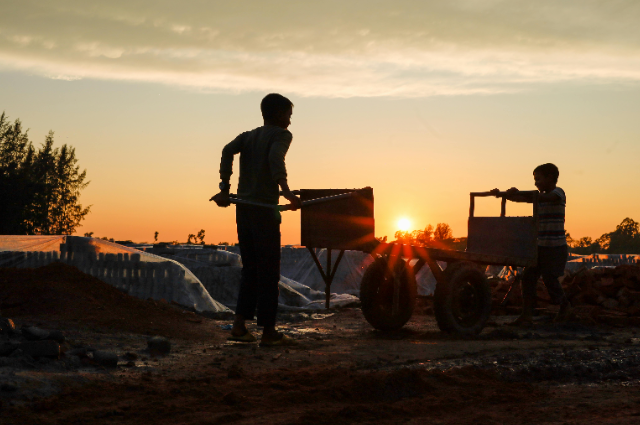
In a village that is very dusty and near a big place where people mine, Amina gets up before it is light outside. She is ten years old. Amina pulls her hair back. Puts on her old shoes. Then she goes under the ground. She does not go under the ground to find something like treasure. Amina goes under the ground to pick up the cobalt. The cobalt she picks up will be used to make a phone that people will use in a city that's very far away from her village. By the time the sun comes up, Amina already has to carry rocks and a lot of dust on her little shoulders. The cobalt that Amina collects will help make a smartphone that someone will use in a big city that is thousands of miles away from the little village where Amina lives. Most viewers of the latest tech advertisements would never guess her name or know her story.
Amina’s work is part of a vast, unseen workforce that millions of companies rarely discuss: children caught in deep supply chains. This isn’t the tidy factory floor we see in glossy ads. This is child labour hidden in the roots of global trade—in farms, backyard workshops, and artisanal mines across low-income countries—bearing the weight of the global economy on shoulders that should be in school or at play.
What Does “Invisible” Child Labour Really Mean?
When a multinational company (MNC) talks about ethical sourcing or safe production, they usually mean Tier 1 suppliers—the large, central factories that appear in official audits. But real production networks look more like tangled trees, with many deep branches:
- Tier 1: Big, certified factory
- Tier 2: Smaller workshop supplying parts
- Tier 3: Remote farms or informal mines providing raw materials
At Tier 2 and 3, work is rarely checked by outsiders. Products enter the formal supply chain only after being assembled from materials that might have been harvested, sewn, or mined in places where child labour is common—yet unnoticed by company auditors. This is why it’s called invisible child labour: it exists in the shadows of the businesses that profit from it.
The Shadow Workforce: Hidden but Widespread
A recent global assessment, Child Labour: Global Estimates 2024, Trends and the Road Forward by the International Labour Organisation (ILO) and UNICEF, revealed that around 138 million children were engaged in child labour in 2024. Of these, 54 million work in dangerous or hazardous conditions like mines, farms with toxic pesticides, or construction sites.
But here’s the harsh truth: these numbers still miss many children who work on family farms, in informal workshops, or in illegal mining operations. These are the places that regular corporate audits rarely visit. That’s why the young hands that pick cotton, sew clothing buttons, or dig cobalt pits largely remain invisible to global consumers—hidden behind certifications, long supply chains, and unclear supplier networks.
The Poverty Trap: No Choice but to Work
Why do families let their children work in such tough conditions? For many, it’s not a choice—it’s about survival.
Recent research shows that millions of families living on less than $3 a day are trapped in poverty, which makes child labour a necessary option. When multinational companies demand extremely low prices from suppliers, the suppliers in turn cut costs wherever possible. The result? Small workshops and farms hire children both to boost production and to reduce expenses. Often, parents bring their children to work because earning money together is the only way for the family to eat.
In remote mining areas like the Democratic Republic of Congo (DRC), children work alongside their parents in informal, unsafe mines. Estimates suggest around 40,000 children work in cobalt mines—extracting the metal that goes into batteries for phones and electric cars.
Why Ending This Is So Difficult
1. Opaque Supply Chains
When raw materials from both ethical and unethical sources are mixed in local markets, it becomes nearly impossible to trace where each bolt, gram of metal, or yard of fabric really came from. These materials are bundled and sold, and by the time they reach the first factory line, their history is lost—even to corporate compliance systems.
2. Audit Failures
Standard corporate audits are easy to prepare for: suppliers often get advance notice and can temporarily remove child workers just for that day. Once the auditors leave, the children return to work as if nothing happened, and the records stay clean on paper. This “box-ticking” exercise looks good in sustainability reports but changes little in reality.
3. Missing the 2025 Target
The world agreed in the Sustainable Development Goals (Target 8.7) to end child labour by 2025. That goal was not met. As of 2024, an estimated 138 million children are still working—nearly two-thirds of them in agriculture and many more in dangerous industries like mining and construction.
What’s Changing Now? New Laws and Accountability
After years of advocacy and pressure from civil society, governments and regulators are finally tightening the rules. One major change is the European Union’s Corporate Sustainability Due Diligence Directive (CSDDD), adopted in 2024. This directive requires companies—not just at Tier 1, but throughout their entire supply chain—to identify and address human rights and environmental harms, including child labour.
This kind of requirement moves beyond the old model of voluntary reporting to legal accountability. Companies now risk legal consequences and financial penalties if they fail to properly investigate and fix abuses deeper in their supply chains—not just on the surface where it’s easy to see.
The Path Ahead: Solutions That Work
Ending invisible child labour takes more than better audits or stricter laws. Experts point to several key strategies:
- Mapping full supply chains so corporate buyers know exactly where materials come from.
- Supporting families financially, so parents don’t have to send their children to work to survive.
- Investing in education and community programs, giving children real alternatives to labour.
- Strengthening local enforcement, especially in rural and mining areas where child labour is most common.
Some promising models are already showing results. For instance, cooperation between governments and international organisations in cotton-producing regions has significantly reduced child labour by forming unions, educating farmers, and building ethical supply networks. But much more work is needed—urgently and at scale.
Conclusion: Hidden, But Not Hopeless
Child labour remains one of the most painful global injustices of our time—not because it is unrecognised, but because it is deeply rooted in economic systems that prioritise profits over people. When we see children like Amina working in the shadows of supply chains that support modern technology and global fashion, we must question the true cost of convenience.
The good news? The world is no longer ignoring this issue. We have better data, increased legal accountability, and growing public awareness. But awareness must lead to action—by consumers, governments, companies, and communities alike—if we truly want to lift the heavy burdens off young shoulders and grant every child the carefree days they deserve.
. . .
References:
Global Reports & Data
- ILO & UNICEF, Child Labour: Global Estimates 2024, Trends and the Road Forward — https://data.unicef.org
UNICEF DATA
- UNICEF, What is Child Labour? — https://www.unicef.org
- Cobalt and child labour issues — https://www.gicj.org
- gicj.org
- Child labour in Africa (including mining) — https://en.wikipedia.org
Legal & Due Diligence
- Corporate Sustainability Due Diligence Directive (CSDDD) — https://en.wikipedia.org
Good Practices
- Telangana and child labour reduction success story — (Times of India news) https://timesofindia.indiatimes.com