
I remember when cybercrime felt like something that happened to people. It seemed far away, like it was not a real problem for ordinary folks. A lot of people thought that only big companies, banks and huge servers got attacked. Regular people, like you and me, felt safe because we were not computer experts or rich business people. We thought that as long as we were not important cyber crime would not bother us. That feeling of being safe is gone now. Cybercrime is sneaky these days. It does not shout to get your attention. Cybercrime slips in quietly, looking like someone you know and sounding like a friend, which makes you feel like you have to act. Cybercrime creates a sense of urgency that makes your heart beat fast. When you figure out that something is not right, it is usually too late. You do not know what is going on with the problem until it is too late. The problem with something is that you do not see it coming. Then it is too late to do anything about the problem. The problem is that you are not prepared for what's happening with the problem.
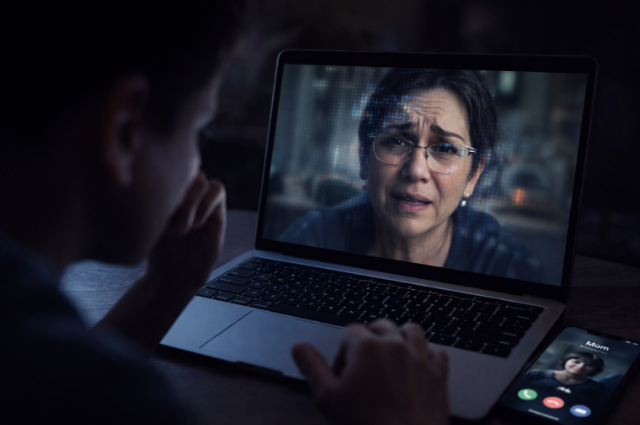
This is really scary. Live face-swapping during video calls is a problem. Let us say you get a call from your mother. You see your mother's face on the screen. You see what your mother is feeling by the look on her mother's face and the way your mother moves her head. Your mother looks really worried. Your mother tells you that she needs some money.
Think about this. Your boss calls you when it is late at night. Your boss asks you to send some money for something in an emergency. You are not sure if you should do it. When you see your boss's face and hear his voice, you start to feel better about it, and your doubts go away. Face-swapping during video calls is an issue because it can make things happen, as this happens with video calls. Lots of people do not know that scammers can use Artificial Intelligence as a kind of disguise. They can actually swap their face with someone else's face in real time. This is not a video that was recorded beforehand. It is happening live. You can even talk to the person. It is really convincing too. Places like Interpol have said that these deepfake scams are getting more common. This is because they take advantage of something that people do naturally. We usually trust what we see. Deepfake scams are getting more popular. That is why agencies, like Interpol, are warning people about deepfake scams.
The problem is how our brains work. When we are kids, we learn that if we see something, it must be true. If someone looks okay, sounds okay and responds away, we usually think they are real. Scammers are aware of this. They try to rush us and make us feel emotional, so we do not have much time to think. They want us to do something quickly and think about it later. In those rushed moments, we might feel scared. We might feel love or respect, and that can be stronger than thinking clearly. And that is all a scammer needs. Scammers know how to use this to their advantage, and they use it to trick people into doing what the scammers want. The scammers are very good at being fake, at making people believe that they are genuine people.
There is a change going on with cybercrime. It is not just people sitting at computers doing things anymore. Now we have machines that can attack machines. This is sometimes called "robots hacking robots". Bad people use programs that can work on their own. These programs are like thieves that go around the internet looking for trouble. They do not need to be told what to do. They are always looking for weaknesses, like software, cloud storage that is not safe and digital doors that are left open. Cybercrime is getting more complicated because of these programs, or what some people call shadow agents, that can find these weaknesses and use them to do bad things. When a human hacker is sleeping, these agents just keep on working. People talk about this at places like the World Economic Forum. They say that because of this automation, cyber attacks happen fast, they do not cost a lot of money, and it is very hard to find out when they are happening. Cyber attacks are a problem, and these agents make them even worse. Cyber attacks are getting faster and cheaper because of this automation.
Model poisoning is another thing we should be worried about. AI systems learn from the data they are given, just as students learn from the books they read. If someone switches those books with wrong information, the student will start giving wrong answers without even knowing it. The same thing happens when hackers mess with AI models. They give the models data, so they start making bad choices. This can cause problems like private information getting out, fake accounts being approved, or users being sent to the wrong place. The bad thing about this is that it does not look like an attack. The system keeps working like normal. It is still causing harm from the inside. Model poisoning is an issue because the AI system is still working, but it is making bad decisions. The Federal Bureau of Investigation and other authorities have warned that if someone messes with Artificial Intelligence systems, it can cause problems that last a long time. The Federal Bureau of Investigation is worried that these Artificial Intelligence security risks will not be noticed. The Federal Bureau of Investigation says that when Artificial Intelligence systems are compromised, it is an issue.
There is something called hijacking. It is a kind of attack. A lot of companies use AI chatbots to answer questions and help people who are customers or employees. These chatbots have rules they have to follow. They can only say things. Prompt hijacking is when someone tricks these systems with inputs. This makes the chatbots forget what they are supposed to do. It is not like someone is breaking into a building. It is like someone is talking their way past a security guard. When someone does this successfully, they can get passwords, secret company documents or private information about users. They can get this information about the users of the company's system, like the users of the AI chatbots. People are using intelligence tools more and more in their daily lives. This makes it easier for bad people to trick others. It is very bad for everyone else. Artificial intelligence tools are making it easy for attackers to do things to people.
The thing that worries me most is body hacking. Our bodies are getting more and more connected to the internet with things like smartwatches, fitness bands, medical implants, heart monitors and devices that help us. These things collect information about us, like our heart rate. How we sleep, where we go, and what we do. When bad people get this information, which is sometimes called body snatching, it can be very bad. They can follow us around. Try to blackmail us or make threats against us. The problem is that information about our health is very personal. It is more personal than a password. You see, you can change a password, but you cannot just change your heart rate or make a medical problem go away. Body hacking is a deal because body hacking affects our bodies and our health. Body hacking is something that we should be aware of because it can hurt us in a way. The World Health Organisation and other groups like the World Health Organisation say that keeping our health information safe is really important for our personal safety. We need to make sure the World Health Organisation and other organisations are doing everything they can to protect our health data.
This thing called bio-ransom is really scary. What happens is that hackers get control of devices or devices that help people, and they want money to make them work again. Think about someone being able to stop a heart monitor, an insulin pump, or a bionic limb from working and saying, "Give us money, or we will not turn it back on". This is not a cybercrime. It is like someone is holding something for ransom. It is a person's life. We do not see this happening a lot now. People who study cybersecurity say it can be done. If something can be done, it usually happens at some point. Bio-ransom is a deal because it is, like digital kidnapping. Bio-ransom is very bad. It is getting attention from people who study cybersecurity and bio-ransom.
We have to deal with attacks on computers, people and also on our minds. These days, just because we see something, it does not mean it is true. Fake people that are made by computers can. Sounds very real, which can trick even careful people, especially when feelings are involved. At the time, some people are getting very good at controlling how large groups of people feel. Bad people use lots of online accounts to make people scared, panicked or really angry. They do this on a big scale. The goal of these people is not to tell the truth but to get a reaction. They want to scare people into selling their stocks, not trusting the institutions or backing political ideas. The thing is, when people are fearful, they do not think clearly. Fear can spread fast and even faster than the facts. When that happens, our society becomes very vulnerable to all sorts of problems. The people who do this have a main goal: to create fear and uncertainty about the stocks, the institutions and the political ideas.
All of this shows that modern cybercrime is not just technical; it is deeply human. It exploits trust, emotion, urgency, and habit. Defending against it requires more than software updates. It requires taking a step back, verifying through different channels, questioning even familiar faces, and raising awareness. In a world where machines can mimic human faces and voices, caution is no longer a weakness; it is wisdom.
Reference Links
- Interpol – Cybercrime and Digital Threats: https://www.interpol.int
- World Economic Forum – Global Cybersecurity Outlook: https://www.weforum.org
- FBI Internet Crime Complaint Centre (IC3): https://www.ic3.gov
- World Health Organisation – Digital Health and Data Protection: https://www.who.int
- MIT Technology Review – AI Security and Model Poisoning: https://www.technologyreview.com
- Europol – Law Enforcement and Deepfake Risks: https://www.europol.europa.eu