
There are some feelings we don’t talk about because they sound wrong when said out loud. They don’t fit into neat emotional boxes like happiness or grief. One such feeling visits people quietly in Varanasi—a city that has been living with death for thousands of years and, strangely, has made peace with it. Here, in a modest place known as Moksha Bhawan, people come not to heal, not to start again, but to wait for the end. And yet, what unfolds inside those simple rooms is not just sadness. Sometimes, it is something softer. Sometimes, it is peace. Sometimes, it even feels like a strange kind of joy.
Calling it a “death hotel” feels too harsh, almost careless. Moksha Bhawan is quiet, plain, and deeply human. No machines are beeping, no rushed doctors, no sterile white walls trying to pretend that death isn’t coming. There are beds, windows, fans, and time. Families arrive with elderly parents or terminally ill relatives, knowing very well why they are here. No one says it directly, but everyone understands the implication. This honesty changes everything. When there is no pretending, there is space—for conversations, for silences, for holding hands without checking the clock.
Sitting beside a loved one who knows they are nearing the end is not an easy task. It hurts in places you didn’t know existed. But something unexpected happens when denial leaves the room. People start talking differently. Not about money, not about unfinished tasks, not about who will say what to whom later. They talk about memories. About childhood homes that no longer exist. About small joys—morning walks, shared meals, old songs. Sometimes they laugh, softly, almost guiltily. Sometimes they cry, without drama. The emotions feel honest, unfiltered. And in that honesty, there is comfort.
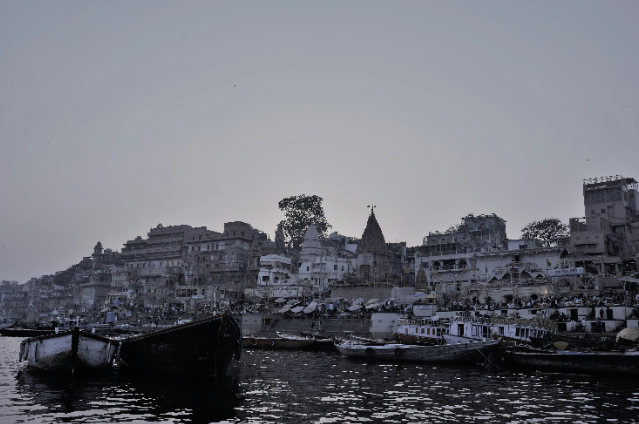
Outside, life doesn’t pause. The Ganga River keeps flowing, as it has for centuries. At Manikarnika Ghat, funeral fires burn day and night. For someone seeing this for the first time, it can feel overwhelming, even shocking. But after a while, you notice something else. Death here is not hidden. It is not whispered about. It is not treated like a failure. It is simply part of the city’s rhythm—like sunrise, prayer calls, and evening lamps floating on the river.
For families staying at Moksha Bhawan, this openness slowly eases fear. When death is not treated as an enemy, it stops feeling like one. You begin to understand that the real pain often comes from resistance—from wanting things to be different when they can’t be. Here, acceptance is not forced; it grows naturally. Watching a loved one sit calmly, chant softly, or simply gaze out of the window changes your own breathing. You realize that panic helps no one. Presence does.
What surprises many people is the calmness of those who are dying. Some look relieved, as if a long journey is finally nearing rest. Some speak about seeing familiar faces in dreams, about rivers and light, about going “home.” Whether these experiences are spiritual, psychological, or something in between doesn’t really matter in that moment. What matters is that they are not afraid. And watching someone you love let go without terror brings a quiet reassurance: maybe death is not as cruel as we imagine.
There is also something deeply healing about closure. In modern life, we rarely get it. People pass away in hospitals, mid-sentence, mid-conflict, mid-life. At Moksha Bhawan, there is time to say what was left unsaid. Apologies happen without ego. Gratitude flows without embarrassment. Love is spoken plainly, without decoration. These moments don’t erase grief, but they soften it. They leave fewer sharp edges behind.
And then there is that strange joy—difficult to explain, even harder to admit. It is not happiness about losing someone. It is the joy of seeing dignity preserved till the very end. The joy of knowing your loved one is not alone, not scared, not surrounded by cold walls and hurried strangers. It is the joy of witnessing a death that feels complete. When the end finally comes, it hurts—but it does not shock. It feels like watching the sun set after a long day. Sad, yes. But also natural.
Leaving Kashi after such an experience is unsettling. The outside world feels noisy, impatient, obsessed with things that suddenly seem small. Deadlines, arguments, social status—all of it feels strangely unnecessary. You return changed. You listen better. You postpone less. You become braver with love and gentler with people. Death, once faced closely, has a way of teaching life.
Moksha Bhawan does not glorify dying. It humanizes it. It reminds us that the end of life does not have to be lonely, frightening, or rushed. It can be slow, meaningful, and deeply connected. Watching a loved one leave this world in such a space is heartbreaking—but it is also grounding. It strips life down to its essentials: love, presence, and acceptance.
Perhaps the strange joy comes from realizing this simple truth—that love does not end when life does. It changes form. It becomes memory, gratitude, and quiet strength. And in Varanasi, where life and death walk side by side without fear, that truth feels not heavy, but comforting.
Reference
- https://www.bbc.com
- https://www.nationalgeographic.com
- https://www.theguardian.com
- https://indianexpress.com
- https://whc.unesco.org