
If you had visited Hiware Bazar in the 1980s, you probably wouldn’t have stayed long. The land looked tired. The wells were empty. The soil cracked under the sun like broken pottery. People spoke softly, not because they were calm, but because hope itself felt fragile. This village lies in a rain shadow region where clouds travel overhead but rarely stop to give rain. For generations, this geography felt like a punishment no one could escape. Back then, Hiware Bazar was slowly emptying. Crops failed year after year. Livestock died due to a lack of fodder and water. Young men left for cities to work as daily wage labourers. Old parents stayed back, guarding homes that felt more like memories than shelters. Water tankers became a routine sight. Government relief came and went, but nothing really changed. Each summer felt worse than the last. Many believed the village had reached its end.
But what happened next is not a fairy tale. There was no sudden rainfall, no overnight transformation, no magical policy announcement. What happened was far more difficult and far more powerful. The people of Hiware Bazar decided to stop waiting.
When Popatrao Pawar returned to the village after studying agriculture, he didn’t promise miracles. In fact, he said something many didn’t want to hear: no one was coming to save them. He spoke about self-respect, about dignity, about taking responsibility for their own land. Aid, he believed, had quietly taught people to depend, not to rebuild. His words were uncomfortable, even upsetting. But they were honest.
Instead of money, he asked for effort. Instead of schemes, he asked for time. And instead of machines, he asked for hands.
The idea was Shramdaan, voluntary labour. At first, people laughed. Some were angry. How could poor villagers fight drought with spades? But desperation has a way of opening doors the mind once kept shut. Slowly, people agreed to try. Not because they were confident but because they had nothing left to lose.
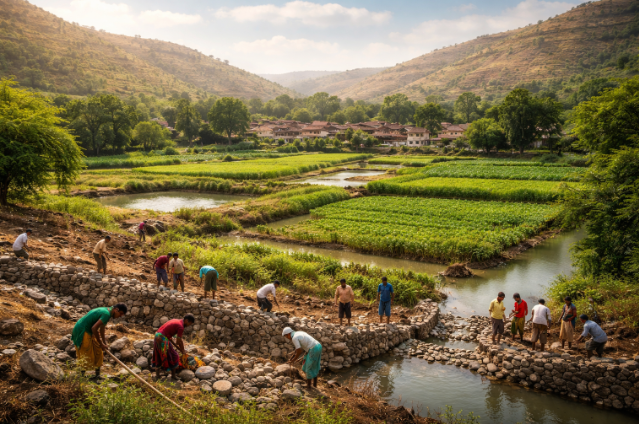
Early mornings changed in Hiware Bazar. Men, women, and even teenagers climbed the surrounding hills carrying tools that were often borrowed or broken. They dug long trenches along the slopes so rainwater wouldn’t rush away. They built small earthen dams across streams that flowed only for a few days a year. Stones were placed carefully, one by one, under the burning sun. Hands blistered. Backs ached. There was no salary waiting at the end of the day, only a shared belief that maybe, just maybe, this effort would matter.
It didn’t feel heroic while it was happening. It felt exhausting. There were days when people questioned everything. Days when the heat was unbearable. Days when arguments broke out. But something held them together: the understanding that this land was theirs, and if they didn’t protect it, no one would.
And then, quietly, things began to shift.
After the monsoon, water didn’t disappear overnight. Wells that had been dry for decades showed faint signs of water. The soil felt cooler. Grass returned slowly, like a shy visitor unsure if it was welcome. This wasn’t a dramatic change; it was a gentle one. But in a village that had known only loss, even small signs felt revolutionary.
The people of Hiware Bazar realised something crucial: the problem was not just less rain, but how fast the rain was escaping. Instead of blaming the sky, they changed the ground. They reshaped the land so it could hold water longer, let it seep underground, and feed the earth patiently. They didn’t fight nature; they listened to it.
With water came responsibility. The village decided together to ban water-intensive crops like sugarcane. Borewells were regulated. Alcohol was banned because addiction was draining families emotionally and financially. These were not easy decisions. They required discipline, trust, and constant discussion. But they were made collectively, in open village meetings, where every voice mattered.
Slowly, agriculture returned, not the risky kind, but the kind suited to dry land. Millets, pulses, and vegetables. Dairy farming grew as fodder became available. Migration slowed, then stopped. Some who had left even came back. Children stayed in school. Homes were repaired. The village began to breathe again.
What makes Hiware Bazar special is not just success but the way success was built. This was not a rejection of government support, but a refusal to be helpless. External help arrived later, once the village had already proven its commitment. The foundation was laid by people who chose action over complaint.
In today’s world, where we expect instant results and quick fixes, Hiware Bazar feels almost uncomfortable. There were no shortcuts here. Only slow progress, repeated effort, and collective discipline. No single hero. Just shared responsibility.
Today, Hiware Bazar is often called a “model village.” Experts visit. Students study it. Policymakers quote it. But labels can never capture what truly happened here. This story is not about trenches or check dams alone. It’s about courage, the courage to believe that ordinary people, working together, can rewrite their future.
The rain shadow still exists. The clouds still move as they always did. But fear no longer lives here. Hiware Bazar did not defeat drought with money or magic. It defeated despair with unity.
And perhaps that is the real miracle.
. . .
References: