
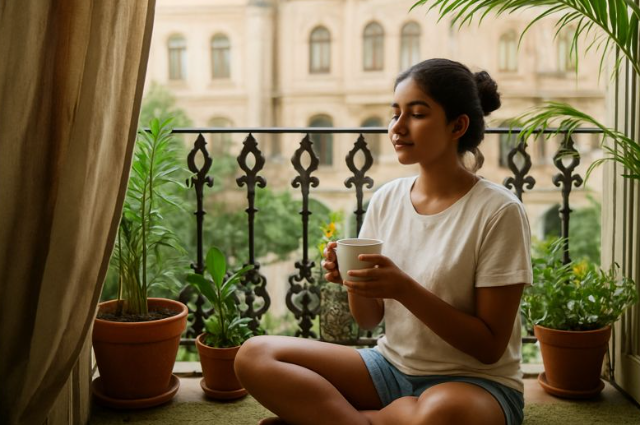
Somewhere between the constant notifications, the pressure to reply instantly, and the silent competition happening on Instagram stories, something inside our generation quietly snapped. I’ve felt it myself, that strange mix of anxiety and guilt every time I saw people partying, travelling, or “doing better” than me. For years, FOMO practically ran our lives. But lately, there’s been a soft rebellion. A shift so subtle you only notice it when you realize your friends are saying things like, “I don’t feel like going out tonight, not because they’re tired, but because they genuinely enjoy being home. That’s JOMO, the Joy of Missing Out —, and honestly, it feels like a breath of fresh air.
What I love about this shift is that it isn’t about rejecting people or becoming anti-social. It’s about choosing peace over chaos. Research actually backs this up; media reports are calling JOMO an antidote to FOMO because it helps improve focus and emotional wellbeing. Many psychologists say disconnecting from the constant digital buzz gives us space to breathe, think, and just be human again. When you’re not glued to your phone wondering what everyone else is doing, it becomes surprisingly easy to appreciate what you are doing.
And let’s be honest: we’re tired. Today’s lifestyle, especially in big Indian cities, has become so fast-paced that burnout is almost a default setting. Late-night hustle culture doesn’t feel inspiring anymore; it just feels exhausting. A Times of India lifestyle piece even mentioned that focusing on JOMO helps people prioritise self-care, gratitude, and healthier relationships. That makes sense: when you’re not trying to keep up with every trend and every plan, your mind has space to slow down and reconnect with what actually matters.
I’ve seen this shift play out around me in the sweetest ways. Friends who once lived for parties now rave about slow mornings with chai and sunlight. Weekends that used to be packed with outings have turned into cozy evenings with books, skincare routines, or guilt-free naps. People are saying no more confidently, not with excuses, but with ease. One blogger wrote, “If I skip your party, just know I’m probably home, hugging my blanket and being genuinely happy.” It’s funny, but also so real. We stopped glorifying busyness and started romanticizing rest.
This change also shows up in how we consume things. Many young Indians are moving toward mindful consumption, choosing fewer, better, more meaningful things. A survey even showed that around 65% of Indian youth prefer eco-friendly or sustainable brands now. I see this everywhere: thrifted clothes becoming cool, local artisans getting attention, farmers’ markets replacing malls in weekend plans. It feels like our generation is saying, “I don’t need more. I need meaningful.”
And honestly, localism is such a big part of the JOMO lifestyle. It’s funny how skipping a nightlife plan to spend time at your local chai tapri or park can feel more grounding than any expensive outing. Some people are even shifting from big metros to smaller towns because they crave cleaner air, community, and slower days. The idea isn’t to escape life, it’s to return to a life that feels like life. And when you support small local businesses, the joy hits differently. A creator once said, “Buying from locals feels personal, like you’re part of their story.” And I think that’s exactly what we’re all craving: connection, not comparison.
Speaking of creators, I want to share a little case-study moment. I recently chatted with Aanya, a lifestyle influencer who has completely embraced slow living. She wasn’t always like this; she used to chase every trend, every event invite, every Instagram-worthy moment. “I was exhausted,” she told me with a laugh. “One day I asked myself, ‘Why am I living like I’m constantly auditioning?’” Now her content is all about mindful mornings, simple cooking, balcony gardening, and finding joy in the small stuff. She told me her DMs are filled with young people saying her videos gave them permission to slow down too. “The biggest flex today,” she said, “is peace.” It felt so honest, almost like a warm reminder that life doesn’t need to be loud to be meaningful.
The best part about JOMO is that it doesn’t ask for big lifestyle changes. It starts small. A no-screen hour. A slow walk without music. An evening spent journaling. Putting your phone in another room while sleeping. One psychologist said that modern success is no longer defined by how busy you are, but by how balanced you feel, and honestly, that hit me. Because when you think about it, we’re not running away from life. We’re just running back to ourselves.
Looking at the larger picture, this isn’t just a trend. It’s a cultural shift. Indian youth are rewriting the rules of what it means to live well. We’re choosing rest without guilt, love without pressure, and experiences without the need to prove anything. NDTV even called JOMO “the joy of savoring life’s moments,” and I couldn’t agree more.
If FOMO taught us fear, JOMO is teaching us freedom: Freedom from comparison, Freedom to create our own pace, Freedom to be present. And maybe that’s the real glow-up of our generation, not the perfect feed, but the peaceful life behind it.
Reference: