
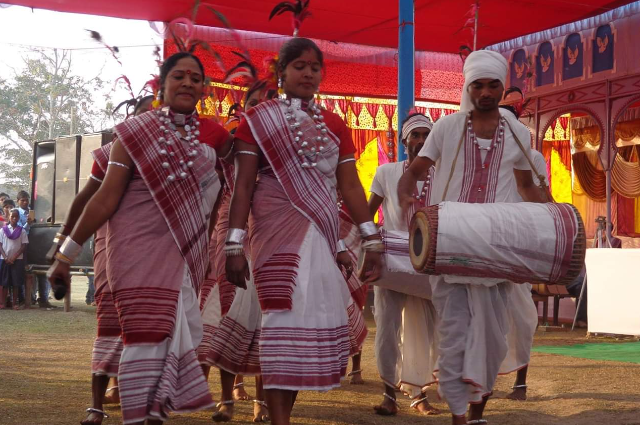
When we talk about gender equality today, it often feels like a modern struggle—something born out of city classrooms, policy documents, and social media debates. We imagine the past as rigid, unequal, and unkind to women. But history has its quiet rebels. Some stories survived not through books or monuments, but through memory and ritual. One such story lives among the Oraon (Kurukh) tribe of India, hidden in forested villages across Jharkhand, Odisha, and Chhattisgarh. It is carried forward through a rare and powerful tradition known as Mukka Sendra, also called Jani Shikar—a festival that does not merely celebrate women, but places power directly in their hands.
Mukka Sendra is not an annual celebration. It does not come every year with drums and decorations. It arrives only once every twelve years, following a cycle similar to the Mahakumbh Mela. This long gap gives the ritual a sense of gravity. It is not meant to be routine. It is meant to be remembered. When the time comes, the entire village prepares—not for entertainment, but for remembrance of a moment when women became the shield of their people.
The roots of Mukka Sendra go back nearly five hundred years, to a dramatic and painful chapter in history at Rohtasgarh Fort, located in what is now Bihar. According to oral tradition, which remains the strongest form of history among the Oraon people, enemy forces—believed to be Mughal or Turk invaders—planned a surprise attack on the Oraon community. The timing was cruelly calculated. The attack was planned for the morning after Sarhul, the spring festival, knowing that the men of the community would be deeply asleep after a night of celebration, dancing, and drinking hadia, the traditional rice beer.
As expected, when dawn arrived, the men were in no condition to fight. The fort was vulnerable. Defeat seemed inevitable. But history did not move the way the invaders expected it to. In that moment of crisis, when surrender would have been the easier path, three women stepped forward—Princess Sinagi Dai, Kaili Dai, and Champa Dai. They did not wait for orders. They did not see themselves as secondary. They saw danger, and they responded.
These women gathered the village women and made a bold, intelligent decision. They dressed them in men’s clothes, tied turbans around their heads, and armed them with bows, arrows, spears, and traditional weapons. They placed them along the walls of Rohtasgarh Fort. From a distance, the fort appeared fully guarded. Thousands of “soldiers” stood alert. The invaders hesitated. And then the fighting began.
What followed became legend. The women fought with such determination that the invaders were repelled three times. Each attack was pushed back. Each time, the women held their ground. It was only during the third battle that the truth was discovered. A spy noticed something small but telling—the way the warriors washed their faces in the river, the way they rubbed their foreheads, movements culturally associated with women. The disguise was revealed. Eventually, the invaders overpowered the fort. Rohtasgarh fell. But something far more powerful survived—the memory of women who refused to surrender.
The Oraon people chose not to let this story fade. Instead, they transformed it into a living ritual—Mukka Sendra, a tribute to women’s courage and leadership. When the twelve-year cycle arrives, the ritual is performed with deep discipline and respect. On this day, women take complete control of the village. They dress in men’s clothing—earlier the traditional karea, and in modern times often shirts, trousers, and caps. They carry weapons as symbols of authority and responsibility.
One of the most striking aspects of Mukka Sendra is the strict exclusion of men. By tradition, men are not allowed to participate in the hunt or even eat the final feast prepared from the “catch.” They stay at home, performing domestic roles, while women move freely from village to village. This is not done to humiliate men, but to reverse roles deliberately—so the community remembers that leadership is not gender-bound.
The hunt itself is not random or chaotic. It follows a relay system. Women from one village march to the next. The host village must welcome them respectfully, wash their feet, and offer them a feast. After this, the women of the host village take up the weapons and march forward to the next village. This relay continues, creating unity and shared responsibility among women across villages. Traditionally, they hunted small livestock such as goats, pigs, and hens. In modern times, to protect wildlife and maintain peace, villages often set aside specific animals so the hunt remains symbolic rather than violent.
One of the most emotionally powerful elements of this tradition lies in a small but deeply meaningful symbol—the three dots on the forehead. During the final battle at Rohtasgarh, when some women were captured, the invaders branded their foreheads with three dots in a straight line to mark them as rebels. What was meant to be a mark of shame became something else entirely. The Oraon women reclaimed it. They turned it into a symbol of honor. Even today, many Oraon women wear these three dots as traditional tattoos, commemorating the three battles their ancestors fought bravely at Rohtasgarh.
Mukka Sendra teaches us something rare and essential. Gender equality is not always a modern invention. Sometimes, it is an ancient truth that survived despite history trying to erase it. The Oraon tribe shows us that women were not always waiting to be empowered—sometimes, they already were. Their story reminds us that courage does not belong to one gender, and leadership rises wherever responsibility is taken. In remembering Mukka Sendra, we are not just learning about the past—we are being quietly invited to rethink the present.
REFERENCE:
- Kurukh (Oraon) people https://en.wikipedia.org
- History & Root of the Tradition https://www.adivasilivesmatter.com
- Traditional Practice & Hunting Ritual https://www.scribd.com
- https://en.gaonconnection.com
- https://timesofindia.indiatimes.com