
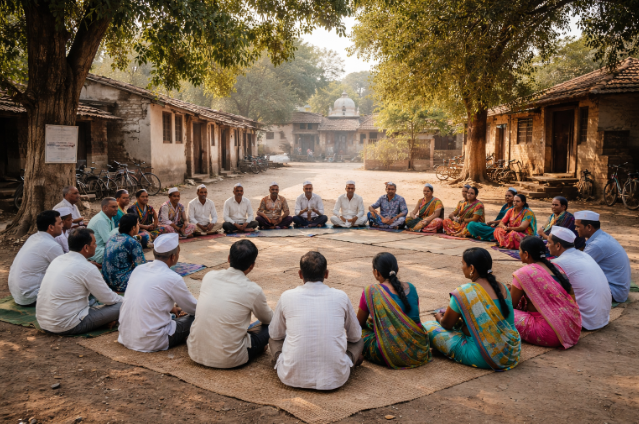
It almost sounds like one of those stories your grandparents tell you and you half-believe it, half-dismiss it as nostalgia. A village with no police cases since 1990. No FIRs. No long court battles. No endless trips to the police station. And yet, Hiware Bazar, a small village in Maharashtra, quietly exists with exactly that reality. In a country where even a small land disagreement can turn into a legal nightmare lasting generations, this feels unreal. But maybe that’s exactly why it matters.
To understand why Hiware Bazar is different, you have to first understand what it was before. In the 1980s, the village was not peaceful or idealistic. It was struggling. Alcohol addiction was common. Drunken fights would break out regularly, often over small issues that quickly escalated. Money disputes, land boundaries, family matters, ego clashes—everything found its way into violence. Crime was not some rare incident; it was a part of daily life. People didn’t trust each other, and fear quietly lived in the lanes of the village. This wasn’t a place you’d look at and imagine becoming a model of harmony.
The turning point didn’t come from outside intervention or some sudden miracle. It came from leadership and collective decision-making. Under new village leadership, especially with the influence of strong local governance, the community decided to take control of its own problems instead of outsourcing them to the police and courts. This is where the idea of the “Tantamukti Samiti” came into existence. The name itself roughly means a committee that ensures freedom from disputes. The idea was simple but bold: disputes should be resolved within the village, openly, honestly, and collectively.
The rule they made was strict and non-negotiable. If two people in the village had a dispute—whether it was about land, money, family matters, or personal conflict—they were not allowed to go directly to the police station. Instead, they had to present their issue before the Gram Sabha, the village assembly. At first glance, this sounds controlling, even risky. In a legal system where individual rights are emphasized, forcing people to avoid formal law enforcement might feel wrong. But the way this system functioned made all the difference.
When a dispute was brought before the Gram Sabha, it wasn’t handled behind closed doors. There were no secret meetings, no lawyers twisting words, no paperwork designed to confuse people. Both parties stood in front of elders, respected members of the village, and sometimes even the entire community. They told their side of the story openly. Everyone listened. People who had known both individuals for years—sometimes since childhood—were present. Lies became difficult. Not impossible, but difficult. You can manipulate a system when it doesn’t know you. It’s much harder to manipulate people who know your habits, your history, your family, and your patterns.
This is where the psychology of the system becomes important. In a courtroom, truth often competes with technicalities. You can delay hearings. You can afford a better lawyer. You can lie and hope evidence doesn’t surface. In Hiware Bazar’s system, social accountability replaced legal fear. The shame of being dishonest in front of your own people acted as a powerful deterrent. No one wanted to be known as the person who lied to the entire village. No one wanted to lose social respect.
That pressure, which might sound harsh, actually worked as a form of moral regulation. Decisions weren’t rushed, but they also weren’t dragged on endlessly. Elders listened carefully, asked questions, and tried to understand not just who was legally right, but what solution would restore peace. The goal wasn’t punishment; it was resolution. The focus was on ending hostility, not winning an argument. Compromises were encouraged. Apologies mattered. Sometimes the verdict wasn’t perfectly fair in a legal sense, but it was acceptable enough for both sides to move on. And that mattered more than technical justice.
One of the most overlooked impacts of this system is how much money it saved the villagers. Legal battles in India are expensive, not just financially but emotionally. Lawyer fees, repeated travel to courts, bribes, lost workdays, mental stress—it adds up. For rural families, one court case can drain years of savings. Hiware Bazar avoided this trap almost entirely. Disputes that might have taken years in court were resolved in minutes or hours. Families didn’t become enemies for generations. Children didn’t grow up watching their parents fight cases endlessly. Life moved forward.
But this system didn’t work in isolation. It was supported by other reforms in the village. Alcohol prohibition played a huge role. When alcohol was removed from the village’s daily life, violence naturally reduced. Many disputes that once escalated due to intoxication simply stopped happening. With clearer minds, people were more willing to talk, listen, and settle differences. Development work, water conservation, employment opportunities—all of these created stability. When people feel secure about their livelihoods, they are less likely to fight over small things.
It’s tempting to romanticize Hiware Bazar and present it as a perfect village with no conflict. That would be dishonest. Conflicts still happen. People still disagree. Human nature doesn’t disappear just because a system changes. The difference is in how those conflicts are handled. Instead of turning every disagreement into a legal war, the village treats conflict as a shared problem that needs a shared solution. That mindset changes everything.
Of course, this model isn’t flawless or universally applicable. It works largely because Hiware Bazar is a close-knit community with strong social bonds and trust in leadership. In larger, more anonymous urban settings, this kind of social pressure could easily turn into mob justice or bias. There is also the risk of powerful voices dominating weaker ones. That’s why such systems require ethical leadership, transparency, and constant self-correction. Without those, they can fail badly.
Still, the story of Hiware Bazar forces us to ask uncomfortable questions about our own systems. Why do we immediately turn to police and courts for issues that could be solved through dialogue? Why has justice become so distant, expensive, and slow? Why do we trust strangers in black coats more than our own communities? Hiware Bazar doesn’t claim to replace the law of the land. It simply shows that not every conflict needs to reach the state to be resolved.
In a time when India’s courts are overburdened and police stations are stretched thin, this village quietly shows an alternative. Not a perfect one, not a magical one, but a human one. A system built on accountability, familiarity, and the simple idea that living together means taking responsibility for each other. Hiware Bazar didn’t eliminate crime through fear of punishment. It reduced it by rebuilding trust.
Maybe the most powerful lesson from this village is not about law or governance, but about community. About what happens when people stop seeing each other as opponents waiting to file cases, and start seeing each other as neighbors who have to continue living side by side long after a dispute ends. In a world obsessed with winning, Hiware Bazar chose peace. And for over three decades, that choice seems to have held.
. . .
Reference