
Some deaths are called accidents because that word feels easy. It sounds like bad luck, like something no one could have stopped. But what happened to Yuvraj Mehta, a 27-year-old software engineer, on the night of January 16–17, 2026, was not bad luck. It was not sudden. And it was not unavoidable. It was the result of long-term neglect and a system that failed at every step.
Yuvraj was driving through Sector 150, Noida, an area known for luxury apartments and large construction projects. Roads here were planned to handle fast-moving traffic, sharp turns, and heavy vehicles. One such spot had a dangerous ninety-degree turn. The architects and planners knew this turn was risky. That is why, when the road was originally designed, a solid boundary wall was placed there.
That wall was not decorative. It was not optional. It existed for one clear reason: to stop vehicles from going straight at the turn and falling into the construction area below. It was meant to act as a final physical barrier, a last line of defence if a driver misjudged the turn, especially at night or in bad weather. In simple terms, the wall was there to save lives.
But nearly four months before Yuvraj’s death, that wall was broken in a previous accident. And after it broke, it was never properly rebuilt. People living nearby knew this spot was dangerous. They complained many times. They wrote emails. They made phone calls. They warned that cars could drive straight into the construction pit if the wall was not fixed. But nothing happened. The Noida Authority blamed the builders. The builders blamed the authority. While files were moved from one office to another, the wall stayed broken.
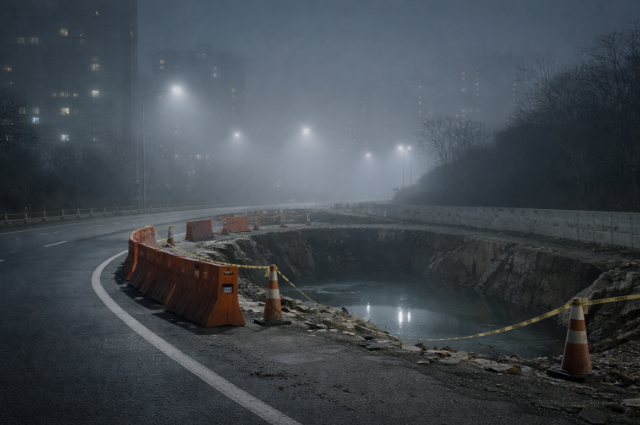
Instead of rebuilding the wall, plastic orange barricades were placed near the gap. On paper, this looked like a safety measure. In reality, it was useless. During winter nights, thick fog covers the road. In that fog, the barricades were almost impossible to see. There were no clear warning signs, no lights, and no solid barrier.
On that night, Yuvraj drove straight ahead, believing the road continued. His car fell into a 20-foot-deep, water-filled construction pit.
What makes this case especially painful is that Yuvraj did not die immediately. The car did not sink right away. He survived the fall and managed to climb onto the roof of the car. The water was extremely cold. It was dark, foggy, and silent except for his voice.
Yuvraj called his father. His father rushed to the spot and reached it while his son was still alive. He saw Yuvraj standing on the car roof, trapped inside the pit. For nearly 90 minutes, Yuvraj
fought to stay alive. He kept shouting for help. To make himself visible in the fog, he switched on his phone torch and waved it. He kept saying the water was freezing.
People could hear him. People could see the light.
Police and fire brigade teams arrived at the location. Their arrival should have meant rescue. Instead, it became another failure. They had no rescue boat. No life jackets. No long ropes. No proper equipment for a water rescue.
Some officers refused to jump into the pit. They said they did not know how to swim. Others said they were scared of electric wires or iron rods under the water. While they discussed risks and waited, Yuvraj continued to suffer in the freezing water.
Instead of acting quickly, the decision was made to call the National Disaster Response Force (NDRF). The NDRF team was not nearby. They had to come from another city. Time passed. Yuvraj’s body grew weaker. His voice slowly faded. Around 2:15 AM, the phone light went off. The shouting stopped. Yuvraj slipped into the water and drowned, likely due to hypothermia and exhaustion. By the time the NDRF arrived, it was too late.
This was not an accident. Accidents do not involve months of ignored complaints and fake safety arrangements. Accidents do not involve a man staying alive for ninety minutes while help stands nearby but does nothing. This was a clear case of system failure.
The situation became even more disturbing after Yuvraj’s death. A delivery agent named Moninder, a gig worker, jumped into the pit to help when trained officers refused to do so. Later, when Moninder spoke to the media and said that the police did nothing, he was allegedly pressured by the police to change his statement. He was made to record a video praising the police response. Later, he admitted that the video was scripted and recorded under pressure.
Instead of accepting responsibility, the focus shifted to protecting the image of the authorities. Public anger grew across the country. Protests, media reports, and social media pressure forced action. The CEO of the Noida Authority was removed from his post. Several engineers were suspended. The builder involved in the construction was arrested, and an FIR was registered for culpable homicide.
These actions looked strong, but they came after the damage was already done. They came after a young man had died slowly, in front of his own father, in an open pit that should never have existed in the first place.
Yuvraj Mehta did not die because of fog. He did not die because he made a mistake. He died because safety was treated as optional, and responsibility was passed from one office to another. He died because warning signs were ignored and proper safety was replaced with cheap solutions. He died because emergency teams were not prepared for an emergency.
Sector 150 is advertised as a symbol of development and progress. But development means nothing if basic safety is missing. Tall buildings and wide roads do not make a city modern. A city is modern only when human life is valued more than paperwork and blame games.
This case raises uncomfortable questions. Why was the wall not fixed when people complained? Why were emergency responders sent without basic rescue equipment? Why does action always happen only after someone dies?
Remembering Yuvraj Mehta should not end with news reports or social media posts. If broken walls remain unfixed, if plastic barricades continue to replace real safety, and if rescue teams remain unprepared, then this tragedy will repeat itself.
The most painful part of this story is not just that Yuvraj died. It is that he stayed alive long enough to hope. He stayed alive long enough to call his father. He stayed alive long enough to believe someone would save him. That night, the system did not just fail him. It watched him die.
Reference:
- https://www.ndtv.com
- https://timesofindia.indiatimes.com
- https://www.thehindu.com
- https://www.indiatoday.in
- https://timesofindia.indiatimes.com
- https://www.news18.com