
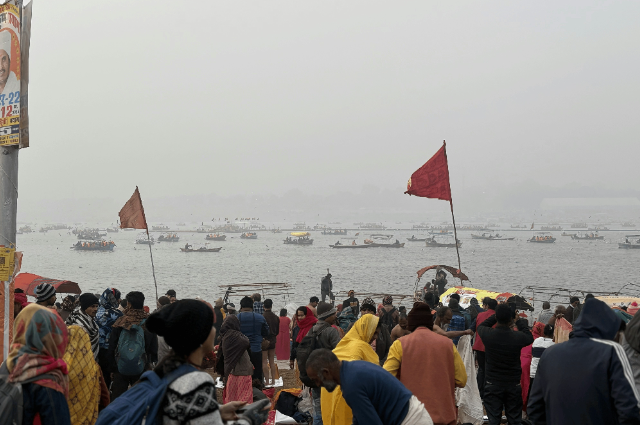
Every year, during the Magh Mela at Prayagraj, lakhs, sometimes millions of devotees arrive with one shared intention: to take a holy dip at the Sangam and feel spiritually renewed. For most people, it’s a peaceful journey of faith. But in January 2026, what should have been just another sacred bathing day turned into a national controversy, one that mixed religion, law, administration, politics, and public emotion into a single explosive moment.
It all began on Mauni Amavasya, considered the most auspicious and also the most crowded day of the entire Magh Mela. This is the day when devotees believe that bathing at the confluence of rivers washes away sins and brings spiritual liberation. Naturally, crowd pressure is at its peak, and authorities operate under maximum alert.
On that morning, Swami Avimukteshwaranand Saraswati, who publicly presents himself as the Shankaracharya of Jyotirmath, began moving toward the river with his followers in a traditional procession. For his supporters, this was not a political act or a show of power; it was simply a religious ritual, something that saints and spiritual leaders have done for centuries. But near a pontoon bridge, the procession was stopped by police and Mela officials.
The administration said their reasons were purely practical: The area ahead was already dangerously overcrowded. Allowing another large group to pass could increase the risk of a stampede. Processions without prior coordination disrupt crowd-flow plans.
Their primary responsibility was public safety.
From the government’s perspective, this was routine crowd control on one of the busiest days of the festival. But from the Swami’s side, it felt like humiliation. At that moment, a halted procession on a packed bridge became the spark. What followed made the situation much bigger than anyone expected.
A few days later, on 20 January 2026, the Magh Mela administration issued a formal notice to Swami Avimukteshwaranand. The notice asked him to explain why he was using the title “Shankaracharya” at public events, given that a dispute over this designation has been pending before the Supreme Court of India since 2022.
In simple terms, according to authorities, his claim to the Shankaracharya title has not been legally settled yet. So when he appears officially as “Shankaracharya of Jyotirmath,” it creates complications, especially at government-managed events like the Magh Mela.
From an administrative viewpoint, this was about legal clarity and protocol. From a devotee’s viewpoint, it felt like questioning a spiritual identity. That difference in perspective is where everything started to unravel.
Swami Avimukteshwaranand and his followers reacted strongly. They said the stopping of his procession was disrespectful, not just to him personally but to religious tradition itself. Some supporters alleged that devotees were roughly handled by officials. Hurt and angry, the Swami refused to take the holy dip that day. Instead, he began a sit-in protest and announced a fast outside his camp.
He openly criticised the administration, saying that spiritual rituals should not require bureaucratic permission. For him, this wasn’t merely about movement restrictions; it was about dignity, faith, and autonomy of religious practice.
And that’s when emotions took over.
What could have remained a localised disagreement between a religious group and festival authorities suddenly found its way onto news channels and social media. Clips circulated. Statements were shared. Supporters expressed outrage. Hashtags started trending.
Soon, political leaders entered the scene.
Some defended the administration, saying rules exist for a reason and that crowd safety during massive gatherings cannot be compromised, no matter who the individual is. Others accused officials of insulting a Hindu religious figure and hurting public sentiment. Each side framed the incident differently, and before long, it stopped looking like a crowd-management issue and began appearing like a cultural confrontation.
This political framing amplified everything.
People who had nothing to do with the Mela started forming opinions. For some, it became a story of state power versus spiritual authority. For others, it was proof that law and order must apply equally to everyone. The narrative split along emotional and ideological lines. And that’s why this incident grew so large. Because it wasn’t just about one saint being stopped on a bridge. It wasn’t just about one holy dip that didn’t happen. It touched multiple sensitive layers at once.
First, religious authority. The title “Shankaracharya” carries immense spiritual weight in Hindu society. Any challenge to it feels deeply personal to believers. Second, legal ambiguity. Since the matter of the title is already before the Supreme Court, administrators felt obligated to act cautiously. Third, administration versus tradition. Officials emphasised safety protocols, while followers saw interference in sacred practice. Fourth, political narrative. Once leaders weighed in, the issue expanded beyond Prayagraj and entered national debate. And finally, public sentiment. Devotees felt something sacred had been denied. Many ordinary people related emotionally rather than legally.
At its core, this controversy shows how fragile the balance is between faith and governance in a country like India. Religious gatherings of this scale require strict management to prevent tragedy. At the same time, spiritual leaders and devotees expect respect for age-old traditions.
When those two worlds collide, especially in front of cameras, the outcome is rarely calm.
The Magh Mela incident is a reminder that in spaces where belief runs deep and crowds run large, even small administrative decisions can carry massive symbolic meaning. A barricade becomes a statement. A notice becomes an insult. A safety measure becomes a question of dignity.
And once politics steps in, the original issue often gets buried under louder arguments.
What remains is a divided public, some standing with law and order, others standing with faith, both convinced they are protecting something important.
In the end, this wasn’t merely a festival controversy. It was a mirror reflecting India’s complex relationship with religion, authority, and emotion, all unfolding on a crowded bridge beside sacred waters.
Reference :
- https://www.newindianexpress.com
- https://www.republicworld.com
- https://www.newindianexpress.com
- https://hinduexistence.org
- https://ianslive.in
- https://hindi.oneindia.com
- https://www.newindianexpress.com