
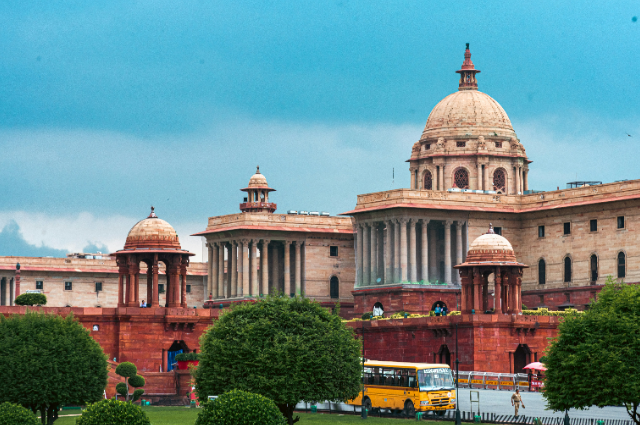
At first glance, the numbers attached to Bihar Bhawan sound impressive: 178 rooms and 240 beds right in the heart of New Delhi. For many people, this immediately raises a question that feels both practical and political: Who exactly is Bihar Bhawan meant for? Is it a luxury rest house for politicians, a necessity for administration, or a public facility that indirectly serves ordinary citizens of Bihar?
Bihar Bhawan was created primarily as an official state guest house, not a hotel and not a public lodge. Its core purpose is to support Bihar’s governance machinery when it operates away from the state. Every day, Bihar’s administration interacts with the Central Government ministries, courts, commissions, parliamentary committees, and national institutions, all of which are based in Delhi. For this reason, the Bhawan acts as a functional base for Bihar in the national capital.
The largest group of users is elected representatives and government officials. This includes Members of Parliament from Bihar, Members of the Legislative Assembly and Council when they are on official visits, ministers, senior bureaucrats, police officers, and technical experts attending meetings or negotiations. These officials often stay for short but intense visits
involving policy discussions, budget approvals, legal hearings, or crisis coordination. The availability of rooms within a controlled, secure environment allows them to work efficiently without depending on expensive private hotels.
Another important group is visiting delegations and experts. When Bihar hosts or participates in national-level discussions on infrastructure, disaster management, education reforms, health projects, or investment proposals, experts and officials from other states or central bodies may stay at Bihar Bhawan. In this sense, the Bhawan becomes a diplomatic and administrative space, where policy ideas are exchanged, and decisions affecting millions of people are shaped.
Bihar Bhawan also plays a quieter but significant role for Bihar’s citizens who interact with the state through official channels. Families of officials on long postings, retired officers attending hearings, or representatives of state-backed institutions sometimes use the facility with proper
authorisation. While it is not open to the general public like a hotel, it indirectly benefits common people by ensuring that officials handling public welfare schemes, legal cases, or development projects have a stable and cost-effective base in Delhi.
The number 240 beds for 178 rooms is not accidental. It reflects the reality that many visits involve shared occupancy, support staff, or short-term stays rather than luxury single-room use. Compared to recurring hotel expenses in Delhi, maintaining Bihar Bhawan is often more economical in the long run. It centralises logistics, reduces dependency on private accommodation, and ensures accountability in spending public funds.
Critics often argue that such Bhawans symbolise political privilege. That criticism is not entirely baseless, especially if transparency and fair usage are not maintained. However, in principle, Bihar Bhawan is less about comfort and more about administrative continuity. Without such infrastructure, officials would either rely on costly hotels or struggle with coordination in a city where space and security are constant challenges.
So, who is Bihar Bhawan really for? On paper and for purpose, it is for governance for elected leaders, administrators, and institutions that represent Bihar at the national level. But in effect, it is also for the people of Bihar, because smoother administration, better coordination, and reduced operational costs ultimately reflect in governance outcomes. The building may house officials, but the decisions taken within its walls travel far beyond its rooms, reaching villages, towns, and cities across Bihar.
In that sense, Bihar Bhawan is not just a structure with 178 rooms and 240 beds. It is Bihar’s permanent address in the capital of India, quietly shaping policy, negotiation, and representation every single day.
Reference links: