
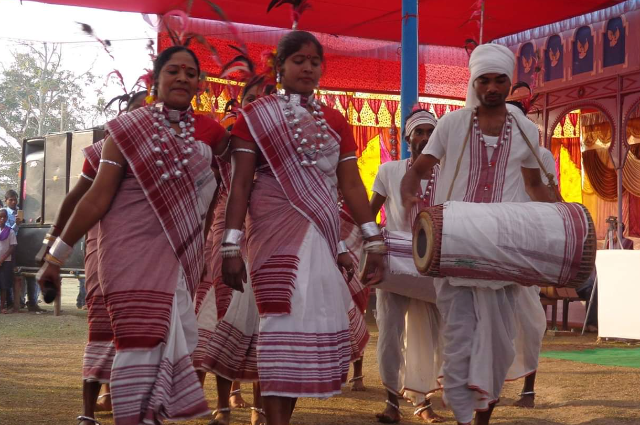
Every twelve years, something quietly radical happens in parts of eastern India. In villages that rarely make it to news debates or glossy documentaries, women step out of their homes dressed as men. They wear dhotis, shirts, and sometimes even trousers now. They carry bows, arrows, and spears. They walk together, not as spectators, not as support, but as the centre of the ritual. This practice is called Shikār Jānī. To an outsider, it may look like a costume change or a festival act. But if you sit with the story long enough, you realise it is not about clothes at all. It is about memory, power, and the refusal to forget what women once did when survival depended on them.
In most mainstream narratives, tribal women are shown as victims of poverty, of displacement, of patriarchy, of the state. Rarely are they shown as warriors, protectors, or decision-makers. Shikār Jānī disrupts that image completely. It belongs mainly to Adivasi communities like the Oraon (Kurukh), and is also remembered among Munda, Santhal, Ho and Kharia tribes across Jharkhand, Chhattisgarh, Odisha and parts of Bihar. It is observed once in twelve years, usually in the spring months. The long gap itself matters. This is not a yearly performance meant for attention. It is a reminder that is allowed to rest, and then return with force.
During Shikār Jānī, women gather at the village akhra, the sacred communal space. The village priest blesses them, just like hunters are blessed before a hunt. They then move out together to hunt animals that are already marked or set aside goats, hens, and ducks. When they return, they are welcomed with songs, garlands, and celebration. There is feasting, dancing, and joy. On the surface, it looks like a role reversal. But reducing it to that would be a mistake. This is not a playful switching of gender roles. This is remembrance.
The roots of Shikār Jānī lie in an oral history that goes back to the early 1600s, around the region of Rohtasgarh Fort. According to tribal folklore passed down through songs and stories, an invading army planned to attack Adivasi villages during the festival of Sarhul. The attackers assumed the men would be drunk on haria, the traditional rice beer, and therefore incapable of fighting. They underestimated the women. With the men unable to rise, the women dressed like them, picked up weapons, and went out to defend their land. They were led by figures remembered as Singi Dai, Champai Dai and Kaili Dai. These names do not appear in school textbooks. But they live on in collective memory.
The women fought not once, but twice. Some versions of the story say they were eventually defeated, others say they managed to push the attackers back long enough to save their people. What remains consistent across versions is courage. The branding or marking that some women received, meant to humiliate them, later became symbols of pride. What was supposed to erase them ended up defining them. Over time, those marks even turned into tattoo motifs worn proudly by later generations. History, here, is not written by victors. It is carried by voices.
This is where Shikār Jānī becomes deeply uncomfortable for modern ideas of feminism and patriarchy alike. It does not ask for equality in theory. It shows equality in action, centuries ago. Long before feminist language entered academic spaces, these women stepped into necessary roles, not symbolic. They did not debate whether women could fight. They simply fought. The festival does not say “women can also do what men do.” It says women already have.
The act of dressing as men, then, is not about pretending to be male. It is about recalling a moment when gender boundaries collapsed under pressure. When survival mattered more than roles. When clothes became armour, not identity. The fact that this ritual is allowed to happen only once in twelve years makes it even more powerful. It prevents dilution. It prevents forgetting, but also prevents spectacle. It stays grounded within the community.
In today’s context, Shikār Jānī feels almost political, even though it predates modern politics. At a time when indigenous women are fighting displacement, mining, loss of land, and violence, this ritual quietly reminds everyone that these women are not new to resistance. They have defended land before. They have led before. They remember how.
What is striking is how little this history is discussed outside tribal spaces. We celebrate queens and warriors when they fit royal narratives. But Adivasi women warriors rarely enter popular imagination. Their resistance was not for thrones or empires. It was for forests, fields, children, and the community. That kind of bravery is harder to package, harder to glorify, and easier to ignore.
Shikār Jānī also challenges the idea that empowerment must always look modern. Here, empowerment looks traditional. It looks rooted. It does not reject culture to find freedom; it uses culture as its strength. Even today, while the weapons may be symbolic and the clothes may include jeans and shirts, the meaning remains unchanged. The women lead. The village follows.
There is something deeply grounding about a tradition that does not need validation from outside. Shikār Jānī does not ask to be understood by the urban gaze. It simply exists. It reminds us that history lives not only in archives but in rituals, songs, and bodies that remember.
In a world that often asks women to prove their strength again and again, this ritual says something quietly radical: we have already proven it. We are just reminding you.
References: