
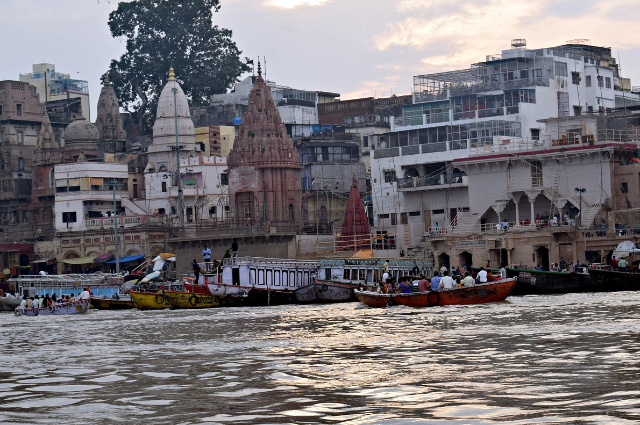
Death is not covered by hospital curtains and discussed in whispers in the fear of being caught, in the old city of Varanasi, when the fires burn throughout the day and night in the ghats of the Ganges. It is concrete, ritualised and mystical. Some of the most captivating establishments in the city are a few guesthouses commonly known as death hotels because individuals do not come to rest, recuperate, or enjoy their time in the institutions, but to die.
Among the most famous ones is Kashi Labh Mukti Bhawan, a small structure located on the outskirts of the riverfront commotion. Its rooms are sparse. There is no luxury, no indulging, and no hope of a medical recovery. Rather, there is a one-purpose based on centuries-old Hindu faith: to die in Kashi is to be full of moksha, the release from rebirth.
This policy brief analyses a phenomenon usually known as the so-called death hotels of Varanasi, religious guesthouses like Kashi Labh Mukti Bhawan, in which terminally ill people are sent with the express aim of dying in the holy city. These institutions are all based on the Hindu thought that one dies in Kashi, which results in moksha, and thus, the rules of admission to these institutions are strict, such as time constraints. The spaces analysed by this brief interpret them as cultural governance, ethical end-of-life governance, and non-state regulation of death with an understanding of how belief systems can inform social institutions (Parry, 1994; Alter, 2018).
Death and Sacred Geography in Hinduism
The city of Varanasi holds a special place in the Hindu cosmology since it is a city where death is transformed spiritually. Religion holds that death in Kashi causes rebirth to cease and then provides liberation from samsara. This is what has created a rich ecology of rituals, institutions and spaces devoted to working with death. Varanasi, unlike the biomedical models, which have focused on life extension, institutions that include acceptance of mortality as a spiritual goal (Parry, 1994).
Institutional Overview: The Death Hotel Model
These centres, like Kashi Labh Mukti Bhawan, are neither hospitals nor typical guesthouses. Only elderly/terminally ill people can be admitted, and usually, medical certification is necessary. The usual allowance is two weeks for the residents. Provided that death does not happen within the period, it is asked that the families should leave to give place to others standing in the queue of admission. Such a system captures a state of scarcity, predetermined prioritisation by perception, and non-market resources logic (Alter, 2018).
Life Inside a Death Hotel
The atmosphere in the interior is all astonishingly quiet. Rooms are quiet. Families recite prayers, read sacred scriptures and do little rites. There is no sense of panic. Relief on a lot of occasions is entertained, even welcomed. Others come with years of preparation towards this time.
Daily needs are met, spiritual comfort is given by volunteers and caretakers and dignity is obviously maintained. Physicians can also come and verify conditions, but there is no artificial life support. It should not be survival, but preparation.
No silence accompanies death. Bells may ring. Mantras are recited. The corpse is hurriedly ready to be cremated at the ghats. In this respect, death does not constitute a medical failure, but the consummation of faith.
Kashi Labh Mukti Bhawan
Kashi Labh Mukti Bhawan is one of the brightest death guessthouses at Varanasi. It is run by charitable trusts, which offer little accommodation, spiritual care, and closeness to cremation sites. Healing is palliative and spiritual as opposed to curative. Time limits are not imposed as punishment but as a control mechanism by the institution to have fair access to a resource that is culturally limited, such as a death in Kashi.
Why Dying in Kashi Matters
Varanasi is not only a city according to Hindu cosmology, but it is also a gateway between the worlds. Some say that a dying person here is whispered the taraka mantra in the ears of Lord Shiva, and thus they are relieved of samsara. To the active Hindus, death in Kashi is not a dead end but a spiritual goal.
This ideology has influenced the social structure of the city in a manner that is hardly observable in the rest of the world. As contemporary societies erect hospitals to postpone the event of death, Varanasi has created places where death is invited.
There are death hotels, such as Kashi Labh Mukti Bhawan, that exist to benefit the people who believe that their last breath taken in this city has a cosmic meaning.
Ethical Analysis: Autonomy, Dignity, and Time-Limited Death
According to the policy ethics, the limitation of time to dying raises ambiguous questions. Nevertheless, in such a cultural setting, consent is informed and voluntary. Admission to families is not imposed but through conviction. Such institutions celebrate dignity, ritual preparedness and acceptance in place of medicalising indefinitely. Moral authority is the result of cultural correspondence as opposed to biomedical standards (UNESCO, 2005).
The Rule That Makes These Places Extraordinary
The guesthouses are not just differentiated by their purpose, but also by their regulations.
Strict control is maintained over admission. An individual will not find it possible to check in unless they are an aged individual or terminally ill. Medical certificates are very much needed. Upon admission, the residents get an average of two weeks to die.
In case the death does not occur within that period, the family is given a friendly yet firm request to take off.
Outsiders might find this rule cruel; however, this rule is a painful truth. Demand far exceeds capacity. Waiting lists are long. To every bed that is occupied by a lingering person, someone else who is thought to be nearer to being free has to wait.
The policy is not influenced by inhumanity, but by paucity and faith. They are not therapy centres; they are transitional centres.
Cultural Governance and Non-State Regulation
Death hotels are types of cultural governance whereby standards, faith, and social trust govern human behaviour without the intervention of state law. Addressing scarcity is best done under moral legitimacy and not legal authority. This model proves to be important as it shows how communities develop ethical systems that guide them in matters of managing the end of life in very different ways than state-managed health systems.
Policy Implications
The Varanasi model provides policy implications for policymakers in palliative care, cultural governance, and pluralistic ethics. It highlights the issue of culturally specific end-of-life institutions as opposed to homogenised standards on biomedical practices. Belief-based models of acceptance and transition have to be considered in policy frameworks dealing with ageing, end-of-life care, and dignity in death (World Health Organisation, 2014).
What These Places Teach the World
The presence of death hotels provokes serious and not-so-comfortable questions.
- Is death supposed to be fought on all occasions?
- Is it possible to accept and, at the same time, be dignified?
- Is fear of death universal or culturally taught?
Another solution is Varanasi. Here, death is not hidden away. It is not totally delegated to machines and institutions. It is recognised as unavoidable and influenced by faith.
Although these spaces can probably never be found outside of this cultural context, they compel an investigation into the way that societies approach end-of-life treatment.
The so-called death hotels of Varanasi are not pathological exceptions but management of death ordered by faith, rituals and agreement. With societies struggling with issues of ageing and end-of-life ethics, these institutions put fundamental beliefs concerning death, dignity and the place of culture in policy to challenge. It is disturbing that even a hotel where people stay to die is heard so that a person will die until one realises the meaning of dying in Kashi. Death in Varanasi does not cancel out, but it is a boundary. Guesthouses such as Kashi Labh Mukti Bhawan do not exist due to the undermining of life but rather provide meaning to death.
These silent buildings are a forceful reminder in a world that is currently obsessed with extending life that some people do not seek more time, but rather emancipation.
References:
- Alter, J. (2018). The Body of Faith: Religion and Medicine in India. New Delhi: Oxford University Press.
- Parry, J. (1994). Death in Banaras. Cambridge: Cambridge University Press.
- UNESCO (2005) Universal Declaration on Bioethics and Human Rights.
- World Health Organisation (2014) Global Atlas of Palliative Care.