
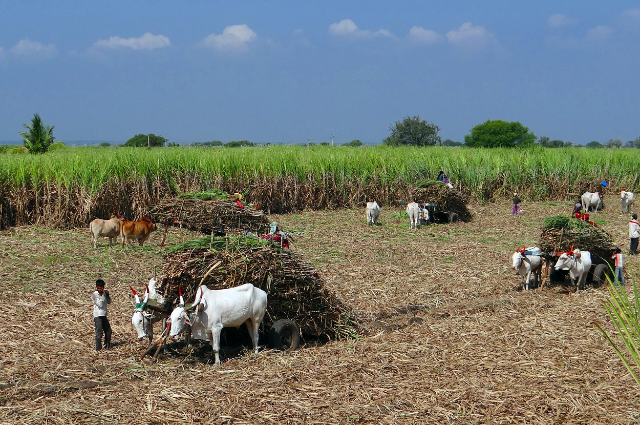
This policy brief takes a longer look at the reasons behind considering sugarcane farming as a social crime in Hiware Bazar, Maharashtra, even though it is legally acceptable according to the laws set by the Indian constitution. The village, which lies in a drought-prone area and relies on common groundwater, has rebranded itself as an agricultural legitimacy based on ecological ethics, unlike codes of law. The sugarcane is a very water-intensive crop that endangers the general water budget and the future sustainability of the aquifer. Democratic governance, which is practised in the form of water budgeting and sanctions that are imposed by the community, ensures that the people of Hiware Bazar put water security ahead of personal profits. The case provides the lessons of a worldwide level in terms of managing common-pool resources, climate adaptation, and sustainable agriculture management in regions with the risk of water shortage (World Bank, 2018). The policy brief examines the reason sugarcane production is not a socially acceptable activity in Hiware Bazar, a region of Maharashtra, yet sugarcane production is legal in the Indian regulations. Sugarcane is regarded as a communal vice in a drought-prone ecosystem, which relies on a common source of water, since it consumes a lot of water. The Gramme Sabha gives water security precedence to individual profit using a village-level water budget and social sanctions, which ensure that the community is resilient to droughts in the long term (Government of Maharashtra, 2017).
When Legality Conflicts with SustainabilitySugarcane is economically desirable to most agrarian areas of India. The subsidies, assured acquisition and political favours have made sugarcane farming grow at an alarming rate in the water-thirsty states. Subversive, however, is the counterexample of the Hiware Bazar. In this case, the sugarcane is to be viewed not as an opportunity but rather as a common threat. This deviation brings out a central policy tension of legality and sustainability. The state determines what is considered to be legal, and the ecological systems determine what is considered to be viable. The case of Hiware Bazar will show how local communities can possess the power over governing bodies again in cases where local ecological boundaries have not been taken into consideration in the state policy.
Ecological Context: Semi-Arid Geography and Hydrological Limits
The rainfall, on the other hand, is very low and extremely fluctuating, and so, Hiware Bazar is situated in the rain-shadow area of Maharashtra. The village in the past relied solely on groundwater to drink and irrigate. Before reforms, extraction was unregulated, and the crops selected were inappropriate, causing severe depletion of aquifers. The continual drought cases led to tankers' reliance, harvest failures and migration of rural distress. This ecological susceptibility is associated with the emerging trends in semi-arid India at large, where the use of groundwater has emerged as a leading factor in the agrarian crisis (Planning Commission of India, 2002).
Sugarcane Economics: Profitability Versus Externalities
Sugarcane has great returns, and they are predictable, and as such, it is a good option for farmers who are in need of income security. Nonetheless, the crop takes between 1,500 and 2500 millimetres of water each year, which is way beyond the water needs of the millets, pulses, or oilseeds. This causes serious negative externalities in systems that are dependent on groundwater. The profit of one farmer directly causes water to be inaccessible to other farmers. In the absence of regulation, these types of dynamics give way to the tragedy of the commons, whereby rational actions on an individual level result in irrational ones on a collective level (World Bank, 2018).
Political Economy of Sugarcane in India
Sugarcane holds a politically dominant value at the state and national levels. Price supports, the existence of sugar cooperatives and mills, give a high level of incentive to keep growing sugar, even where it does not make ecological sense to do so. This political economy usually prevails over hydrological facts, which leads to non-sustainable water utilisation. The oppression of sugarcane in Hiware Bazar is a very isolated example of local opposition to state-sponsored crop regimes.
Institutional Innovation: The Village Water Budget
With the ecological catastrophe looming over them, the City of Hiware Bazar came up with an annual budgetary water system. Before every farming season, the availability of groundwater is estimated, and the crops authorised to be cultivated are agreed collectively by the Gramme Sabha. This turned water into an open-access resource to a controlled common good. Sugarcane was officially declared as incompatible with the water capacity in the village and prohibited by a democratic decision (Government of Maharashtra, 2017).
Sugarcane as a Social Crime
Even though the sugarcane crop is not prohibited by Indian legislation, Hindu Hiware Bazar considers it an anti-social crime against society. Violating the ban results in fines, shaming in public, and a lack of village benefits for the violating farmer. These sanctions are rather corrective, and they are punitive to safeguard collective survival. With ecological reshaping of the concept of crime, the village will focus on long-term sustainability and be short-term gain averse.
Social Sanctions and Behavioural Governance
According to behavioural economics and social psychology, reputational consequences can be more effective than legal penalties. In Hiware Bazar, compliance is established by influencing forces that are generated by social sanctions. The social exclusion factor is more dominant than the temptation of immediate gain, leading to the almost universal compliance with water discipline (Banerjee and Duflo, 2011).
Outcomes: Water Security and Agricultural Stability
The sugarcane ban saved groundwater for drinking and low-water crops, so that there was availability all year round. Even when local drought struck, the region of Hiware Bazar never relied on the tankers. The agricultural yield became stable, and the water security between generations was guaranteed.
Climate Change and Future Water Stress
In semi-arid countries, climate change will lead to more variability in rainfall and more droughts. In this situation, cultivated crops that demand large quantities of water are becoming increasingly dangerous. The strategy of Hiware Bazar is a proactive approach to adaptation that puts resilience as the main priority over maximisation.
Policy Implications and Global Relevance
The model of the Hiware Bazar provides some suggestions to policymakers around the world. Formal regulation can be complemented by decentralised regulations, crop discipline, and social enforcement. Agriculture should be aligned with the ecological limits in long-term sustainability, especially in the regions that are climate-vulnerable (World Bank, 2018).
Redefining Agricultural Crime
The illegalities of growing sugarcane include the fact that it is not illegal in Hiware Bazar, but rather illegitimate. Completely managing to revise the definition of crime in ecological terms, the village shows that, occasionally, sustainability means limiting profitable activities. The case contradicts the prevailing development stories and highlights collective self-discipline in the utilisation of common natural resources.
References:
- Banerjee, A. and Duflo, E. (2011) Poor Economics. New York: PublicAffairs.
- Government of Maharashtra (2017) Hiware Bazar Model Village Development Report.
- Planning Commission of India (2002) Watershed Development and Rural Livelihoods.
- World Bank (2018) Social Norms and Community-Driven Development.