
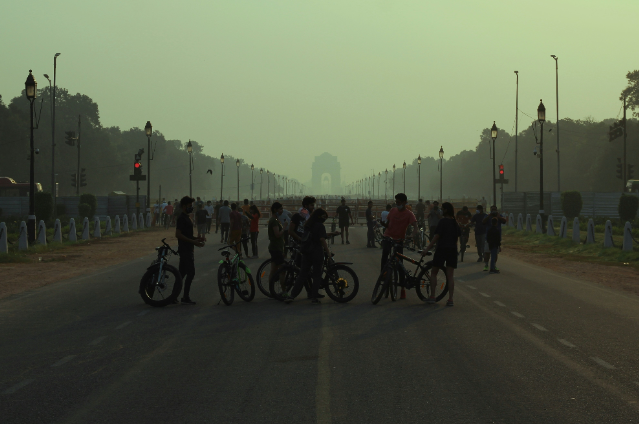
India has been noted to have the most polluted capital city in the world, New Delhi. Being the second largest city in the world with a rapid economic and urban growth, such a drastic environmental issue of poor air-quality endangers the health of the approximately 33 000 000 residents in the city notably. The most common pollutant in the city of New Delhi is fine particulate matter which is estimated to cause approximately 10 000 untimely deaths every year. According to the latest World Health Organization (WHO) database on air quality of the ambient air, New Delhi also has its annual average of 121 µg m -1 of fine particulate matter, which is 2400 times higher than the recommended level of the WHO air-quality in its guideline.
This has been a critical air-pollution problem of New Delhi which has gained the wide attention of scientists worldwide. They include a huge number of short-term intensive measurements and long-term systematic monitoring networks which have been built over the past few years to improve knowledge in air-pollution dynamics and supply mitigation measures as the Central Pollution Control Board (CPCB) and the SAFAR networks. The highest known hourly concentration of fine particulate matter observed by CPCB network measurements in New Delhi during the Diwali Festival among unfavourable stable meteorological environments reached up to 1676 µg m at Ref. answer 70 per cent higher than most direct reading ever recorded in Beijing, China.
The concentrations of particulate-matter that are reported in New Delhi are already disturbing, but they might also be understated. Hygroscopic particulate matter growth may decrease the sampling efficiency and, thus, result in an underestimation of the mass concentration of PM. Hygroscopic growth triggers swelling of particle-size causing a shift of the sampling-inlet cut-off resulting in reduced collection efficiency. Such a bias is natural when it comes to the sampling of particles and is practically universal in the entire world; it vigorously depends on the physical properties of the aerosol to take in water. Bigger hygroscopicity of aerosols leads to bigger underestimation of mass concentration. As an illustration, the concentration of particulate-matter can be underestimated by kind of 40 percent in marine lowlands where highly hygroscopic sea-salt particles dominate, and the underestimation is thought to be less than 5 percent in Cities in Asia where particles are presumed to be less hygroscopic. The last observational studies, however, have demonstrated, at least, the first time, that particulate matter in New Delhi is very hygroscopic and the daily content of water in the associated matter may go up to 740 µg/m 3 and thus falls under significant underestimation of particulate-matter concentration. The hygroscopic growth of the particles, the cut-off shift that follows sampling and the resulting underestimation of the dry PM 1 concentration has been long acknowledged, the magnitude of these phenomena has been determined in Europe, America, Africa, and China. However, a significant gap in air-pollution measurement in India, which happens to be the country hosting the greatest number of people being affected by unhealthy air-pollution, is mainly because of the lack of observations. New Delhi has recently measured, the first long-term in-situ measurements of specific physicochemical property of the particulate matter have allowed the quantification of sampling bias of the observations of the particulate-matter. The following synthesis presents overall findings in a supersite in New Delhi and implements the latest thermodynamic theories to get a more impartial picture of pollution due to particulate-matter pollution in the city.
Air pollution situation in Delhi
Delhi (the National Capital Territory of Delhi) is a territory with a joint governmental accountability of the central and state authorities and has around 167.5 lakh people as per the 2011 Census of India.1 Metropolises all over the world have a high level of environmental pollution and Delhi is the typical example of such metropolises in India. From the research that was funded by World Bank Development Research Group, between the year 1991 and 1994, the effects of air pollution were researched and the results of the research indicated that the average total suspended particulate (TSP) concentration in Delhi was estimated at about five times more than the annual average standard of the World Health Organization (WHO) and TSP had surpassed the standard of 24 hours Provided by WHO on 97 per cent of the surveyed days. The study established that the proportional mortality due to non-traumatic causes of air pollution in Delhi was lower than that in the United States of America, but the cost of air pollution mortality in Delhi was in the form of higher loss of life-years since the deaths were at an earlier age.
In increasing levels of deterioration, a report by the Ministry of Environment and Forests, India, examined the environmental conditions in Delhi in 1997 as another study.2 The report cited air pollution as the key issue in Delhi. It approximated the daily emissions at around 3,000 metric tons of air pollutants with the major emissions of vehicles accounting 67 fame central to coal based thermal power plants accounting 12 fame. The Central Pollution Control Board (CPCB) tomography spotting showed that there was an increase in pollution between 1989 and 1997. The carbon monoxide levels due to vehicular emissions in 1996 were 92 per cent more than the levels in 1989; this is an indication of the growth in the number of vehicles. Lead concentrations of particulate nature seemed to be kept under control, which can be explained by petrol de-leading and the limitation of lead-related industrial facilities. The greatest concentration of small scale industries in India is found in Delhi that generates 12 per cent of the air pollutants in India, among other industry units.
The air pollution in Delhi is a major contributor through vehicle pollution. The Department of Transport, Government of the National Capital Territory of Delhi provides more than the data that the population of vehicles is above 3.4 million and is increasing annually (7⛻1). Although this industry contributes two-third of the air pollution, it is observed that a visible fall compared to the state in 1995-1996 has been noted.
The PM10 standard is widely used to measure air quality. PM10 contains particles that have a diameter of 100.0004 inches (approximately 1/7 th of a human hair). Such small particles are probably the causes of negative health consequences because they can penetrate deep in the lower respiratory path. According to the WHO Air Quality Guideline, the recommended value of PM10 is 20 -3/year, and above this, there is an increase in the risk of cardiopulmonary, lung tissue damage, carcinogenesis and early mortality. The elderly, children, and those with chronic lung disease, influenza, or asthma are the most susceptible to the impacts of the particulate matter. According to the urban air database released by the WHO according to September 2011, Delhi was way over the maximum quantified as 198pm3-1 limit of PM10, it ranked third in terms of air pollution: both indoors and outdoors, due to vehicular traffic and industrial pollution.
Health-based, dynamic triggers
There is substantial research that has been done in Delhi to examine air pollution on the respiratory functioning and the morbidity attributed to it. The analysis, which was the most extensive of these, was conducted by the Central Pollution Control Board in 2008, which found serious correlations with all the corresponding adverse health outcomes. These results were compared to a West Bengal rural control population. It was also discovered that Delhi had a 1.7 folds greater prevalence of respiratory symptoms in the past three months compared to rural controls (P 0.001); odds ratios of upper respiratory symptoms, including the presence of a dry cough, wheeze, breathlessness, and chest discomfort; were 1.59 (95% CI 1.3 2 1.91), 1.67 (95% CI 1.3 -1.93), respectively. Past asthma prevalence (in the past 12 months) and rates of physician-diagnosed asthma among participants in Delhi were also statistically large compared to the situation in the control group. A lower level of lung functioning was found to be the case among the Delhi residents and non-Delhi residents at 40.3 and 20.1 respectively. Delhi showed statistically significant (P 0.05) higher restriction (22.5 vs 11.4 in terms of prevalence) and obstructive (10.7 vs 6.6) and a combination of both (7.1 vs 2.0) lung function losses. There were more reports of metaplasia and dysplasia of airway epithelial cells in Delhi, as well as an increased occurrence of several cytological alterations in sputum. Non-respiratory effects were also bigger in the city of Delhi as compared to rural controls. The occurrence of hypertension was 36 per cent in Delhi and 9.5 per cent controls with a positive correlation with the responsibility of respirable suspended particulate matter (PM10) in the ambient air. It was also reported that the frequency of having chronic headaches, eye irritation, and skin irritation were significantly higher among the Delhi residents.
A number of community-based studies have supported the relation of air pollution and respiratory morbidity. A large number of researchers have noted the results of indoor air pollution on respiratory ailment and a smaller number of researchers have identified the result of respiratory well-being in children specifically. Other studies that concentrate on children have found parallel associations between ambient PM with attention-deficit/hyperactivity disorder as well as between highway air pollution and high blood levels of lead, a potential risk factor to abnormal neurodevelopment and between low levels of serum vitamin D metabolite levels and low values of the mean haze index (a proxy of ultraviolet-B radiation to the ground).
A study of the synergistic influence of weather conditions on air pollution has demonstrated that winter increases the air quality both indoors and outdoors. These studies also found that they had positive relationships between the winter weather and the number of hospitalizations due to chronic obstructive airway disease. There has been a relative lack of literature that has directly measured the level of outdoor air pollutants and subsequently objectively associated them with the negative health outcomes; however, other studies have identified such relationships. An air-pollution time-series study and mortality study in Delhi revealed that all-natural-cause mortality increased with the increase in air pollution. In another study, gaseous pollutants (however, within the allowed parameters) were in agreement with respiratory admissions. In hospital-based research, it was found that there was an increase in emergency department visits on asthma, chronic obstructive airway disease and acute incidents of coronary events accompanied by an increase in air pollutant concentrations.
Poisoned capital: Causes for making Delhi polluted
Air pollution in New Delhi has a complex etiology that is interdependent and, thus, makes the crisis of air quality more acute in the city. These motor emissions, specifically the release of the harmful pollutants of carbon monoxide, nitrogen oxides, volatile organic compounds, and fine particulate matter (PM2.5), are all caused by vehicular emissions to a significant extent, especially the release of the carbon monoxide and the nitrogen oxides. Construction, manufacturing, and power production processes are also the contributors to industrial pollution of the air; the usage of low-quality fuel and inefficient technologies only aggravate the situation. Burning of crops in the neighboring states, Punjab, Haryana, and Uttar Pradesh is also another primary contributor of seasonal pollution as the emission pollutes the atmosphere with smoke and particulate matter. The construction operations triggered by urbanization and the visual dust emissions disorganize the fine particulates matter dynamics whereas the fossil-fuel power production which is mainly caused by coal-fired thermal power plants releases sulfur dioxide and carbon dioxide among other destructive compounds. Depending on the seasonal weather conditions such as temperature inversion and slower wind velocity acting during the winter months, hinder dispersion of pollutants and support the trapping of smog layers. The burning of domestic waste and especially plastic waste and non-biodegradable wastes, which occur outdoors, emits toxic gases, including dioxins and carbon monoxide. In addition, domestic emissions caused by biomass fuels, wood and coal, which are predominant in the low-income areas, contribute to both indoor and outdoor emissions. Sewers and other wastewater treatment plants also release methane and ammonia, thus having an impact on the composition of the atmosphere. Climate change worsens the quality of local air, because it increases temperatures and ozone developed on the ground, whereas transboundary pollution caused by global emissions exacerbates the air quality of Delhi. This means that a holistic mitigation policy requires these diverse sources to be dealt with using very strict rules that govern them, technological advancements, educational campaigns, and regional and international cooperation.
The Global Ramification of the Air Pollution Crisis in Delhi
The air pollution crisis in Delhi especially in November 2025 has worldwide implications that are far reaching beyond the local health effects. Due to motor vehicles, industrial effluents, and burning of crop residues, the city has very high concentrations of PM 2.5, with transboundary effects that produce toxic smog and spread it to the surrounding countries as Pakistan, Bangladesh and Nepal. The pollution increases respiratory and cardiovascular diseases and is an extensive liability to the local healthcare systems, especially in the developing countries. The World Health Organization (WHO) cites annual cases of millions of premature deaths attributed to air pollution, and Delhi is turning out to be a major cause. In addition, the crisis increases the speed with which the world warms up; the emission of black carbon during stubble burning and vehicle emissions increases the greenhouse effect. This increases not only the temperatures in the world but also intensifies extreme weather such as floods and heatwaves thus contributing to climate-driven migration. Since millions of people must leave inhabitable lands, the competitiveness regarding resources and ethnic conflicts increase, which is disrupting whole regions and increasing geopolitical conflicts.
Moreover, the toxic environment of Delhi has a direct impact on the world agricultural system because it not only decreases agricultural output but also increases food insecurity that further drives up food prices and unstable economies that rely mainly on agricultural imports. In a way, economically, the pollution disrupts main sectors like manufacturing, transportation, and logistics, which are considered as part of the global supply chain. Lack of productivity due to delays in production and labour absenteeism and healthcare costs are some of the factors that undermine investor confidence and increase the instability of the global markets. Transboundary pollution, especially between India and its neighbors, is also a complication to international relations because it creates a geopolitical tension. The decision by diplomats to encourage India to adopt tighter regulations on emissions can trigger the development and developed countries in relation to the need to balance economic development with the sustainability of the environment.
Moreover, the pollution crisis also worsens social inequality in India as the poor air quality is experienced, more often, by the marginalized populations in the country, which promotes more instances of social stress and unrest among the population. Overall, the pollution problem in Delhi is not only a local environmental problem but a global one with immense consequences of the well-being of people, economical conditions, climate, and geopolitical safety. The response to this crisis requires concerted efforts globally to reduce pollution, fight global warming and to come up with sustainable governance systems that put into consideration the health of the people and the environment. Countries around the world should acknowledge the interconnection of environmental issues and collectively come to the rescue of pollution, reduce climate change, and build the forms of governance that would be able to overcome the interrelated crises. Although the pollution in Delhi does not directly cause a geopolitical turmoil, the impacts of this issue on the locals and humanity in general, as well as the global climate change, have a spill-over effect on the global stability, which highlights the sense of urgency in taking a collective action to address air pollution and its long-term effects, in particular.
India: Addressing the Pollution Crisis in Delhi: Solutions and Recommendations of Experts in a Sustainable Future
The ongoing air pollution crisis in New Delhi that has been rated as the most polluted capital city in the world for 3 years requires a swift and wide-ranging intervention in a bid to safeguard human health, the environment, and the economy. The danger of air pollution on health as one of the most important risk factors of the environment has already been warned by the World Health Organization (WHO), which is causing millions of premature deaths annually. The WHO has the particulate matter (PM 2.5) categorized as a big issue since this substance enters the bloodstream and deep into the lungs, leading to respiratory diseases and cardiovascular, stroke disabilities, and cancers. The health hazards associated with the unclean air in Delhi are not the only consequences and the financial cost of the problem may be very huge as the healthcare system must bear the costs, the output of workers is reduced, and the systems are harmed. In response to this crisis, social scientists working in health, environmental, and policy disciplines have proposed several solutions to a multilayered strategy that involves the application of strict control of pollution, social health policies, and long term measures that could be taken to change Delhi to a more sustainable and habitable city.
- Enhancement of Policy and Regulation: A Rounded plan.
The enforcement of environmental policies and regulations is also one of the most vital points in resolving the pollution of Delhi. Experts believe that the introduction of tougher vehicle emissions rules, better fuel, and faster switching to electric vehicles (EVs) are needed. Cleaner technologies have been promoted by the Central Pollution Control Board (CPCB), but it needs to be enforced on a more regular basis. The transport sector in Delhi that contributes a considerable percentage of pollution in the city will require improved systems in the public transport and non-motor transport. Increasing the number of metro routes, encouragement of bicycle paths and car-pooling could all help decrease the amount of individual vehicles on the road thus, decreasing the emission of pollutants in the air and improving the quality of the air. Moreover, the specialists suggest implementing a zero-emission strategy in the industries situated in cities and increasing the pollution standards and punishing non-conformist organizations. These steps by the government of Delhi should not only be observed during the high seasons of pollution but also throughout the year, as the pollution levels remain to increase or decrease because of the domestic emittance into the air, the work of constructions, and other things like crop burning in other states.
- Dealing with Crop Burning and Agricultural Pollution.
Crop burning in nearby states and specifically Punjab, Haryana and Uttar Pradesh are the major contributors to the pollution of Delhi. The incineration of crop remains especially in the winter seasons produces huge smokes and particulate matter. I believe that it will enhance severe smogs and haze in the area. Researchers perceive stubble burning as one of the agricultural practices that should be gradually eliminated and replaced with alternative processes that are more sustainable. The solutions involve subsidies to farmers to use new technologies like residue management using machines that do not consume fossil fuels, zero-tillage agriculture, and compost. The central government and state governments should work together to present policies that will encourage a sustainable agricultural system, offer economic incentives, and train farmers on the environmental and economic value of abandoning the practice of stubble burning. Introduction of crop residues management programmes in the states is also important in minimising the intensity of pollution in the peak seasons in agricultural seasons. In addition, the air pollution monitors ought to be enhanced in order to make sure that crop burning impact is duly measured and prevented.
- Greenery urbanism and green city planning.
Another remedy that has been advanced by experts to counter the pollution issue of Delhi is to create more green spaces and better urban planning. WHO stresses the importance of urban vegetation to fulfil their role of filtering air and absorbing carbon dioxide and emitting oxygen, along with fine particulate matter. Analysts recommend the introduction of more urban parks, green rooftops, and tree plantations all over the city as a measure of mitigating the concentration of harmful pollutants. The master plan of Delhi must also incorporate the growth of green corridors that would facilitate the connectivity of the green areas that can also be used as community hubs and promote good health of the population due to the promotion of physical activity. In addition, the city development plans should integrate sustainable constructions of buildings, which should be energy efficient, waste minimizers, and air quality improvers. Sustainable city building may also entail the creation of smart cities that are both clean energy driven, waste disposal systems and water saving technology.
- Awareness and Health Education.
The creation of community awareness of the risks of air pollution and proactive actions of citizens is an important part of mitigation of air pollution in Delhi. WHO recommends massive public health promotions to inform people on the dangers of air pollution as well as ways of reducing it. Healthcare specialists and doctors suggest a range of mitigatory practices, including N95 masks and reducing outdoors activities on days of high prevalence of pollution, as well as air filters in home and school. Children, elderly, and people with pre-existing conditions should also be the target population of the public health campaigns due to their increased susceptibility to the negative impact of poor air quality. Air filtration systems in schools and places of work should be installed to make sure that children do not breathe and work in environments that contain harmful amounts of pollutants. Specialists claim that the government must offer financial support to the families in low-income neighborhoods to enable them purchase air filters and other instruments to reduce pollution. Moreover, the health-tracking and pollution-exposure databases will have to be developed and help to track how the population is affected by pollution and used in distributing healthcare resources.
- Innovations in Technology and Cleaning Energy.
A long-term action plan is a significant move in the direction of the use of clean energy and the implementation of new technologies aimed at reducing air pollution. Researchers indicate that renewable sources like solar power, wind energy, and biofuels are required to replace the reliance on fossil fuels, which continue to play a major role in the atmospheric pollution of Delhi. One of the important parts of this transition is the promotion of electric automobiles (EVs), which can work on zero emissions. They are proposing such measures as subsidies and incentives, allowing individuals and businesses to use EV technology. Besides, the introduction of smart technologies like waste-to-energy transformation, energy-efficient building designs, and more sophisticated smart grids will be able to drastically decrease the carbon footprint of Delhi and decrease the use of the power generation through coal. The government is called upon to focus more on green technologies that would at the same time create jobs or counter the current crisis of pollution. Lastly, the clean technology research and development initiatives should be well incentivized so as to portray the country at the forefront in creating sustainable solutions.
The Government of the National Capital Territory of Delhi has made a number of attempts to minimize air pollution throughout the last decade. These measures are effective as seen in the available data. However, more needs to be done to further reduce the level of pollution. The current efforts should be strengthened and increased. Wilful measures by the government are merely not enough and community involvement is untouchable when it comes to attaining practical decrease in pollution. Public transportation should be encouraged. This usefulness of encouraging the use of Metro rail services can be made achievable by ensuring that there are sufficient numbers of feeder buses in the stations at the required frequency. The civic authorities ought to do more frequent checks on the Pollution Under Control Certificates to ensure that the vehicles do not emit emissions exceeding the required limits. A process should be adopted to educate the people about turning off engines when they are at traffic lights. Besides, the aspect of upstream causes of pollution should be tackled. Controlling the increasing number of migrants through providing jobs to the people in the periphery and suburban regions may ease congestion in an already congested capital. An integrated strategy that will address the main sources of pollution, encourage sustainable ways of doing things, and consolidate the focus on people's health is necessary. These recommendations can guide Delhi towards a cleaner, healthier, and more sustainable future and thus act as an example to other cities in the world, which are encountering similar problems.
Health as we all know is a ubiquitous topic which not just falls within jurisdiction of the health sector but also within all other fields of humanity development. Through Charaka, Hippocrates, and classical pedagogues, the importance of environmental conditions in the health of the individual has been emphasized. This further means that all stakeholders who affect the environment have a moral duty to protect the health of the population by acting upon the countless factors affecting health.