
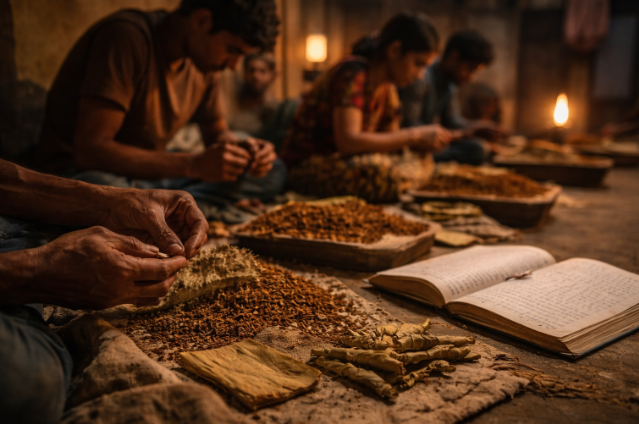
The early morning mist in the district of Murshidabad often carries a distinct smell. It is not just the scent of the river Ganges or the damp earth of the paddy fields; it is the sharp, pungent aroma of raw tobacco. For the outside world, this smell represents an industry that generates revenue. But for thousands of young students in towns like Dhuliyan, Jangipur, and Suti, this smell represents the defining struggle of their lives. It is the scent of their survival, and paradoxically, the barrier to their dreams.
This article is a "Real Story" from the ground a report on the invisible students of West Bengal who live a dual life. By day, they are scholars discussing English literature, history, and political science in college classrooms. By night, they are laborers in the unorganized bidi (cigarette) industry, their fingers stained with nicotine, working frantically to support their families. This is not a story of victimhood, but a narrative of extraordinary resilience in the face of systemic poverty.
The Reality of the "Home Factory"
To understand the magnitude of this story, one must look at the unique structure of the bidi industry in West Bengal. Unlike large factories with regulated shifts and safety protocols, this industry operates almost entirely inside the home. This "cottage industry" model means that there is no separation between "living space" and "working space." The bedroom is the factory; the dining floor is the warehouse.
For a student growing up in such a household, the day does not begin with a calm breakfast or a revision of last night's study notes. It begins with the delivery of tendu leaves and tobacco dust. I have closely observed the life of a nineteen-year-old undergraduate student—let us call him Rahim who lives in the heart of this industrial belt. Rahim is a bright student in the English department. His professors praise his grasp of grammar and his ability to analyze Victorian poetry. But what his professors do not see is the reality of his evenings.
When Rahim returns from college, he does not go to a study desk. He sits on the floor with his parents and younger siblings. The entire room is filled with raw materials. For the next six to seven hours, the family operates like a machine. The target is relentless: a thousand bidis must be rolled to earn a meager wage, often less than two hundred rupees. If the target is not met, the family struggles to buy rice for the next day. This is the brutal mathematics of poverty that dictates the schedule of his education.
The Art of Rolling: A Skill Born of Necessity
Outsiders might think rolling a bidi is simple, but it is a task that demands immense focus and speed focus that should ideally be spent on books. The process is manual and repetitive. First, the rough tendu leaf must be soaked and cut into a precise rectangular shape using a metal stencil. This sounds easy, but doing it thousands of times creates calluses on the fingers.
Next comes the filling. A pinch of tobacco dust is placed on the leaf. This is the most dangerous part. As the dust is sprinkled, fine particles float into the air, settling on clothes, food, and inevitably, inside the lungs. The leaf is then rolled tightly and tied with a tiny thread. The speed at which these students work is frightening; their hands move in a blur, tying the thread in split seconds. It is strange to watch. Their hands are black with dust, but their minds are thinking about English poetry. It hurts to see.
The Health Crisis in the Classroom
The physical cost of this dual life is severe. Medical reports and local health surveys in the Murshidabad and Malda regions have repeatedly highlighted the prevalence of tuberculosis (TB), asthma, and chronic back pain among bidi workers. But we rarely discuss how this impacts education.
In the classroom, these students often appear lethargic or distracted. To an outsider or a strict teacher, it might look like a lack of interest or laziness. The "Real Story," however, is one of exhaustion. Sitting in a cross-legged position (padmasana) for six hours a night to roll bidis causes severe spinal strain and leg numbness. Inhaling tobacco dust inside poorly ventilated homes leads to chronic respiratory issues. When a student like Rahim coughs in class, it is not just a cold; it is the occupational hazard of his survival.
My friend told me yesterday: "I don't skip class because I am lazy. I skip because my back hurts so much I cannot sit up." Yet, they return the next day. Why? Because the classroom is the only place where the air is clean both literally and metaphorically. The college campus offers a few hours of escape from the suffocating dust of the home factory.
The Financial Trap and Shadow Education
Another layer of this "Real Story" is the financial pressure of the modern education system. While government colleges in West Bengal have affordable tuition fees, the real cost of education lies in the "Shadow Education" system, private tuition. In rural Bengal, it is widely believed and often true that passing competitive exams or scoring high marks requires expensive private coaching.
For the son or daughter of a bidi worker, paying 500 or 1000 rupees a month for a tutor is a massive burden. This creates a vicious cycle. To pay for the tuition that will help him escape the bidi industry, the student must roll more bidis. He must work harder in the very trap he is trying to escape. I have witnessed students who work extra shifts on Sundays, sacrificing their only rest day, just to buy a reference book or pay an exam fee for the SSC or Teacher Eligibility Test. This is a level of dedication that goes unnoticed in the grand statistics of literacy rates.
The Gender Dimension: A Double Burden
This story is incomplete without mentioning the female students. For girls in this region, the burden is double. In traditional setups, bidi binding is often categorized as "women's work." Therefore, female students are expected to manage household chores, cook, assist in bidi binding, and then find time to study late at night.
Despite this, when the exam results are declared, it is often these girls who top the lists. Their success is a silent revolution. Every girl from a bidi-worker family who completes her graduation is breaking a generational chain of illiteracy and labor exploitation. She is proving that her destiny is not tied to the thread of a bidi, but to the thread of her own ambition.
A Ray of Hope: Why They Keep Going
Despite the toxic dust, the back pain, and the financial stress, the classrooms in Dhuliyan are full. Why? What drives a student to wake up at 5 AM, work in a hazardous environment, and still pursue a degree in History or English?
The answer is "Hope." For these families, education is not a hobby; it is a survival strategy. They have seen their parents age prematurely due to the hard labor. They know that a B.A. or an M.A. degree is the only ticket out of the dust-filled room. They dream of becoming school teachers, clerks, or government officers jobs that offer dignity and a steady salary.
The Unseen Scholars
As we celebrate the achievements of the Indian education system, we must acknowledge these unseen scholars. They do not study in air-conditioned libraries. They study under dim bulbs, amidst the rustle of dry leaves, fighting sleep and fatigue.
The "Real Story" here is not just about the hardship; it is about the triumph of the human spirit. When a student from this background graduates, they do not just earn a certificate. They earn a victory over their circumstances.
This December, as we reflect on "Real Stories," let us look beyond the statistics. Let us recognize the student who smells of tobacco but speaks of Shakespeare. He is the true hero of our education system. The smoke of the industry may cloud his room, but it has failed to cloud his ambition. "He is fighting a war every night.". And I believe he will win.