
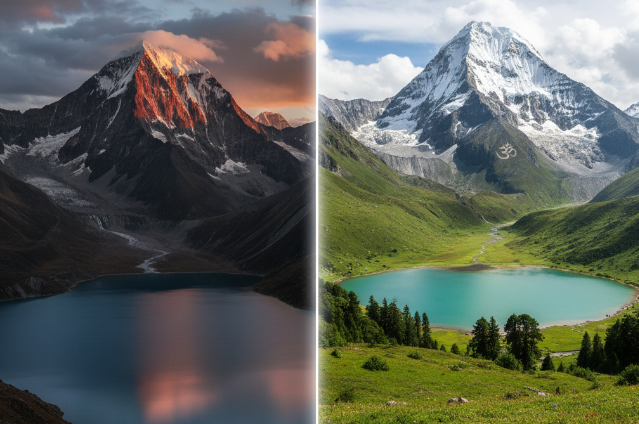
Both Adi Kailash Yatra and Kailash Mansarovar Yatra are linked to Mount Kailash, yet they differ in terms of geography, accessibility, and religious significance. In today’s blog, we will discuss the differences between Mount Kailash and Adi Kailash, as well as their relevance.
Adi Kailash Vs. Mount Kailash
Both Adi Kailash and Mount Kailash are sacred peaks and pilgrimage destinations located in the Himalayan region. Both the sacred peaks hold tremendous religious, spiritual, and cultural significance in India. Devotees embark on this spiritual yatra for self-reflection, devotion, and connection with the divine. Although they share the same reverence associated with lord Shiva, they are distinct in locations, accessibility, mythological significance, and pilgrimage experience. Knowing the main difference between these two sacred pilgrimage destinations allows you to appreciate the multifaceted heritage of the Himalayas.
Geographical Location of Mount Kailash and Adi Kailash
Mount Kailash
Mount Kailash is located in the remote southwest corner of Tibet in the Himalayan region. This sacred peak is often referred to as “The Abode of Shiva, which is located at an elevation of 6,638 metres near the western Trijunction of China, India, and Nepal. It is a mountain in Ngari Prefecture in the Tibet Autonomous Region of China, near Lake Mansarovar and Rakshastal. This is one of the most sacred yet unclimbed peaks in the world. Its remote location and proximity to borders make the Kailash Mansarovar Yatra challenging, which also requires permits and international clearances.
Adi Kailash
Also known as “Chhota Kailash” (Little Kailash), Adi Kailash is a sacred Himalayan mountain in the Pithoragarh District of Uttarakhand’s Kumaon region in India, near the Indo-Tibetan border. Located at an altitude of 6310 metres, Adi Kailash is more accessible than Mount Kailash. Every year, the Adi Kailash Yatra is organized by the Indian pilgrimage authorities. Devotees embark on this spiritual journey that can be covered by vehicles.
Physical Appearance of Mount Kailash and Adi Kailash
Mount Kailash is a symmetrical black granite peak, a pyramid-like structure with four faces (North, South, East, and West). Its symmetrical and unique shape has made it an unclimbed peak on earth. Standing tall at about 6638 metres, it features a sheer cliff, glacial formations, and deep crevices. It is even famous for its striking view of the reddish hues during sunrise and sunset, which turn it golden.
Adi Kailash is a majestic snow-capped peak in the Himalayan region of Uttarakhand in India. Though smaller, it is quite similar in resemblance to Mount Kailash, giving it the name “Chhota Kailash”. However, Adi Kailash slopes are surrounded by lush greenery, valleys, and lakes at the base, making it an easily approachable and key pilgrimage with serene lakes and surroundings.
Religious Significance of Mount Kailash and Adi Kailash
Although both peaks are associated with the divinity of Lord Shiva, their mythological narratives are different.
Mount Kailash
Mount Kailash is a sacred and revered peak across Hinduism, Buddhism, Jainism, and the Bon religion. This is known as “The Abode of Lord Shiva”. According to Hindu scriptures, it is the place where Lord Shiva resides with his wife, Goddess Parvati. And, undertaking the Kailash Mansarovar Yatra cleanses one’s sins and provides salvation. On the other hand, Buddhists consider it the dwelling of Buddha Demchok, and Jains consider it the place of their first Tirthankara’s liberation. Well, Mount Kailash is also known as the Universal Axis or Axis Mundi, where heaven and the earth meet.
For soul purification and divine blessings, pilgrims complete Kailash Kora or Parikrama on their Kailash Mansarovar Yatra. They complete the circumambulation in a clockwise direction.
Adi Kailash
Adi Kailash holds a tremendous spiritual and religious significance in India for Hindus. This is a sacred peak associated with Lord Shiva and is revered as a replica of Kailash Parvat. According to Hindu mythology, Adi Kailash is the home of Lord Shiva since the beginning of time. It is even mentioned in scriptures, like the Skanda Purana, that Adi Kailash was Lord Shiva’s first divine seat. Another mythology narrative associated with Adi Kailash is that it was the main stop of Lord Shiva's marriage with Goddess Parvati in Triyuginarayan. They spent their time here in meditation.
For this spiritual and religious significance, people embark on the Adi Kailash Yatra. As a part of the Yatra, pilgrims do a parikrama around the peak. The nearby lake, Parvati Sarovar, adds to the sanctity of the location.
Accessibility and Logistics Difference of Mount Kailash and Adi Kailash
International Travel
Mount Kailash: You need special permits and a visa from the Chinese authorities to visit Mount Kailash. It involves international travel and complex logistics for Indian pilgrims.
Adi Kailash: Since Adi Kailash is located in India, it is not an international travel. Devotees from any part of the country can embark on the Adi Kailash pilgrimage. This may not involve any special permits, visas, or cross-border permits. But this requires an Inner Line Permit, which can be obtained from local Indian authorities.
Difficulty and Duration
- Mount Kailash: Mount Kailash Yatra is a longer and more significantly challenging trek than Adi Kailash Yatra. The duration of the trek is approximately 15-20 days, including the 52 km challenging Parikrama.
- Adi Kailash: Adi Kailash Yatra is a moderate level of difficulty trek with a shorter duration of approximately 7-10 days. The trek to Adi Kailash is challenging but less strenuous than the famous Kailash Mansarovar Yatra, thanks to its motorable route.
Scenic Beauty and Pilgrimage Experience
Both peaks are in the Himalayan region, surrounded by scenic landscapes, yet they offer distinct pilgrimage experiences. The experience of visiting Adi Kailash and Mount Kailash in terms of travel, accessibility, and rituals is different.
Mount Kailash Pilgrimage
Pilgrims embark on the trek of Mount Kailash, known as “Kailash Mansarovar Yatra”, which includes the divine darshan of Mighty Kailash Parvat and Lake Mansarovar. Devotees and trekkers begin their journey from India and cross over into Tibet through specific routes that are regulated by authorities and require special permits to enter the region. This trek includes the trail of high-altitude rugged terrains, freezing temperatures, and a circumambulation of 52 km. It is believed that completing one Kailash Kora (Parikrama) is enough to cleanse your previous births and current birth’s sins and attain Moksha (Salvation).
Adi Kailash Pilgrimage
Since this sacred Yatra takes place in Uttarakhand, India, it is a more accessible pilgrimage for Indians. This trek involves passing through the Panchachuli Valley and Darma Valley in Uttarakhand. Although the route is challenging, it is way easier than Mount Kailash because of its motorable route. Alongside the darshan of Adi Kailash peak, pilgrims also have darshan of Om Parvat, which is a sacred mountain revered for its natural snow formation in the shape of the ‘OM’ symbol. There is also a pious lake, called Parvati Kund, where offerings and prayers are made. It is a great spiritual alternative for pilgrims who cannot undertake the arduous journey of the Mount Kailash pilgrimage.
Quick Comparative Differences
Both peaks are revered as the abode of Lord Shiva, yet the experience of the pilgrimage is different. Here’s the quick comparison that highlights the unique experiences they offer and the approximate costs to embark on the pilgrimage:
| Factors | Mount Kailash | Adi Kailash |
| Location | Tibet Autonomous Region, China | Pithoragarh District, Uttarakhand, India |
| Altitude | 6638 metres (Approximately) | 6310 metres (Approximately) |
| Visa Required | Yes | No |
| Types of Permits | Tibet Travel Permit | Inner Line Permit |
| Duration | 15 - 20 Days | 7-10 Days |
| Cost | Rs. 2-4 Lakhs | Rs. 20,000 to Rs. 70000 |
| Best time to Visit | May - September | May-June and Sept-Oct |
| Parikrama | 52 Kilometers | No tradition of doing Parikrama |
| Nearby Places | Lake manarovar and Lake Rakshastal | Parvati Sarovar, Gauri Kund, Om Parvat |
| Age Limit | 18-70 years | 15-70 years |
Which Yatra Should You Choose?
Pilgrims who are looking for a budget-friendly tour should opt for Adi Kailash Yatra. It is comfortable for elderly or even less fit travelers. If it is your first high-altitude trek, then Adi Kailash Yatra is recommended.
On the other hand, only experienced and fit travelers are advised to embark on the Kailash Mansarovar Yatra. This is also more expensive than the Adi Kailash Yatra. So, if your budget allows, you can visit Mount Kailash.