
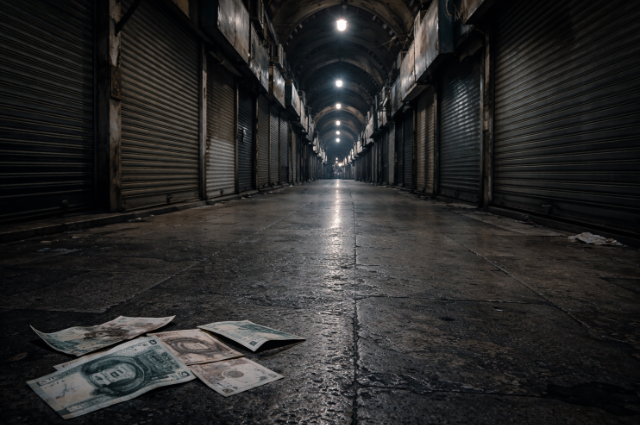
On a cold winter night in late December 2025, Tehran’s historic Grand Bazaar — once the beating heart of Iran’s commercial life — stood eerily quiet. Shop gates were locked, once-busy lanes deserted, and for the first time in decades, the merchant class, traditionally a bastion of regime support, joined a growing wave of unrest sweeping the country. This symbolic closure reflected not only economic desperation but a profound turning point in Iran’s public life. Citizens from university students to seasoned traders protested not merely for bread and stability, but for political dignity and accountability. What began with the collapse of the rial has evolved into the most widespread unrest Iran has seen in years, challenging both the economy and the political legitimacy of the Islamic Republic. (Reuters)
Economic Crisis: The Spark That Ignited the Streets
Iran’s economic malaise has deep roots, but its recent decay is dramatic. Years of sanctions — particularly from the United States — have crippled energy exports, slashed state revenue, and battered foreign exchange reserves. The rial, once relatively stable, spiralled downward, trading at record lows against the U.S. dollar by late 2025. This currency collapse, coupled with inflation creeping well above 40 per cent, made essential goods unaffordable for ordinary families. Food prices reportedly soared over 70 per cent within a year, decimating household budgets. (Outlook India)
Unemployment and under-employment have compounded the misery. With limited foreign investment and restricted access to international financial systems, Iran’s private sector struggles to absorb new labour market entrants. Meanwhile, water shortages and infrastructure issues have added to living costs and social strain. (Wikipedia)
For many Iranians, economic hardship is no longer an abstract policy issue but a daily struggle for survival. This material stress laid the groundwork for a broader social and political uprising.
Public Protests and Social Unrest: From Markets to Main Streets
What began in late December 2025 with traders and shopkeepers quickly escalated into nationwide resistance? Protests spread from Tehran to nearly every province, involving students, workers, and ordinary citizens. Unlike the 2022 movement — which focused on social and cultural rights — the current unrest is rooted primarily in material hardship: inflation, joblessness, and a currency in free fall. (Wikipedia)
Slogans like “Death to the dictator” and public acts such as toppling statues signify that the movement has outgrown its initial economic grievances. Visible participation of youth and women, long catalysts of social change in Iran, underscores how widespread discontent has become. The absence of a single leader suggests a decentralised movement that reflects broad societal frustration. (The Guardian)
Government Response and Human Rights Concerns
Iran’s leadership has been caught between two imperatives: suppressing unrest and avoiding further international isolation. The government imposed a near-total internet blackout starting January 8, 2026, severely restricting communications and independent reporting on protest sites. (Wikipedia)
Security forces have used lethal force, resulting in hundreds of reported deaths. The United Nations has raised alarms over widespread violence, with some estimates suggesting fatalities may number in the hundreds or more. Mass arrests — over 2,000 according to rights groups — and detentions have drawn sharp international condemnation. (Reuters)
Tehran claims to be countering “terrorists” and foreign interference, while critics argue the state is responding with disproportionate force to largely peaceful protests. The risk of executions and harsh sentences for dissenters remains a pressing human rights concern. (The Times of India)
Political Leadership under Strain
The crisis has exposed fractures within Iran’s political elite. President Masoud Pezeshkian, representing a moderate faction, has publicly acknowledged economic grievances and called for restraint and dialogue. However, ultimate authority rests with Supreme Leader Ayatollah Ali Khamenei, whose power remains substantial but appears increasingly contested. (Al Jazeera)
The state’s inability to offer credible economic solutions — such as stabilising the currency or containing inflation — has weakened public trust. Even within conservative circles, tensions over budget priorities and economic reform reflect a leadership grappling with competing pressures. This internal friction highlights broader questions about the regime’s long-term viability without substantive political and economic adjustments.
Sanctions, Geopolitics, and International Pressure
Iran’s external environment compounds its internal struggles. Longstanding U.S. sanctions — intensified since Washington withdrew from the nuclear deal — have choked access to global markets and financial liquidity. International isolation has limited diplomatic and economic options for Tehran. (CGTN)
The situation has drawn international responses ranging from new sanctions by Western governments to threats of military involvement. For example, recent actions by the United Kingdom and the United States target key sectors of Iran’s economy in response to human rights abuses and nuclear concerns. (The Guardian)
Former U.S. leaders have even signalled support for Iranian protesters and hinted at potential military options if the crackdown continues, a stance that heightens geopolitical tension and risk. (TIME)
Iran’s regional relationships — particularly with Israel and Gulf states — remain tense, further influencing energy markets and security calculations across the Middle East.
Impact on Citizens and the Road Ahead
For everyday Iranians, this crisis is not abstract geopolitics but a lived reality. Families face spiralling food costs, dwindling savings, and uncertain futures. Young people, long hopeful for greater political freedoms, find their frustrations intertwined with basic economic survival. Workers in energy, logistics, and service sectors report strikes and demands for wage increases aligned with inflation, illustrating the socioeconomic breadth of discontent. (Reddit)
As protests persist and the economy teeters, Iran stands at a crossroads. Domestic pressures — from economic reform demands to calls for broader political change — will test the state’s capacity to adapt. International pressures and sanctions will continue to shape Tehran’s options.
Possible Futures for Iran
Iran’s near future is fraught with uncertainty. Three broad scenarios stand out:
- Managed reform: The government responds with meaningful economic policy changes and opens political space, potentially easing unrest and restoring some international engagement.
- Hardline consolidation: The regime doubles down on repression and isolation, risking deeper social fracture and a prolonged economic downturn.
- Escalated crisis: Continued conflict between state and society, compounded by external pressures, could lead to broader instability with regional ramifications.
Each path carries risks and consequences for Iranians and global stakeholders alike. What has become clear is that Iran’s current crisis goes beyond economics — it is a test of political legitimacy, social cohesion, and the ability of a nation to navigate internal demands in a turbulent world.