
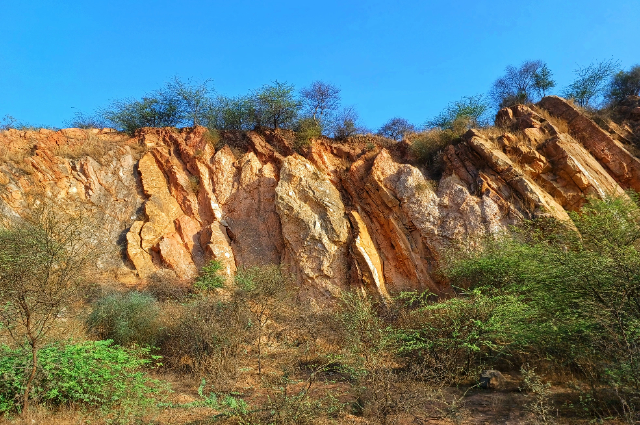
When Nature Can No Longer Speak
The mountain did not collapse in a single day.
It weakened slowly—tree by tree, rock by rock, decision by decision.
There was no sudden disaster, no dramatic headline at first. Only trucks moving quietly at night, forests thinning gradually, hills scarred by mining, and rivers drying without protest. Mountains, unlike humans, do not scream when they are hurt. They endure. And that endurance is often mistaken for strength.
Mountains are among nature’s greatest protectors. They regulate climate, store water, support forests, and shelter life. Yet across the world—and especially in India—mountains are being treated as resources to be consumed rather than systems to be protected. The Aravalli Valley, one of the oldest mountain ranges on Earth, stands today not as a symbol of strength, but as a reminder of neglect.
This article looks beyond geography and development statistics to understand why mountains matter, why forests are their lifeline, and why the destruction of the Aravalli Valley is not just an environmental issue—but a human one.
Mountains: The Silent Guardians of Life
Mountains do not ask for attention, yet they quietly sustain everything below them.
They are the birthplace of rivers that quench cities and farms. They influence rainfall patterns, control temperatures, and protect plains from extreme weather. Without mountains, fertile lands would turn dry, floods would become frequent, and the climate balance would collapse.
For centuries, civilisations have depended on mountains without fully acknowledging their role. Glaciers stored in high ranges release water slowly, ensuring a year-round supply. Forests growing on slopes prevent erosion and landslides. Even the air we breathe is filtered through mountain ecosystems that absorb carbon and release oxygen.
And yet, despite their importance, mountains are often seen as obstacles to development—land to be mined, levelled, or exploited. Their value is calculated not in survival, but in profit.
Forests: The Heart That Keeps Mountains Alive
A mountain without forests is a body without veins.
Forests are what give mountains stability, life, and resilience. Tree roots bind soil together, preventing landslides and erosion. Canopies regulate temperature and rainfall. Forests act as natural sponges, absorbing rainwater and slowly releasing it into groundwater systems.
When forests are cut, the damage is not immediate—but it is inevitable.
Floods follow heavy rains because soil can no longer hold water. Droughts arrive because groundwater fails to recharge. Wildlife disappears, and with it, ecological balance. Climate change accelerates as carbon sinks are destroyed.
Yet deforestation continues, justified in the name of development, infrastructure, and short-term economic gain. What is rarely acknowledged is that forests take centuries to grow and only minutes to be destroyed. Once lost, their protective function cannot be easily replaced.
Destroying forests does not weaken nature alone—it weakens human survival.
The Aravalli Valley: A Barrier Between Life and Desert
The Aravalli Range is older than the Himalayas, older than recorded human history. Stretching across Rajasthan, Haryana, and Delhi, it has stood for millions of years as a natural shield against desertification.
Its role is critical.
The Aravalli’s prevent the Thar Desert from spreading eastward. They regulate groundwater levels in some of India’s most densely populated regions. They support forests, wildlife corridors, and rural livelihoods. Without them, northern India would face severe water shortages, extreme temperatures, and ecological collapse.
Yet today, the Aravalli Valley is being eaten away.
Illegal mining has hollowed out hills. Forest land has been cleared for construction. Quarrying has scarred landscapes beyond recovery. What was once a continuous ecological system is now fragmented and weakened.
This destruction does not happen in isolation. It directly affects cities like Delhi, contributing to water crises, heat waves, air pollution, and falling groundwater tables. The collapse of the Aravalli’s would not be an environmental tragedy alone—it would be a humanitarian one.
When Development Means Destruction
Development is often used as an unquestionable justification.
Roads, buildings, and industries promise jobs and growth. But when development ignores ecological limits, it becomes self-destructive. Mountains are dynamited, forests cleared, and valleys flattened—without accounting for long-term consequences.
The irony is painful: we destroy natural systems to improve human life, only to suffer from floods, droughts, heatwaves, and pollution that follow.
Mountains do not regenerate like urban infrastructure. Once a range is destabilized, recovery is nearly impossible. What is lost is not just land—but protection against climate extremes that no technology can fully replace.
True development should strengthen coexistence with nature, not dominate it.
Why Cutting Forests Is a Crime Against the Future
Cutting forests is often framed as necessity. But the cost is never fully counted.
Forests provide oxygen, regulate climate, protect water sources, and support biodiversity. They are essential not only for wildlife, but for farmers, cities, and future generations. Their destruction increases disasters, health problems, and economic instability.
What makes deforestation particularly dangerous is its invisibility. The damage accumulates quietly until it becomes irreversible. By the time floods drown villages or droughts empty reservoirs, the forests that could have prevented it are already gone.
Protecting forests is not an environmental luxury—it is a survival strategy.
Responsibility Beyond Policies and Promises
Environmental protection cannot survive on laws alone.
While regulations exist to protect mountains and forests, enforcement is often weak. Illegal mining continues. Forest clearances are approved without transparency. Environmental impact assessments are treated as formalities rather than warnings.
Responsibility lies not only with governments, but with industries, communities, and individuals. Awareness must replace apathy. Conservation must replace convenience.
Saving the Aravalli Valley requires collective action—reforestation, strict enforcement, sustainable planning, and public pressure. Silence, in this context, is not neutrality; it is complicity.
If Mountains Fall, We Fall With Them
Mountains have protected humanity long before humans learned to protect themselves.
They have given water without asking, stability without demand, and shelter without conditions. Today, they stand weakened—not because they failed us, but because we failed them.
Saving forests and preserving mountain ranges like the Aravalli Valley is not about preserving beauty alone. It is about preserving climate stability, water security, and human life itself.
If we continue to destroy mountains in the name of progress, we will inherit a future where survival becomes the struggle, and development is no longer promised.
Protecting mountains is not an environmental choice.
It is a moral one.