
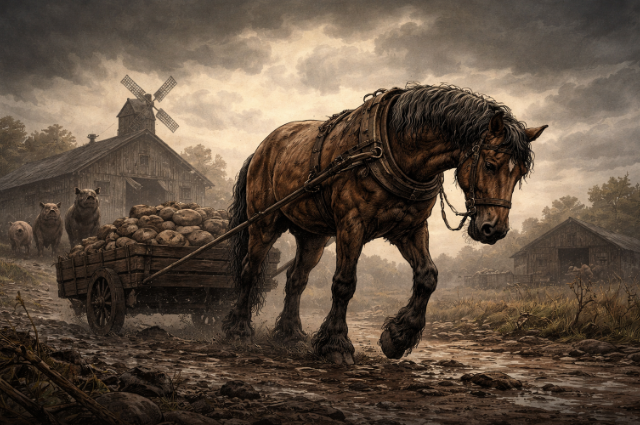
The Role of the Working Class in Orwell's Allegory
George Orwell’s Animal Farm offers a compelling critique of political systems and the way the working class is manipulated by those in power. Through the character of Boxer, Orwell explores the tragic reality of the proletariat: hardworking, loyal, and dedicated, but ultimately exploited and abandoned. Boxer represents the ideals of the working class, whose endless toil sustains the system, yet whose value is only recognised when they are useful. Orwell uses Boxer’s fate to highlight the deep injustices and exploitation that persist in society, making the novel an enduring and tragic portrayal of the struggles faced by the working masses.
Boxer’s Character: The Embodiment of the Working Class
Boxer is introduced as a strong, hardworking, and idealistic horse, committed to the revolution and the dream of a better life for all the animals on the farm. His famous slogan, “I will work harder!” encapsulates his unwavering belief that labour and perseverance will bring about progress and prosperity. Boxer’s strength and work ethic are central to the success of the animal rebellion. He tirelessly works to build the windmill, which he believes will bring about a better future for all animals, reflecting the hopes of the working class that their labour will eventually result in equality and freedom.
However, Orwell’s portrayal of Boxer reveals the darker side of this idealism. Boxer believes that the hardships they endure are temporary and that the sacrifices they make will lead to a brighter future. Unfortunately, this belief is exploited by Napoleon, the pig who seizes power after the rebellion. Boxer’s loyalty to Napoleon and the revolution becomes the driving force of his existence, as he believes in the promises of the new regime, even as it becomes increasingly corrupt.
Major Events and Boxer’s Role in the Farm’s Struggles
The Rebellion and Boxer’s Enthusiasm.
Boxer is one of the key figures in the overthrow of Mr Jones, the oppressive farm owner. His physical strength and tireless work ethic help ensure the success of the revolution, and he becomes one of the leaders in the new society. However, despite the success of the rebellion, Boxer’s role becomes less about liberation and more about sustaining a system that is beginning to mirror the same abuses that the revolution sought to overthrow. Boxer represents the ideal worker who believes that working harder will solve problems, yet he is blind to the changes occurring around him.
The Construction of the Windmill
The construction of the windmill is perhaps the most significant project undertaken after the rebellion. Boxer dedicates himself to this task with unyielding resolve, believing that the windmill will provide the farm with electricity and make life easier for all the animals. His personal motto, “Napoleon is always right,” reflects his unshakable faith in the leadership, despite the growing corruption under Napoleon’s rule. Boxer’s dedication to the windmill, even in his old age, highlights the sacrifices that the working class makes in the hope of progress, only to see their dreams manipulated and betrayed by those in power.
Boxer’s Injury: The First Signs of Betrayal
As the years pass and the farm continues to suffer from mismanagement and the pigs’ increasing corruption, Boxer grows older and weaker. His injuries during the windmill construction symbolise the exhaustion of the working class. Despite his strength, Boxer cannot sustain the endless labour. When Boxer collapses while working, his injury is a turning point in the novel, as it marks the moment when Boxer’s utility as a worker begins to decline. In a just society, his injury would be met with compassion and care, but in the world of Animal Farm, it marks the beginning of his inevitable betrayal.
Boxer’s Death and the Ultimate Betrayal
When Boxer’s health deteriorates further, Napoleon makes the call to sell him to a glue factory. The pigs lie to the other animals, telling them that Boxer has been taken to a veterinary hospital, but the truth is far more tragic. Boxer, who had worked tirelessly for the revolution, is discarded when he is no longer of use. His death at the hands of the pigs is the ultimate betrayal—a betrayal of his labour, his trust in Napoleon, and his dream of a better life for the animals. Orwell uses this moment to underscore the ultimate exploitation of the working class. Those who labour for the state or for a revolution are often cast aside once their labour is no longer needed, their sacrifices forgotten.
The lie that Boxer is sent to a veterinary hospital is one of Orwell's most poignant critiques of propaganda and the manipulation of truth. The pigs’ ability to present Boxer’s death as something positive is a reflection of how those in power use deception to maintain control over the oppressed. Boxer’s death, and the lies surrounding it, are a tragic reminder that the ruling class has no use for the working class once they no longer serve their interests.
Boxer as a Symbol of the Exploited Working Class
Boxer’s journey in Animal Farm serves as an allegory for the exploitation of the working class in both totalitarian and capitalist systems. Orwell’s depiction of Boxer as a loyal, self-sacrificing worker who is ultimately discarded by the very system he helped to build reflects the realities faced by the proletariat throughout history. Boxer works tirelessly, believing in the ideals of the revolution and the promises of equality, but in the end, he is discarded like a tool that has outlived its usefulness. His fate illustrates the harsh truth that, in many systems, the working class is valued only for its ability to contribute labour, not for its humanity or individual worth.
Orwell’s use of Boxer as a symbol is a critique of how the working class is often manipulated and exploited by those in power. Napoleon and the pigs represent the ruling class that takes advantage of the hard work and idealism of the proletariat. They promise equality, freedom, and prosperity, but ultimately use the labour of the working class to strengthen their own power. Boxer’s tragic fate is a direct commentary on how the system consumes the labour of the working class without any regard for their well-being, leaving them with nothing once their usefulness is exhausted.
The Cycle of Exploitation: A Reflection of History
The story of Boxer in *Animal Farm* is not just a fictional account of farm animals; it is a reflection of real-world history. Throughout history, revolutions and political movements have often been built on the backs of the working class, only for the labourers to be abandoned when their work is no longer needed. Orwell’s portrayal of Boxer as a symbol of the exploited masses serves as a warning about the cyclical nature of exploitation: those who labour for change are often the first to be sacrificed when the system becomes corrupted.
Boxer’s belief in the revolution, his loyalty to Napoleon, and his constant work are emblematic of the working class in many societies who are driven by the hope of progress. But like Boxer, many workers find that their efforts are in vain, as the systems they build are co-opted by the very forces that once sought to overthrow the status quo. The tragedy of Boxer is not just his death, but the fact that he is remembered by the animals for his sacrifice, while the pigs continue to enjoy the fruits of his labour.
The Enduring Legacy of Boxer’s Tragedy
In conclusion, Boxer’s fate in Animal Farm is a powerful and tragic commentary on the exploitation of the working class. Through Boxer, Orwell reveals the harsh realities faced by labourers in both capitalist and totalitarian societies. Boxer’s endless toil, his faith in the revolution, and his ultimate betrayal by the pigs reflect the struggles of the working class, whose contributions are often taken for granted and whose sacrifices are too easily forgotten.
Boxer’s story is a sobering reminder that the working class, while essential to the functioning of society, is often left behind once its labour is no longer needed. Orwell’s portrayal of Boxer is not just a critique of totalitarianism, but a broader reflection on how society often exploits those who work the hardest, only to discard them once their utility is exhausted. The story of Boxer remains a timeless and poignant warning of the dangers of exploitation and the betrayal of the working class by those in power.