
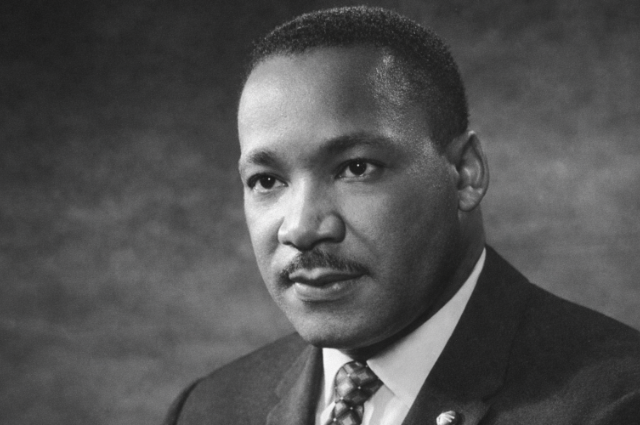
Early Life and Intellectual Formation
Martin Luther King Jr. was born on January 15, 1929, in Atlanta, Georgia, into a family deeply rooted in the African American Baptist tradition. His father and grandfather were both ministers, and the Black church played a central role in shaping his moral outlook. From an early age, King was exposed to both the spiritual resources of Christianity and the harsh realities of racial segregation in the American South.
King’s intellectual development was marked by exceptional academic achievement. He entered Morehouse College at the age of fifteen, where he studied sociology and first encountered systematic reflections on race, ethics, and social responsibility. At Morehouse, King was influenced by President Benjamin E. Mays, who emphasized the social role of religion and the moral obligation to confront injustice.
King later pursued theological studies at Crozer Theological Seminary and earned a PhD in systematic theology from Boston University. During these years, he engaged deeply with Western philosophy, Christian theology, and modern social thought. He studied thinkers such as Plato, Aristotle, Aquinas, Kant, Hegel, and Marx, as well as Protestant theologians like Reinhold Niebuhr. Most importantly, he encountered the philosophy of Mahatma Gandhi, whose doctrine of nonviolent resistance profoundly shaped King’s own theoretical framework.
The Philosophy of Nonviolence
At the center of Martin Luther King Jr.’s thought lies the theory of nonviolence (Nonviolent Resistance). For King, nonviolence was not simply a strategic choice but a comprehensive moral philosophy grounded in Christian ethics and Gandhian principles.
King defined nonviolence as active resistance to evil without the use of physical force. Contrary to the misconception that nonviolence implies passivity, King argued that it requires courage, discipline, and moral strength. Nonviolence seeks not the humiliation or destruction of the opponent but their moral transformation.
According to King, violence ultimately perpetuates cycles of hatred and retaliation. He famously asserted that “hate cannot drive out hate; only love can do that.” In this sense, nonviolence functions as both a means and an end: the method of struggle must reflect the moral quality of the society one seeks to create.
King outlined several key principles of nonviolence:
- Nonviolence is resistance to injustice, not submission.
- It seeks to win friendship and understanding, not defeat the opponent.
- It attacks unjust systems rather than individuals.
- It is grounded in love (agape), not fear or hatred.
- It believes in the ultimate triumph of justice.
This philosophy became the moral foundation of the American Civil Rights Movement and distinguished it from other forms of political resistance.
Civil Rights and Democratic Theory
King’s theory of civil rights (Civil Rights Theory) was rooted in a deep commitment to democratic ideals. He believed that the American Constitution and Declaration of Independence contained universal moral promises that had been denied to African Americans. His struggle was therefore not against democracy itself, but against its incomplete realization.
King argued that segregation was not merely a social inconvenience but a systemic violation of human dignity. Segregation, he wrote, “distorts the soul and damages the personality.” By enforcing racial hierarchy, it denied both the oppressed and the oppressor their full humanity.
Central to King’s civil rights theory was the idea of equal citizenship. He maintained that access to voting rights, education, employment, and public spaces was essential for meaningful participation in a democratic society. Without these rights, political freedom remained an illusion.
King’s advocacy contributed directly to landmark legislative achievements, including the Civil Rights Act of 1964 and the Voting Rights Act of 1965. However, he consistently warned that legal reforms alone were insufficient without bigger moral and cultural change.
Law, Justice, and Moral Philosophy
One of King’s most significant theoretical contributions appears in his discussion of just and unjust laws, most famously articulated in “Letter from Birmingham Jail.” Drawing on natural law theory, King argued that not all laws deserve obedience.
A just law, according to King, aligns with moral law and uplifts human personality. An unjust law degrades human dignity and is imposed by a majority on a minority without the minority’s consent.
King asserted that individuals have a moral responsibility to disobey unjust laws, provided that such disobedience is conducted openly, peacefully, and with a willingness to accept legal consequences. This acceptance of punishment, he argued, exposes the injustice of the law and appeals to the conscience of society.
In this way, King reconciled civil disobedience with respect for law, framing it not as anarchic rebellion but as a higher form of legal fidelity rooted in justice.
The “I Have a Dream” Vision
King’s famous “I Have a Dream” speech represents not merely rhetorical brilliance but a theoretical vision of social transformation. The “dream” is a moral and political ideal that integrates equality, freedom, and brotherhood.
In this vision, individuals are judged not by the color of their skin but by the content of their character. King imagined a society in which racial divisions no longer determined life chances and where former adversaries could coexist in mutual respect.
The dream functions as a normative framework—a standard against which existing social arrangements are measured. It also serves as a source of hope, mobilizing collective action by projecting a morally compelling future.
Social and Economic Justice
In the later years of his life, King increasingly emphasized economic inequality as a fundamental injustice. He argued that racial equality could not be fully achieved without addressing poverty, unemployment, and unequal access to resources.
King criticized capitalism’s excesses and called for a more equitable distribution of wealth. While not rejecting private enterprise outright, he believed that economic systems must serve human needs rather than profit alone.
His support for labor rights, fair wages, and social welfare reflected a broader conception of social justice (Social Justice Theory)—one that linked racial justice with economic and structural reform.
Moral Leadership and Legacy
Martin Luther King Jr.’s concept of moral leadership remains one of his most enduring contributions. He believed that true leadership arises from integrity, sacrifice, and service rather than power or coercion.
King’s assassination in 1968 cut short his life but not his influence. His ideas continue to inspire movements for racial justice, human rights, and peaceful resistance across the globe.
Today, King is remembered not only as a civil rights icon but as a thinker whose theories challenge societies to confront injustice through moral courage and nonviolent action.