
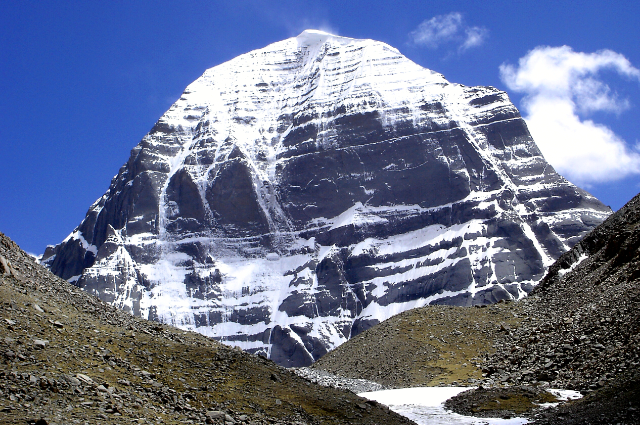
Rising in solitary majesty on the Tibetan Plateau, Mount Kailash, known in India as Kailash Parvat, stands not merely as a geographical formation but as a living symbol of mystery, faith, and cosmic wonder. With an elevation of about 6,638 meters (21,778 feet), it is not the tallest peak in the Himalayas, yet it commands a reverence that surpasses even the loftiest summits of Earth. For Hindus, Buddhists, Jains, and followers of the ancient Bon religion, this mountain is sacred. For scientists, it is a fascinating geological structure surrounded by unusual claims and unexplained phenomena.
The mysteries of Mount Kailash have inspired spiritual seekers, historians, geologists, and adventurers for centuries. Stories of its unclimbed peak, its perfect pyramid-like geometry, time anomalies, sacred symbols, and its reputation as the “centre of the world” continue to spark debate between faith and reason.
The Unclimbed Peak and the Legend of Milarepa
One of the most astonishing facts about Mount Kailash is that it has never been officially summited. While peaks such as Mount Everest have witnessed thousands of climbers, Kailash remains untouched. The Chinese authorities officially prohibit climbing out of respect for religious sentiments. However, beyond legal restrictions, many mountaineers themselves have refrained from attempting it due to its sacred status.
In Hindu belief, Mount Kailash is the abode of Lord Shiva, the cosmic yogi. To climb it would be seen as a spiritual violation. Tibetan Buddhists revere it as the home of Demchok (Chakrasamvara), symbolising supreme bliss. Jains believe it to be the site where their first Tirthankara attained liberation.
The only figure said to have reached its summit is the Tibetan saint Milarepa, who, according to legend, ascended the mountain through spiritual power rather than physical climbing. After reaching the peak, he returned, declaring that ordinary humans should never attempt such a feat.
There are also accounts from trekkers describing strange visual illusions around the mountain—reports that the mountain appears to shift position or disorient travellers. From a scientific perspective, such experiences can be explained by high-altitude hypoxia, extreme weather conditions, and the optical illusions created by shifting sunlight and snow reflections. Research in high-altitude medicine, such as studies published in journals of mountain medicine, shows that oxygen deprivation can cause confusion, dizziness, and distorted perception. Thus, what may seem mystical can often be linked to physiological stress.
Pyramid Shape and Perfect Geometry
Another striking feature of Mount Kailash is its near-perfect symmetry. The mountain’s four steep faces appear aligned with the cardinal directions—north, south, east, and west. This geometric precision has led some researchers and theorists to suggest that it might be an ancient pyramid or even a man-made structure.
Geologists, however, provide a natural explanation. Mount Kailash is composed mainly of sedimentary rock uplifted during the collision of the Indian and Eurasian tectonic plates millions of years ago. Studies in Himalayan geology indicate that such symmetrical formations can result from erosion patterns shaped by glaciers and wind over immense time scales.
The pyramid-like appearance is enhanced by horizontal strata lines across its surface. These layered formations create an almost architectural impression. Yet, geological surveys confirm that the mountain’s structure is consistent with natural tectonic uplift and erosion processes rather than artificial construction.
Still, its remarkable symmetry continues to inspire symbolic interpretations. In Hindu cosmology, it represents Mount Meru—the cosmic axis of the universe. In Buddhism, it symbolises the spiritual centre of existence. Thus, geometry becomes both a scientific fact and a sacred metaphor.
Time Acceleration and the Mystery of Ageing
Among the most intriguing claims associated with Mount Kailash are reports of accelerated ageing. Pilgrims and travellers have said that hair and nails grow unusually fast in the region and that they feel older after spending just a few days there.
From a scientific standpoint, no verified research confirms the actual acceleration of time in the area. According to Einstein’s theory of relativity, time can indeed vary under extreme gravitational forces or high velocities. However, the gravitational difference at Kailash compared to other high mountains is negligible. There is no known physical mechanism that would cause measurable time acceleration.
The sensation of rapid ageing can be explained physiologically. High-altitude environments expose the body to increased ultraviolet radiation, dehydration, low oxygen levels, and physical exhaustion. These factors can make skin appear aged or cause temporary stress responses that affect the body’s appearance. Research in environmental physiology suggests that stress hormones and dehydration can alter perception and bodily sensations, which may contribute to such reports.
Thus, while relativity theory acknowledges time dilation under certain cosmic conditions, there is no scientific evidence that Mount Kailash alters the flow of time. The experience is more likely psychological and environmental rather than cosmic.
The “Shiva Face” and Sacred Symbols
Many pilgrims claim to see a face-like formation on the southern face of Mount Kailash, which they interpret as Lord Shiva. During sunset, shadows cast by ridges and snow patterns create striking visual impressions. Some visitors also report seeing shapes resembling the sacred syllable Om or the Swastika formed by snow lines and rock patterns.
Human psychology provides insight into this phenomenon. The brain has a natural tendency called pareidolia—the perception of familiar patterns, especially faces, in random shapes. This explains why people see animals in clouds or faces in rock formations. In a sacred context, such perceptions become deeply meaningful.
Religiously, these symbols reinforce faith. The mountain becomes not just a rock formation but a living divine presence. In Hindu scriptures such as the Shiva Purana, Kailash is described as the eternal dwelling of Shiva, radiating spiritual energy. For believers, the visible symbols are manifestations of divine reality rather than coincidence.
Axis Mundi: The Centre of the World
Mount Kailash is often described as the “Axis Mundi,” the centre of the world. Ancient cosmologies from different traditions describe a sacred mountain at the centre of the universe connecting heaven, earth, and the underworld.
Interestingly, some modern researchers have noted that Kailash lies at approximately 6,666 kilometres from the North Pole and Stonehenge, and roughly 13,332 kilometres from the South Pole. While these numbers are mathematically intriguing, scientists caution against reading cosmic significance into coincidental distances. The Earth’s spherical geometry allows for many such numerical alignments.
Nevertheless, symbolically, its central position in Asian geography—near the sources of major rivers like the Indus, Brahmaputra, Sutlej, and Karnali—adds to its mythic status. These rivers sustain millions of people, strengthening the belief that Kailash is a life-giving cosmic centre.
Unmelting Snow and the Sacred Lakes
Despite global warming affecting many Himalayan glaciers, the snow cap of Mount Kailash appears remarkably persistent. Scientists attribute this to microclimatic conditions. The mountain’s steep faces prevent heavy snow accumulation, while cold high-altitude winds maintain low temperatures around the summit.
At the base of Kailash lie two sacred lakes: Lake Manasarovar and Rakshastal. Lake Manasarovar, almost perfectly round, symbolises purity and light. Rakshas Tal, crescent-shaped and saline, represents darkness and duality. Together, they reflect a cosmic balance similar to the yin-yang concept.
Scientific studies describe Manasarovar as a freshwater lake fed by glacial melt, while Rakshas Tal is a saltwater lake due to a lack of outflow. Their contrasting chemistry and shape result from geological processes, yet spiritually they embody harmony between opposing forces.
Science and Faith: Conflict or Complement?
Scientific investigations into Mount Kailash reveal no supernatural anomalies. Geological surveys confirm natural formation. High-altitude medicine explains physical sensations. Environmental science accounts for snow patterns and lake chemistry.
Yet science does not diminish the mountain’s significance. Instead, it offers a different lens of appreciation. The power of Kailash lies not only in measurable data but in its enduring capacity to inspire transformation. Pilgrims who perform the sacred circumambulation, known as “kora,” often describe profound psychological renewal. Studies in psychology suggest that intense spiritual experiences can alter perception, reduce stress, and enhance emotional resilience.
Religious texts portray Kailash as a realm of transcendence. In Hindu tradition, it is the seat of meditation and cosmic dance. In Buddhism, it represents enlightenment. In Jainism, liberation. These narratives may not be testable in laboratories, but they shape civilisations and moral imagination.
Between Earth and Eternity
The mystery of Kailash Parvat lies not in proving whether it is supernatural or geological, but in understanding how both dimensions coexist. Scientifically, it is a product of tectonic uplift and glacial erosion. Psychologically, it is a catalyst for awe. Religiously, it is the dwelling place of the divine.
No verified evidence supports time acceleration, artificial construction, or literal cosmic centrality. Yet the mountain’s symbolism continues to transcend empirical boundaries. Its unclimbed summit preserves a rare sanctity in a world where nearly every frontier has been conquered.
Mount Kailash remains a meeting point of faith and science, myth and measurement, imagination and investigation. Its true mystery may not be hidden in rock layers or numerical alignments, but in the human heart’s search for meaning. Standing before its silent grandeur, one realises that some mysteries are not meant to be solved—they are meant to be experienced.
. . .
References:
- Eliade, Mircea. The Sacred and the Profane. Harcourt, 1959.
- Einstein, Albert. Relativity: The Special and the General Theory. 1916 edition.
- Himalayan Geological Survey Reports on Transhimalayan Tectonics, Geological Society Publications.
- West, J. B. “High-Altitude Medicine and Physiology.” Journal of Applied Physiology, various editions.
- Environmental Studies on Lake Manasarovar and Rakshas Tal, Chinese Academy of Sciences Reports.