
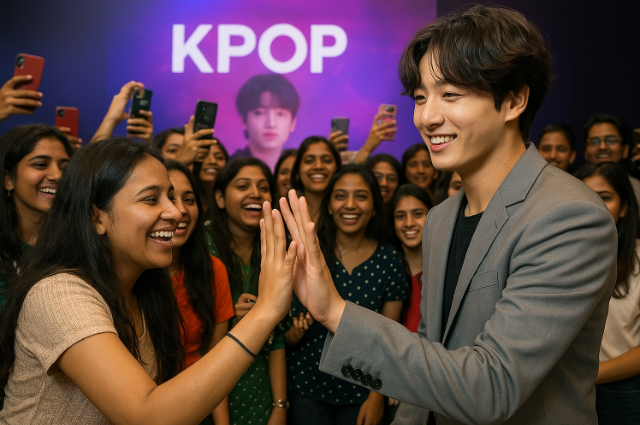
Over the past decade, K-pop has grown from a niche hobby in India to a major cultural force. Thanks to platforms like YouTube, Spotify, and fast-expanding social-media communities, Indian listeners began discovering Korean music, dramas, and idols at a pace that even industry insiders did not anticipate. Today, India is home to one of the most active and loyal K-pop fanbases in the world. This rising wave has now evolved into a business opportunity so significant that South Korea’s biggest entertainment giants. HYBE and JYP Entertainment are looking at India not just as a fanbase market but as a future production hub with global potential. This shift marks the beginning of a new chapter in India's entertainment ecosystem, blending Korea’s creative expertise with India’s massive, digitally driven youth culture.
HYBE, one of the world’s most influential entertainment companies, was originally founded in 2005 by producer Bang Si-hyuk under the name Big Hit Entertainment. What began as a modest agency eventually transformed into a global powerhouse with the unprecedented rise of BTS. Over time, HYBE expanded into a multi-label corporation spanning music, gaming, education, and global artist management. JYP Entertainment, founded in 1997 by Park Jin-young. stands as another foundational pillar of the Korean entertainment industry and is home to groups like TWICE, Stray Kids, and ITZY. Both HYBE and JYP are widely recognised for producing globally successful artists and developing the highly structured K-pop training and storytelling system that many countries have attempted to replicate.
Yet despite India’s massive fanbase, the country remained largely untapped. not because of lack of interest, but due to the absence of a formal training, networking, and production pipeline. That reality shifted dramatically in 2025.
In September 2025, HYBE officially announced the launch of HYBE India Entertainment Private Limited in Mumbai, making it its fifth global headquarters after Japan, the U.S., Latin America, and China. This move was not symbolic; it was a data-backed strategic decision. HYBE highlighted that India now has around 185 million streaming users, one of the largest digital music consumer bases globally, and Spotify India alone recorded over 183 billion annual streams. These numbers made India impossible to ignore.
Additionally, India’s overwhelming social-media engagement, with millions of daily interactions with Korean artists on Instagram and YouTube. Proved that the demand was not passive. Indian fans were actively participating on platforms like Weverse, logging in to watch idols go live, posting real-time comments, and even getting opportunities to interact directly with their favourites. This level of engagement signaled both strong market potential and cultural readiness, encouraging HYBE to establish a long-term base in India.
HYBE chose Mumbai intentionally. As the centre of Indian entertainment, advertising, fashion, and youth culture, Mumbai offers the ideal environment for an agency seeking to discover and train local talent. In its statement, HYBE expressed its vision to let “the voices of India become global stories,” aligning perfectly with Mumbai’s identity as the “city of dreams.” HYBE India plans to hold nationwide auditions, introduce structured training programmes tailored to Indian performers, support regional content creators, and integrate Indian trainees into its global multi-label system. When HYBE India debuted on social media with a simple “Namaste India” post in November 2025, it marked the beginning of a long-term cultural partnership.
While JYP Entertainment has not yet set up an official Indian division, its growing fanbase and India-oriented marketing suggest that the company may soon follow HYBE’s lead. Stray Kids is one of the most-streamed boy groups in India, and TWICE continues to have a steady and dedicated audience. Industry analysts believe JYP is observing HYBE’s model closely before making similar investments. If both companies establish operations in India, it could trigger a major cultural transformation that extends beyond fandom. into content production, global collaborations, and new creative pathways for Indian artists.
The momentum is already visible. As a clear sign of commitment, HYBE is bringing the global exhibition “GOLDEN: The Moments” to Mumbai from December 12, 2025. a milestone that allows Indian ARMYs to experience K-pop on a scale previously reserved for global capitals. The exhibition, produced in partnership with BookMyShow Live, will feature immersive zones displaying Jungkook’s performance outfits, studio recordings, visual effects, and exclusive behind-the-scenes content. Fans across cities are already excited by the announcement alone. This exhibition is more than a fan event. It marks HYBE’s first major on-ground initiative in India and signals the beginning of deeper integration between Indian fandom and global K-pop activities.
Meanwhile, on the innovation front, G-Dragon’s partnership with Galaxy Corporation, a South Korean AI-entertainment company. adds another dimension to the expanding Hallyu wave. Although not connected directly to HYBE or JYP, this collaboration reflects a wider trend where Korean entertainment increasingly blends technology, music, and cultural branding. Galaxy Corporation’s work with digital avatars and interactive virtual experiences shows where the future of fan engagement might be headed, especially in digitally active markets like India.
Together, these developments present a clear picture: India is no longer standing outside the global K-pop movement. it is becoming an essential part of it. HYBE’s expansion marks a structural shift in how global entertainment companies view India, and JYP’s rising influence suggests that others may soon integrate Indian audiences into their core global strategies. As India strengthens its position as a digital superpower, the connection between Korean entertainment and Indian fans is only set to grow, opening new opportunities for fans, creators, and the entertainment workforce.
In conclusion, the Indian entertainment landscape is entering a defining moment. With HYBE formally establishing its Indian operations and JYP preparing for future expansion, India has moved from being a passive consumer of K-pop to becoming a strategically important global market. For years, Indian fans have admired their favourite idols from a distance. streaming music, joining Weverse lives, and interacting through social media. Now, for the first time, they can look forward to experiencing these moments in person through concerts, exhibitions, and on-ground fan events. This transition brings fans closer to their artists while also opening doors to collaborations, creative partnerships, and even career opportunities with these global entertainment companies.
HYBE’s decision to include India for the first time in BTS’s upcoming world tour reflects this shift clearly. It shows that Indian audiences are no longer just enthusiastic, they are influential enough to shape global tour routes. Similarly, the upcoming Jungkook “GOLDEN: The Moments” Exhibition in Mumbai marks HYBE’s first physical step into the Indian market and demonstrates strong confidence in India's capacity to support large-scale fan engagement.
Together, these developments highlight a partnership that stands to benefit both sides: Korea brings its expertise in global content creation, while India contributes scale, creativity, and one of the strongest fan communities in the world. As companies, artists, and audiences continue to grow together in this evolving space, India is no longer just watching the K-pop wave. it is becoming a central part of its future.