
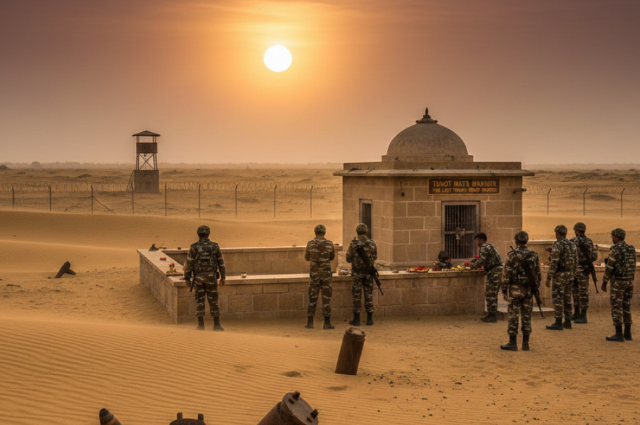
At the edge of India’s western frontier, where the land slowly gives way to fences, watchtowers, and silence, stands a temple that should not exist. Tanot Mata Temple is located in the Jaisalmer district of Rajasthan, barely a few kilometres from the India–Pakistan border. The geography around it is harsh and unforgiving, an endless stretch of desert where summers burn, and winters cut deep. Historically, this region has never been safe or stable. It has seen invasions, troop movements, artillery fire, and two full-scale wars. And yet, in the middle of this vulnerable landscape, Tanot Mata stands intact, calm, and unbroken. This is why it is known as the last temple before the border. Beyond it, there is no civilian life, no villages, no everyday worship, only military posts and contested land.
The history of Tanot Mata goes back centuries, long before modern borders were drawn. The temple is believed to be dedicated to Hinglaj Mata, a form of the divine feminine worshipped across parts of Rajasthan and Sindh. For generations, local communities have considered this land sacred, a place of quiet strength rather than grandeur. The temple itself is simple in structure, not marked by elaborate carvings or towering spires. Its power lies not in architectural dominance but in presence. It has always been a place where people came to pray for protection, especially in a land where survival was never guaranteed. Over time, Tanot Mata became woven into the emotional geography of the desert, a point of faith in a place where nature itself could feel hostile.
What makes Tanot Mata extraordinary is how deeply it is respected by those who live around it and those who guard it. The local villagers speak of the temple not with dramatic claims but with quiet certainty. For them, it is a protector, a constant in an uncertain land. Soldiers posted in the region treat the temple with equal reverence. Before patrols, before long nights of duty, many visit the shrine, not necessarily asking for miracles, but for courage and clarity. Respect here is not loud or performative. It is shown through care, through discipline, through the belief that this place has watched over generations. That respect deepened after history tested the temple in ways no one could have imagined. Tanot Mata sits in what is historically one of the most vulnerable locations imaginable. It lies close enough to the border to be within direct artillery range. During times of conflict, this land becomes a target by default. Any structure standing here should have been reduced to rubble long ago. And yet, when war came, the temple did not fall. It stood directly in the firing range of two full-scale wars, absorbing the shock of history without collapsing. It was not hidden or shielded. It was exposed. Hundreds of live artillery shells landed in and around the temple complex. Still, the structure remained untouched. This contradiction between expectation and reality is what turned a place of worship into a subject of national wonder.
The year 1965 marked the moment when Tanot Mata entered the collective memory of soldiers and civilians alike. As war broke out between India and Pakistan, the Tanot post became a strategic point. Heavy artillery fire was directed towards the area, with the intention of weakening Indian defences. Shells rained down on the desert, tearing through sand and silence. Many of them fell directly into the temple premises. Soldiers stationed nearby expected destruction. They prepared themselves for loss. But what followed defied every assumption shaped by war. The shells did not explode. One after another, they landed, buried themselves in the ground, and remained silent. For the soldiers witnessing this, the experience was deeply unsettling and strangely comforting at the same time. In the middle of fear, exhaustion, and uncertainty, something stood firm. Stories began to circulate among the troops. Some spoke of dreams, of the goddess appearing and assuring protection. Whether taken literally or metaphorically, what mattered was the effect. Morale strengthened. Fear loosened its grip. Faith entered the battlefield, not as blind belief, but as emotional grounding. In a war where death could come without warning, the presence of something untouched felt like a sign that they were not entirely alone.
Six years later, history repeated itself. In 1971, during the Battle of Longewala, the region once again became a war zone. Tanks moved across the desert. Explosions shook the ground. The scale of violence was even larger than before. Everything around Tanot Mata bore marks of conflict. The land was scarred. Structures nearby suffered damage. Yet again, the temple remained standing. No cracks. No collapse. No visible harm. By this point, coincidence became a difficult explanation to hold onto. What had once been an anomaly became a pattern.
Today, Tanot Mata houses a small museum that quietly presents what words cannot fully explain. Inside, unexploded bombs from both the 1965 and 1971 wars are preserved. These are not replicas or symbolic objects. They are real, recovered from the surrounding desert. For those who do not believe stories passed down through voices, this space offers something else. It allows people to see with their own eyes. The museum does not attempt to interpret or explain. It simply displays. In doing so, it leaves visitors to confront the mystery on their own terms.
The story of Tanot Mata has naturally sparked debate between science and faith. For the Border Security Force and local communities, the explanation is simple. The temple is a protector. Faith here is lived, not argued. The respect extended to the temple goes beyond national lines. After the war, a Pakistani brigadier, Shaukat Ali, reportedly visited the temple and offered a silver canopy as a mark of reverence. This gesture carries emotional weight because it reflects respect beyond borders. Even an enemy, shaped by the same battlefield realities, acknowledged that something about this place was unusual.
From a scientific perspective, explanations exist, though none feel entirely sufficient. The desert sand in this region is soft and deep. It can absorb impact. Faulty fuses in artillery shells are not unheard of. Under certain conditions, shells may fail to detonate. But probability becomes a challenge here. Hundreds of shells falling across two separate wars, all within the same limited area, stretch statistical comfort. Science may not agree with faith, but even it pauses when patterns refuse to dissolve into chance.
The fact that the Border Security Force manages the temple today adds another layer of meaning. This stewardship is not merely administrative. Soldiers do not just guard borders here. They guard memory, faith, and morale. Many carry a small pinch of the temple’s sand with them, not as superstition, but as emotional armour. In places where danger is constant, belief becomes a form of resilience. It steadies the mind. It reminds soldiers why they stand where they do.
When religion and war are stripped away, the story of Tanot Mata becomes something deeply human. It is about how people search for meaning in chaos. It is about how belief survives where logic struggles to offer comfort. Borders may divide land, but they do not divide reverence. In the middle of noise, fear, and destruction, the temple offered stillness. For soldiers fighting under extreme conditions, faith became strength. Memory became purpose. The belief that something watched over them gave them the courage to protect not just territory, but each other.
Tanot Mata does not demand belief. It does not declare miracles. It simply stands. In doing so, it reminds us that some stories endure not because they are explained, but because they are witnessed. And at the very edge of the nation, before the border turns into barbed wire and silence, that quiet endurance continues to speak.
References: