
In a country where most festivals arrive like clockwork every year, some traditions choose to wait. They wait patiently, quietly, gathering meaning with time. Mukka Sendra, also known as Jani Shikar, is one such tradition. Celebrated only once every twelve years, much like the Mahakumbh, it does not announce itself often. But when it does, it carries with it centuries of memory, resistance, and pride.
Practised by the Oraon (Kurukh) tribe across parts of Jharkhand, Odisha, and Chhattisgarh, Mukka Sendra is not just a festival. It is a reminder that history is not always written by kings and armies. Sometimes, it is carried forward by women, through rituals, songs, and shared silence. At its heart, Jani Shikar is a celebration of women’s strength, not as an idea, but as lived truth.
The rhythm of this tradition is slow and deliberate. Once every twelve years, villages prepare not for celebration alone, but for remembrance. The day does not belong to spectacle or decoration. It belongs to women, who step into roles that history once forced upon them, and which tradition has chosen never to forget.
The story of Mukka Sendra begins nearly five centuries ago, at Rohtasgarh Fort, in what is now Bihar. The details live not in textbooks, but in oral stories passed down through generations. According to these accounts, invaders, often identified as Mughal or Turk forces, planned a calculated attack on the Oraon community. Their timing was deliberate. The attack was meant to come right after Sarhul, the spring festival, when men would be tired from nights of celebration, dancing, and drinking hadia, the traditional rice beer.
The attackers assumed victory would come easily. They believed the village would be unguarded, its people unprepared. What they did not expect was resistance from the women.
With the men exhausted and unable to fight, Princess Sinagi Dai, along with Kaili Dai and Champa Dai, refused to accept surrender as the only option. Instead of waiting for rescue, they created their own defence. The women of the village were gathered, dressed in men’s clothing, their heads wrapped in turbans, their hands holding bows, arrows, spears, and farming tools turned into weapons. From a distance, the fort walls appeared guarded by a full army. The invaders hesitated, and then retreated. Not once, but twice. Each time they returned, the women fought back with courage that confused and terrified the enemy. It was only during the third confrontation that the truth began to surface. A spy noticed small gestures—women washing their faces by the river, touching their foreheads in ways the invaders read as feminine. The disguise was revealed, and eventually, the fort fell.
But defeat did not erase the story. Instead, it shaped it.
What could have faded into silence became ritual. The bravery of those women was remembered, honoured, and passed down—not through monuments, but through Mukka Sendra.
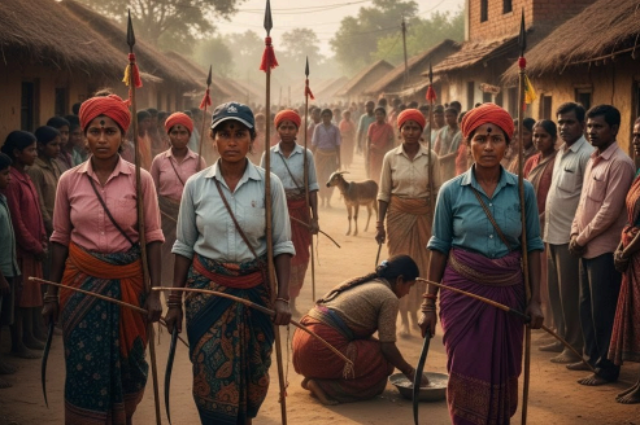
Today, when the twelve-year cycle arrives, the last being in 2017, and the next expected around 2029, the villages prepare once again. When Jani Shikar begins, the social order gently turns on its head. Women dress in men’s clothes. Earlier, this meant the traditional karea; today, it may include shirts, trousers, and caps. They carry symbolic weapons—bows, arrows, spears, and daos—and step out together, not as performers, but as participants in a living memory.
The hunt that follows is not chaotic. It moves like a relay. Women from one village march to the next, where they are welcomed with respect. Their feet are washed, food is served, and their journey is acknowledged. The weapons are then passed on to the women of the host village, who continue the march forward. This continues across villages, strengthening bonds and reminding communities that this tradition belongs to all of them.
In earlier times, animals were hunted as part of the ritual. Today, the practice has adapted. To protect wildlife and maintain harmony, villages often set aside animals symbolically. What matters is not the kill, but the act of participation, leadership, and remembrance. One of the most striking aspects of the day is what men are not allowed to do. Men do not take part in the hunt. They do not cook the feast. They do not eat the food prepared from the catch. For one day, domestic and public roles are reversed—not to humiliate, but to remind. Power, the tradition suggests, is not fixed. It moves. It listens. It remembers.
Food prepared on this day is simple, shared, and symbolic. It is not about indulgence, but about community. The act of cooking becomes as important as the act of hunting. Women are celebrated, respected, and given space—not as an exception, but as tradition.
Among the many symbols of Jani Shikar, one stands out quietly: the three dots worn on the forehead by many Oraon women. According to oral history, when some women warriors were captured during the Rohtasgarh battle, invaders marked their foreheads with three dots to label them as rebels. It was meant to shame them.
Instead, the mark was reclaimed.
Over time, those three dots became a symbol of honour. Today, they appear as traditional tattoos, remembering the three battles fought by the women of Rohtasgarh. What was once meant to erase identity now preserves it. Shame was transformed into pride.
In a modern world that often speaks about empowerment through slogans, Mukka Sendra offers something quieter, and deeper. It shows empowerment through memory. Through shared action. Through ritual that refuses to forget. This tradition matters because it challenges the idea that feminism, courage, or leadership arrived recently. Long before modern conversations began, tribal women were already defending land, making decisions, and shaping history. Mukka Sendra does not reject men; it simply reminds society that strength has never belonged to one gender alone.
For today’s generation, this tradition offers lessons beyond history. It teaches respect without dominance, leadership without loudness, and courage without recognition. It asks us to listen to stories that were never written down, but lived fully.
In remembering Mukka Sendra, we are not just honouring the past. We are learning how dignity survives, and how some traditions choose not to fade.
References: