
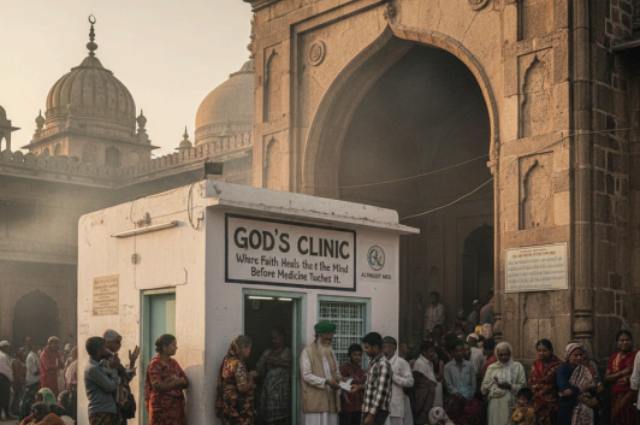
In the quiet village of Unava in Gujarat’s Mehsana district, there stands a shrine that has witnessed human suffering for centuries. Mira Datar Dargah is not surrounded by hospital walls or clinical silence. Instead, it is wrapped in prayer, incense, chants, tears, hope, and belief. For generations, families from across India have travelled long distances to this shrine, believing that something unseen has taken hold of their loved ones. They come not with medical files or prescriptions, but with fear, desperation, and faith. Locally and nationally, Mira Datar Dargah is known as the Supreme Court for spirit possession, a place where the final verdict is believed to be delivered by the divine.
The shrine is dedicated to Hazrat Saiyed Ali Mira Datar, a revered martyr whose legacy is deeply tied to healing and spiritual justice. Long before psychiatry entered rural India, people believed Mira Datar listened to those who were unheard elsewhere. Over time, the Dargah became a refuge for families who had nowhere else to go. Parents brought sons who spoke to invisible figures, wives brought husbands who turned violent overnight, siblings brought sisters who collapsed, screamed, or dissociated without warning. To the families, these were not medical conditions. These were possessions, curses, or spiritual disturbances caused by Jinns.
Every day, thousands gather inside the Dargah complex. Some stay for days, others for weeks, performing rituals, offering prayers, waiting for miracles. What they do not realise is that medically, a majority of these patients are not possessed at all. They are suffering from paranoid schizophrenia, bipolar disorder, or conversion disorder, conditions that are treatable with consistent psychiatric care. Yet these patients would never have entered a mental health clinic on their own. In rural India, mental illness carries a stigma heavier than the illness itself. Hospitals represent shame, labels, and rejection. Faith, however, represents acceptance.
This gap between belief and medicine is where most mental health programs fail. They arrive with pamphlets, awareness campaigns, and lectures aimed at replacing faith with science. Resistance follows immediately. Patients refuse treatment. Families pull away. Doctors sit in empty clinics while religious shrines overflow with untreated mental illness. Mira Datar Dargah was no different until a quiet intervention changed everything.
The transformation did not begin with doctors or government policy. It began with a social worker named Milesh Hamlai. His understanding of mental illness was not academic alone. It was deeply personal. His brother suffered from schizophrenia, and Hamlai witnessed firsthand the confusion families face when medical logic collides with societal stigma. He saw parents torn between hospital advice and community judgment, between pills and prayer. This conflict led him to a realisation that would reshape mental health intervention in traditional societies. The problem was not ignorance. The problem was trust.
Hamlai noticed something striking. Psychiatrists were waiting in clinics with expertise and medicine, while patients were standing in religious spaces seeking answers. Instead of asking why people avoided doctors, he asked a different question. What if doctors went where the patients already believed healing existed? From this thought emerged Altruist, an NGO based in Ahmedabad, founded not to challenge faith but to collaborate with it.
The core innovation that followed is now known as the Divine Referral. It is deceptively simple yet psychologically powerful. When a family arrives at Mira Datar Dargah seeking an exorcism, the Mujavir, the faith healer, performs the ritual as expected. The prayers are recited. The faith is affirmed. But instead of sending the family away afterwards, the Mujavir hands them a referral slip. He tells them that the spirit is strong and that to make the Dua work faster, the patient must take Dava from the clinic next door. The medicine is framed not as a replacement for faith, but as a tool that strengthens it.
The patient then walks into a government-supported clinic located inside the Dargah compound. There, psychiatrists diagnose and prescribe antipsychotic medication. The patient takes the pills believing they weaken the spirit, allowing the prayer to succeed. Slowly, symptoms reduce. Hallucinations fade. Mood stabilises. Families witness improvement and attribute it to the blessing of the shrine. Treatment adherence increases because belief has been preserved rather than attacked.
This system required dismantling deep-rooted hostility between faith healers and medical professionals. Initially, Mujavirs resisted strongly. They feared doctors would steal their followers and expose rituals as superstition. Hamlai addressed this not with confrontation but with negotiation. He explained that doctors would manage violent and severe cases that healers struggled to control, making their own work easier. Over time, a fragile trust formed.
Another conflict emerged around credit. Who would be acknowledged for the cure? The solution was radical humility. Doctors agreed to let faith healers take the credit. When a patient improved, psychiatrists openly said it was the Dargah’s blessing. This lack of ego became one of the most crucial elements of success. Healing was prioritised over recognition.
From a psychological perspective, this model aligns strongly with Cognitive Dissonance Theory. Patients and families hold a belief that illness is spiritual. Introducing medical treatment directly contradicts this belief and creates resistance. The Divine Referral avoids this conflict by reframing medicine within the belief system. The pill does not challenge faith. It supports it. This reduces psychological discomfort and increases acceptance.
The model can also be examined through Lewin’s Change Management framework. The unfreezing stage occurs when families acknowledge something is wrong and seek help at the shrine. The change stage happens subtly when medication is introduced through a trusted authority. The refreezing stage occurs when recovery reinforces the belief that both prayer and medicine work together, solidifying a new behavioural norm without forcing ideological change.
One documented case involved a young man brought to the Dargah after months of paranoia and aggression. His family believed he was possessed. After ritual prayers, the Mujavir referred him to the clinic. He was diagnosed with schizophrenia and placed on antipsychotic medication. Over the weeks, his symptoms reduced significantly. When interviewed later, the family credited Mira Datar’s blessings, unaware or unconcerned with medical terminology. The result mattered more than the explanation.
Since its launch in 2008, the project has treated over thirty-eight thousand patients. It has been cited by the Supreme Court of India as a model mental health intervention for other states. Researchers studying the program have documented improved recovery rates, reduced stigma, and lower economic burden on families. Because patients recover faster, families spend less time and money staying in Unava, preventing debt accumulation caused by prolonged rituals and accommodation costs.
What makes this model exceptional is not innovation in medicine, but innovation in humility. It respects tradition while treating illness. It recognises that in deeply cultural societies, belief is not an obstacle but a pathway. Mira Datar Dargah has quietly become a place where superstition and science coexist, where pills and prayers share space, where healing begins not by correcting people, but by understanding them.
In a country where mental illness is often hidden, denied, or punished, this shrine tells a different story. It proves that progress does not always require rejection of the past. Sometimes, the future of healthcare lies in walking barefoot into sacred spaces, listening first, and prescribing later. At Mira Datar Dargah, faith does not disappear when medicine arrives. Instead, it opens the door.
References
- Altruist NGO, founded by Milesh Hamlai, Ahmedabad, Gujarat: www.thealtruist.org
- Shields L et al, How can mental health and faith-based practitioners work together, Transcultural Psychiatry, 2016
- Unique collaboration of modern medicine and traditional faith healing for the treatment of mental illness, Best practice from Gujarat, Read on ResearchGate.
- Satyamev Jayate, Season 3 Episode 5, Nurturing Mental Health, Interview with Milesh Hamlai
- PBS News, India Mental Health Care, Documentary coverage of Mira Datar Dargah clinic