
I didn’t arrive at the idea of anti-consumerism through theories or books. It grew on me slowly, through what I’ve seen and experienced in real life. In a world where loud success is often confused with real success, choosing simplicity feels rare and quietly powerful. I didn’t fully understand this until I witnessed it up close.
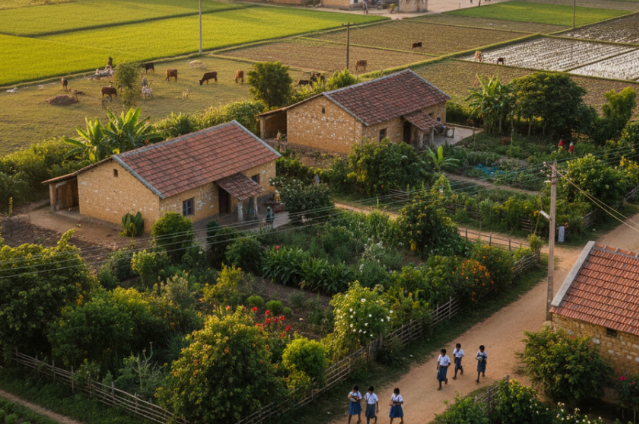
I remember visiting my grandparents’ hometown, a place that immediately felt different from the cities we’re used to. What struck me first was the houses. They were minimal, simple, and beautifully structured. Not flashy. Not overloaded with marble, glass, or unnecessary decoration. No oversized gates trying to announce wealth. Yet every house looked complete, intentional, and deeply lived-in. These homes weren’t trying to impress anyone; they were simply built to exist well.
There’s one house I still remember clearly. It was large, but incredibly simple. Well-structured, balanced, and calm. It had a small garden, lush, green, and alive. The greenery almost felt like the soul of the house. Looking at it, you couldn’t tell whether the family living inside was rich or poor. And that was the point. The house didn’t scream status; it spoke comfort. It didn’t demand attention; it earned respect.
Before this experience, I carried a very common assumption: the richer the person, the flashier their house must be. Bigger money meant bigger display. But seeing these homes completely changed that belief. As I spoke to people there and had conversations about life, money, and choices, I slowly understood that this simplicity wasn’t accidental. It was deliberate.
The people there believed their money should be invested, not exhibited. They spoke about buying better seeds, expanding land, investing in dairy cattle, improving farming techniques, and most importantly, funding their children’s education. Their idea of a “good lifestyle” wasn’t defined by how their house looked from the outside, but by how secure and sustainable their lives were on the inside.
What stood out to me was how much they valued a quiet life. There was no urge to prove wealth to others. No pressure to compete visually. It reflected a deep understanding that quiet confidence always wins over loud validation. In farming communities especially, they believed that maintaining simplicity helped preserve unity. When everyone lives modestly, relationships stay intact. Jealousy doesn’t creep in as easily. Comparison doesn’t poison bonds.
This reminded me of what many people call “new money,” the kind of wealth that seeks validation through display. In contrast, the people who had been there for generations understood reinvestment. They knew that money grows when it’s put back into productive systems, not when it’s drained into appearance. Their wealth wasn’t meant to talk; it was meant to work.
We often grow up believing that success only counts if others can see it. That wealth means visibility. That status is something you show. But when I learned about places like Hiware Bazar, this idea began to crack. There, wealth isn’t measured by the size of a gate or the shine of tiles. Status is measured by productivity. By how green your fields are. By how healthy your cattle are. By how educated your children become.
This doesn’t mean one value system is evil and the other is right. It simply means different values create different outcomes. People who spend heavily on material display may gain recognition and social attention, but it often comes with comparison and jealousy. Others choose simplicity, not because they lack money, but because they value peace, relationships, and long-term security more than momentary applause.
Anti-consumerism, in this sense, shapes society very quietly. It doesn’t announce itself. It influences behavior slowly. When people see that dignity doesn’t depend on luxury, they begin to rethink their own choices. They realise that living a simple, decent life holds more value than constantly chasing symbols of success.
In such communities, restraint becomes a form of protection. Simplicity turns into a social achievement. Anti-consumerism here isn’t poverty, it’s intentional restraint. It’s the understanding that just because you can spend, it doesn’t mean you should.
This is where the psychology becomes important. Leaders like Popatrao Pawar understood something many societies overlook: people don’t compare incomes, they compare lifestyles. Visible inequality hurts more than actual inequality. When one person builds a palace while another struggles nearby, the gap isn’t just economic; it becomes emotional. That feeling of relative deprivation doesn’t motivate; it fractures unity.
When success becomes a threat instead of inspiration, communities suffer. By discouraging showy consumption, the village protected itself from internal division. Clean but modest homes, healthy farms, educated children, this became the new definition of success. Status shifted from consumption to contribution.
I’ve also personally noticed, through conversations, that families who live simply often have a deeper awareness about long-term growth. Their discussions revolve around sustainability, education, and planning ahead. Again, this isn’t a rule; it’s an observation. Loud display doesn’t automatically mean lack of wisdom, and simplicity doesn’t guarantee it. But patterns do emerge when values are consistent.
What struck me most was how this mindset redefines success entirely. Success isn’t what you show people today; it’s what remains with you tomorrow. It’s sustainability. It’s thinking about your future self, your family’s future, and the continuity of your work.
In Hiware Bazar, success is visible in outcomes, not appearances. A well-maintained field speaks louder than a marble floor. An educated child carries more status than a luxury car. A stable community holds more power than an individual displays. This culture quietly challenges the modern obsession with consumerism. It reminds us that wealth doesn’t have to announce itself to be real. Sometimes, the richest choices are the ones that don’t demand attention at all.
Anti-consumerism, in this form, isn’t about rejecting comfort or progress. It’s about choosing intention over impulse. Purpose over performance. It shows us that restraint can preserve unity, that simplicity can hold dignity, and that real wealth often lives in silence, working patiently, growing steadily, and sustaining generations to come.
. . .
References: