
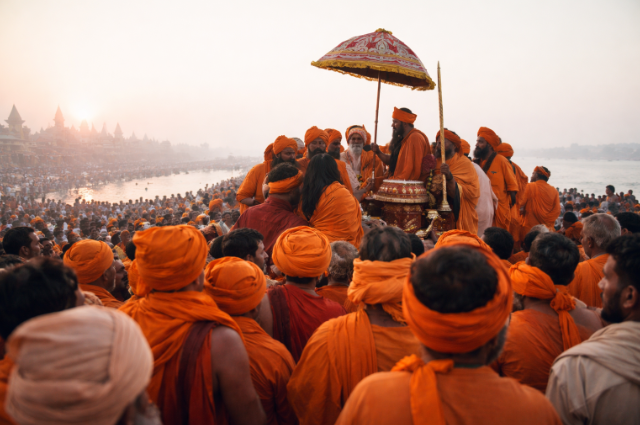
The controversy that unfolded at the Magh Mela in Prayagraj in January 2026 did not begin as a dramatic confrontation, but as a moment that revealed the fragile balance between faith, law, and governance in contemporary India. The Magh Mela is one of the most sacred Hindu gatherings, where millions of devotees come together to take a holy dip at the confluence of the Ganga, Yamuna, and the mythical Saraswati. For pilgrims, the act of bathing in these waters is not symbolic alone. It is deeply emotional, personal, and spiritual. On Mauni Amavasya, the most crowded and significant bathing day of the festival, this emotional intensity reaches its peak. It was on this very day that Swami Avimukteshwaranand Saraswati, who claims the title of Shankaracharya of Jyotirmath, was stopped by the administration while leading a religious procession toward the river. What followed was not just a disagreement over movement and permission, but a controversy that exposed deeper questions about authority, dignity, and the role of the state in religious spaces.
From the administration’s point of view, the situation was rooted in safety concerns. Mauni Amavasya sees an overwhelming surge of devotees, and even a small disruption can trigger panic or a stampede. Officials stated that allowing an unscheduled procession in an already congested area could endanger lives. Their decision to halt the procession near a pontoon bridge was framed as an act of crowd management, not religious interference. In large gatherings like the Magh Mela, the state carries the responsibility of ensuring that faith does not turn into tragedy. Past experiences of stampedes at religious events have made administrations cautious, sometimes even rigid, in enforcing rules. In that sense, the stopping of the procession was, administratively speaking, a preventive step rather than a targeted action.
However, the matter did not remain limited to crowd control. Shortly after the procession was stopped, the Magh Mela authority issued a formal notice to Swami Avimukteshwaranand, asking him to explain his use of the title “Shankaracharya” in public events. The notice cited the fact that a legal dispute regarding the Jyotirmath Shankaracharya title has been pending before the Supreme Court since 2022. This legal ambiguity meant that, from the state’s perspective, the title had not been conclusively settled. The administration argued that it was within its rights to seek clarification, especially when public platforms and large gatherings were involved. What may have seemed like a procedural step to officials was perceived very differently by the saint and his followers.
For Swami Avimukteshwaranand and his supporters, the incident felt like a deep personal and spiritual insult. They viewed the stopping of the procession as a humiliation of religious tradition and authority. According to them, a saint leading devotees to a sacred river should not require bureaucratic permission, especially on a day that holds immense spiritual value. Allegations were also made that followers were handled roughly by officials, further intensifying emotions. In response, the swami refused to take the holy dip and began a sit-in protest outside his camp, accompanied by a fast. This act transformed the situation from an administrative disagreement into a symbolic stand. It was no longer just about a procession, but about dignity, faith, and the perceived intrusion of the state into sacred space.
As news of the incident spread, political reactions quickly followed. Leaders from different parties entered the debate, each interpreting the event through their own ideological lens. Some defended the administration, emphasising that law and order and public safety must come first, regardless of religious status. Others accused the authorities of disrespecting a revered spiritual figure and hurting religious sentiments. What could have remained a local issue soon became a national talking point. Television debates, social media posts, and public statements amplified the narrative, turning it into a broader discussion about whether the state was overstepping its boundaries or simply performing its duty. In the process, the original context of crowd safety began to blur under louder political messaging.
The reason this incident resonated so widely lies in the multiple layers it touched at once. The title of Shankaracharya is not just an honorific. It carries centuries of spiritual authority and commands deep respect among devotees. Questioning its use, even on legal grounds, inevitably triggers emotional responses. At the same time, the legal dispute surrounding the title introduced a complication that could not be ignored by the administration. The state found itself navigating a space where religious belief, legal process, and public safety overlapped. Each decision, or even delay, carried the risk of being misinterpreted. For devotees, the river represents liberation and faith. For the saint, it symbolized spiritual duty. For the state, it was a site requiring regulation and control.
This controversy also highlights a recurring tension in Indian democracy. The country is deeply religious, yet constitutionally secular. The state is expected to respect faith while also regulating large-scale events to ensure safety and order. When religious authority clashes with administrative authority, the outcome is rarely simple. In Prayagraj, the river became a silent witness to this clash. To devotees, denying access felt like denying faith. To officials, enforcing rules felt like preventing disaster. Both sides believed they were acting responsibly, yet the lack of mutual understanding widened the gap.
In the end, the Magh Mela incident was not about one saint or one notice alone. It reflected how easily administrative decisions can be perceived as personal or ideological attacks in emotionally charged environments. It also showed how quickly such moments can be politicised, shifting focus from practical concerns to symbolic battles. The controversy forced uncomfortable questions into public conversation. Can the state regulate religious practice without being seen as disrespectful? Can religious authority operate outside legal scrutiny? And where should the line be drawn when faith and governance meet at the same riverbank?
The river, the saint, and the state each represent powerful forces in Indian society. When they flow in harmony, faith and order coexist. When they collide, even a single halted procession can turn into a national debate. The Magh Mela controversy serves as a reminder that in a country where belief runs deep, governance requires not just rules and notices, but sensitivity, dialogue, and trust.
. . .
References:
- Notice & controversy over the “Shankaracharya” title
Magh Mela authority issued a notice to Swami Avimukteshwaranand over his use of the Shankaracharya title: https://www.republicworld.com - Another news on the title issue and political reactions: https://www.thewire.in
- Detailed coverage on the notice and controversy: https://www.ibtimes.co.in
- Admin questions title use amid holy dip clash: https://news.abplive.com
- Notice details and legal context: https://www.newindianexpress.com
- Hindi coverage on the notice at Magh Mela: https://hindi.news24online.com
- Another Hindi report explaining the controversy at Magh Mela: https://hindi.oneindia.com
- IANS news on the title notice and Supreme Court context: https://ianslive.in