
In January 2026, silence arrived in parts of Telangana long before outrage did. It was not the silence of peace or resolution, but the unsettling quiet that follows disappearance. In villages across Hanamkonda, Kamareddy, and nearby districts, stray dogs that had lived alongside communities for years vanished within days. These were animals people recognised, fed occasionally, avoided sometimes, complained about often, but ultimately coexisted with. Their sudden absence did not raise alarms immediately. It felt like an administrative solution had finally arrived. Only later did it become clear that this silence was manufactured through violence. Over five hundred stray dogs were allegedly killed in the span of two weeks, not as an act of desperation, but as a fulfilment of political promises made during local elections.
The roots of this incident lie in the December 2025 Gram Panchayat elections, where several candidates framed stray animals as symbols of administrative failure. Campaign speeches reportedly promised dog-free and monkey-free villages, appealing to public fear of attacks and inconvenience. In a climate where quick solutions win votes, these assurances resonated. What was not discussed was how such promises would be executed. Investigations later revealed that newly elected sarpanches allegedly ordered mass cullings almost immediately after assuming office. Instead of consulting veterinary departments or implementing Animal Birth Control programmes, contractors were hired quietly. Reports indicate that professional dog catchers were brought in from neighbouring states like Andhra Pradesh. The operation was organised, systematic, and carried out away from public scrutiny.
The methods used reveal the calculated nature of the act. Lethal injections and poisoned bait were allegedly employed, ensuring speed and minimal resistance. Dogs were targeted one by one, often during night hours or early mornings when public movement was low. Bodies were dumped in open fields, buried hastily, or left near temples and secluded areas. The intention was clear. Remove the evidence before questions can be asked. This was not a chaotic outburst of cruelty. It was a planned administrative exercise disguised as problem-solving. The killings spread across villages like Shayampet, Arepally, Bhavanipet, Palwancha, Faridpet, Wadi, and Bandarameshwarapally. In Hanamkonda alone, estimates suggest nearly three hundred dogs were killed. Kamareddy followed with over two hundred deaths.
What is most troubling is how long this continued without resistance. Villagers later admitted they noticed the disappearance but assumed it was authorised. This assumption created a dangerous moral vacuum. When violence carries the illusion of legitimacy, people stop questioning it. Some residents expressed relief, others discomfort, but very few intervened. Children asked where the dogs had gone. Adults chose silence. This collective inaction illustrates how communities become passive participants when authority normalises cruelty. The absence of protest was not born from agreement alone, but from fear of challenging local power structures. In this way, governance did not merely fail. It actively silenced empathy.
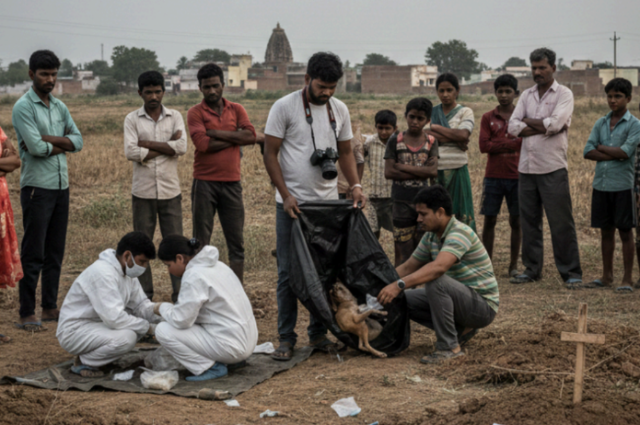
The truth emerged only after animal welfare activists began documenting the disappearances. Adulapuram Goutham and others raised alarms after discovering carcasses and burial sites. Veterinary teams were brought in, and exhumations followed. Post-mortem examinations confirmed unnatural deaths, prompting forensic investigations. Viscera samples were sent to the Forensic Science Laboratory to identify the toxins used. Once images and reports surfaced, national outrage followed swiftly. What had been an invisible local act became a national conversation about cruelty, accountability, and the limits of political authority.
The legal response that followed was significant but delayed. Telangana Police registered multiple First Information Reports against fifteen to seventeen individuals, including at least seven sarpanches. Charges were filed under Section 325 of the Bharatiya Nyaya Sanhita, which addresses killing or maiming animals, along with provisions of the Prevention of Cruelty to Animals Act. These charges acknowledged that the killings were illegal, not administrative measures. However, the delay between action and accountability exposes a systemic flaw. Justice arrived only after irreversible harm had occurred. The law responded to death rather than preventing it.
The timing of the incident further intensified its significance. The mass killings coincided with Supreme Court hearings on the stray dog issue across India. While the Court recognised the genuine concerns of dog bite injuries and public safety, it firmly reiterated that mass culling is illegal and unacceptable. It emphasised that local bodies are legally bound to follow Animal Birth Control rules, which prioritise sterilisation, vaccination, and population management over elimination. These guidelines exist precisely to prevent reactionary violence. Yet in Telangana, elected leaders bypassed this framework entirely, choosing speed and spectacle over legality and compassion.
This contradiction highlights a deeper issue within democratic governance. When elected officials treat lives as obstacles rather than responsibilities, democracy loses its ethical foundation. The Telangana incident reveals how electoral pressure can distort decision-making at the grassroots level. Promises made for votes transformed into actions taken without foresight. Stray dogs became symbols of inconvenience rather than living beings protected under the law. The choice to eliminate rather than manage reflects a mindset that values immediate visible results over sustainable solutions.
Beyond legality, the incident raises psychological questions about collective morality. How does a community watch mass violence unfold without intervening? Studies in social psychology describe this phenomenon as diffusion of responsibility, where individuals assume someone else will act. In village settings, this effect is amplified by power hierarchies and fear of social isolation. When leaders endorse cruelty, resistance becomes risky. Over time, silence becomes normal. This is how violence embeds itself quietly within everyday life.
The Telangana case also exposes a recurring flaw in how animal welfare is perceived. Stray animals are often treated as temporary problems rather than shared responsibilities. Yet public safety and animal welfare are not opposing goals. Scientific evidence consistently supports Animal Birth Control programmes as the most effective long-term solution. Sterilised and vaccinated dogs reduce population growth and aggression. Poison and injections achieve only a temporary absence, followed by ecological imbalance and eventual return of the problem. By ignoring this, authorities not only violated the law but undermined public safety itself.
What occurred in January 2026 is not an isolated incident. It reflects a broader pattern where convenience becomes policy and ethics are sidelined. When governance prioritises removal over reform, it sets a dangerous precedent. If animals can be eliminated for convenience, what other inconveniences may follow the same path? The silence that followed the killings is as alarming as the act itself. It reveals how quickly societies adjust to cruelty when it is framed as a necessity.
The deaths of over five hundred stray dogs in Telangana are not merely statistics in a news report. They are evidence of a system that failed at multiple levels: political, legal, moral, and social. Accountability may unfold in courtrooms, but the deeper reckoning lies within the collective conscience. Governance is not measured by how efficiently problems disappear, but by how responsibly they are addressed. When poison becomes policy, society pays a price far greater than inconvenience. It loses its humanity.
References
- The Hindu, 550 stray dogs killed in Telangana in one week to fulfil poll promise.
- Times of India, Mass culling exposed in Telangana, lethal injections wipe out 500 stray dogs.
- Indian Express, In Telangana, mass killing of stray dogs, police action puts entire villages on edge.
- Livemint, Why 500 stray dogs were killed in Telangana Kamareddy, and Hanamkonda explained.
- PTI News, Police register case against nine after 300 stray dogs killed in Hanamkonda.
- NDTV, Telangana Panchayat kills 500 dogs in a week to fulfil election promise.
- WION, Telangana dog killings activists sue village heads over mass culling.