
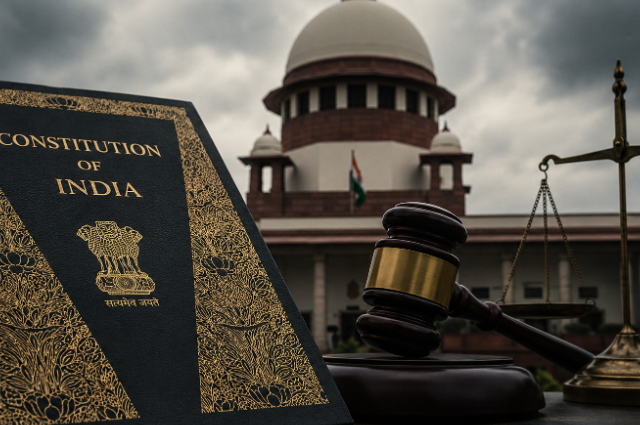
The Constitution of India represents a foundational legal and moral framework that has sustained the world’s largest democracy for over seven decades. However, contemporary political, institutional, and socio-economic developments have prompted renewed scholarly debate regarding whether the Constitution stands at a critical juncture. This essay evaluates the structural challenges confronting Indian democracy, focusing on executive dominance, institutional erosion, federal tensions, judicial independence, and civil liberties. While acknowledging the resilience of constitutional mechanisms, it argues that the cumulative effect of these pressures necessitates urgent reflection on constitutional morality and democratic accountability. Since its adoption in 1950, the Constitution of India has served as a transformative instrument, guiding India’s transition from colonial subjugation to a sovereign democratic republic. Drafted under the leadership of B. R. Ambedkar, it aimed to harmonise diversity with unity and liberty with social justice. The constitutional design incorporated a system of checks and balances, a federal structure with unitary features, and a robust framework of Fundamental Rights.
In recent years, however, scholars have increasingly questioned whether the constitutional order is experiencing structural strain. The metaphor of a “crossroads” captures a moment of decision—whether the trajectory of governance will reinforce constitutional ideals or gradually depart from them. This essay critically examines these concerns, situating them within the broader framework of democratic theory and constitutional practice.
Historical Foundations and Constitutional Philosophy
The philosophical underpinnings of the Indian Constitution reflect a synthesis of liberal democracy, social justice, and pluralism. Influenced by global constitutional traditions and indigenous political thought, the framers sought to create a document that was both aspirational and pragmatic.
Central to this vision was the concept of constitutional morality, articulated by B. R. Ambedkar. He emphasised that the success of the Constitution depended not merely on its textual provisions but on the ethical commitment of those entrusted with its implementation. This principle remains critical in assessing contemporary challenges.
The Constitution established:
- A parliamentary system of governance
- An independent judiciary
- Fundamental Rights enforceable by courts
- Directive Principles guiding state policy
These elements collectively formed a framework intended to prevent the concentration of power and ensure accountability.
One of the most debated structural challenges is the increasing centralisation of power within the executive. In a parliamentary democracy, the executive is drawn from the legislature, creating an inherent overlap. However, the effective functioning of this system depends on active legislative scrutiny.
Recent trends suggest a decline in parliamentary deliberation. Legislative sessions have often been marked by reduced debate, expedited passage of bills, and limited committee scrutiny. The frequent use of ordinances raises further concerns about bypassing legislative processes.
This shift risks undermining the principle of separation of powers. While efficiency in governance is important, excessive executive dominance can weaken democratic accountability and erode institutional balance.
Judicial Independence and Constitutional Adjudication
The judiciary has historically played a pivotal role in safeguarding the Constitution. Through judicial review, it has ensured that legislative and executive actions remain within constitutional limits. The landmark judgment in Kesavananda Bharati v. State of Kerala introduced the basic structure doctrine, which acts as a bulwark against constitutional amendments that threaten foundational principles.
Despite this strong doctrinal foundation, challenges to judicial independence persist. Delays in judicial appointments, tensions between the judiciary and executive, and concerns about transparency in decision-making have sparked debate.
Additionally, the growing backlog of cases affects access to justice, potentially weakening public confidence in the legal system. While the judiciary continues to function as a critical check, its effectiveness depends on maintaining both independence and institutional credibility.
India’s federal structure, though unique, is designed to accommodate its vast diversity. The Constitution distributes powers between the Union and the states, allowing for both unity and regional autonomy.
However, recent developments indicate increasing centralization. Fiscal policies, legislative interventions, and the use of gubernatorial authority have contributed to tensions between the Union and states. The implementation of nationwide frameworks sometimes raises questions about the erosion of state autonomy.
While a strong centre may be necessary for national integration, excessive centralization risks undermining the federal balance. A cooperative federal model requires mutual respect and dialogue, rather than hierarchical dominance.
Civil Liberties and Democratic Freedoms
Fundamental Rights form the cornerstone of the constitutional framework, ensuring individual freedoms and protecting against state excesses. These rights include freedom of speech, expression, religion, and equality before the law.
In recent years, concerns have emerged regarding restrictions on these freedoms. Legal provisions related to national security, public order, and defamation have sometimes been criticised for limiting dissent. The expansion of digital surveillance has also raised questions about privacy and data protection.
The judgment in Justice K. S. Puttaswamy v. Union of India recognised privacy as a fundamental right, marking a significant advancement. However, the practical enforcement of such rights remains uneven.
Balancing security and liberty is a complex task, but the erosion of civil liberties, even gradually, can have long-term implications for democratic governance.
Electoral Integrity and Democratic Representation
Elections are the bedrock of democratic legitimacy. India’s electoral system, administered by an independent Election Commission, has generally been regarded as robust. However, concerns about campaign finance, media influence, and the role of technology have emerged.
The increasing cost of elections and the influence of money power raise questions about equal representation. Additionally, the use of digital platforms for political communication introduces challenges related to misinformation and voter manipulation.
Ensuring free and fair elections requires continuous adaptation to new realities, while preserving the integrity of the democratic process.
Media, Civil Society, and Public Discourse
A functioning democracy depends on informed public discourse. The media and civil society play crucial roles in shaping opinion, exposing wrongdoing, and holding power accountable.
However, issues such as media consolidation, political influence, and restrictions on nongovernmental organisations have raised concerns about the shrinking space for dissent. When critical voices are marginalised, the democratic ecosystem becomes less vibrant.
The Constitution implicitly relies on these institutions to sustain its values. Their weakening can indirectly affect constitutional governance.
The flexibility of the Constitution allows it to adapt to changing circumstances. Amendments have played a significant role in shaping India’s political and social landscape.
However, the nature and frequency of amendments have occasionally sparked debate. While some changes strengthen democratic institutions, others raise concerns about altering the balance of power.
The basic structure doctrine serves as a safeguard, but its interpretation depends on judicial discretion. This creates an ongoing dialogue between the judiciary and legislature regarding constitutional boundaries.
Beyond institutional structures, the health of a democracy depends on political culture. Constitutional morality requires respect for dissent, adherence to norms, and commitment to democratic principles. Increasing political polarisation and identity-based mobilization have raised concerns about the erosion of this moral framework. When political competition becomes adversarial rather than deliberative, the quality of governance may decline.
The Constitution cannot function effectively without a supportive political culture. As B. R. Ambedkar cautioned, the success of a Constitution ultimately depends on the people who operate it. Despite these challenges, it is important to recognise the resilience of the Indian constitutional system. Regular elections, judicial interventions, and active civil society engagement demonstrate the continued vitality of democratic institutions.
India’s experience shows that the Constitution is not a static document but a living framework capable of adaptation. The presence of institutional checks and public awareness provides a foundation for addressing emerging challenges.
The characterisation of the Constitution of India as being “at a crossroads” captures a moment of reflection rather than crisis. The structural challenges identified—executive dominance, judicial pressures, federal tensions, civil liberty concerns, and evolving political culture—highlight areas requiring careful attention.
The Constitution remains robust, but its future depends on the collective commitment of institutions and citizens to uphold its principles. Safeguarding Indian democracy requires not only legal safeguards but also a renewed emphasis on constitutional morality, accountability, and inclusive governance.
Ultimately, the crossroads presents an opportunity: to reaffirm the foundational values of justice, liberty, equality, and fraternity, and to ensure that the Constitution continues to guide India toward a more equitable and democratic future.
References:
- B. R. Ambedkar – Constituent Assembly Debates
- Kesavananda Bharati v. State of Kerala
- Justice K. S. Puttaswamy v. Union of India
- Granville Austin – The Indian Constitution: Cornerstone of a Nation
- Upendra Baxi – The Future of Human Rights