
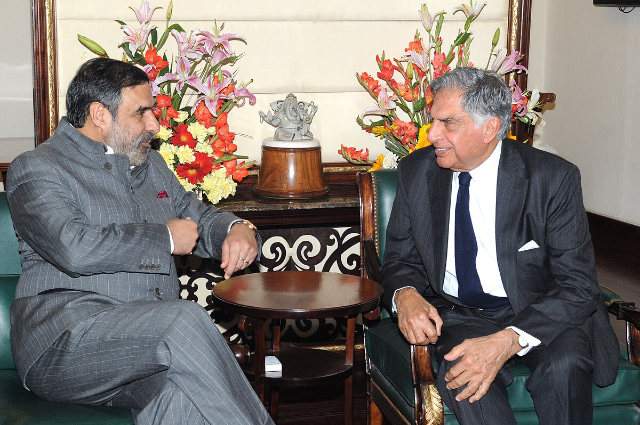
Ratan Naval Tata (1937–2024) remains one of the most consequential business leaders of the late twentieth and early twenty-first centuries. His chairmanship of the Tata Group (1991–2012) coincided with India's economic liberalisation and transformed a domestic conglomerate into a globally recognised multinational. This narrative examines Tata's trajectory through the analytical lens of entrepreneurial leadership, highlighting the interplay of personal adversity, strategic restructuring, bold acquisitions, and ethical stewardship. Drawing on biographical accounts, business histories, and scholarly analyses, the study argues that Tata's success was neither inevitable nor purely dynastic; rather, it was forged through deliberate struggle against internal resistance, market scepticism, and the inherent volatility of global expansion. His leadership style, characterised by humility, long-term perspective, and a commitment to ethical capitalism, offers enduring lessons for emerging-market multinationals.
The Tata Group, founded in 1868 by Jamsetji Tata, is among India's oldest and most diversified conglomerates. By the time Ratan Tata assumed its chairmanship in 1991, the group comprised over 80 companies but operated largely within a protected domestic economy. His twenty-one-year tenure saw the group's revenues grow forty-fold and its profits fifty-fold, with operations expanding into over 100 countries. Yet this ascent was neither smooth nor uncontested. This narrative explores the dialectic of struggle and success that defined Ratan Tata's leadership, situating his achievements within the broader context of India's post-liberalisation corporate evolution.
Formative Struggles: A Reluctant Apprentice
Ratan Tata's early life was marked by emotional disruption. Born on 28 December 1937 to Naval and Soonoo Tata, he experienced his parents' separation at the age of seven and was raised by his grandmother, Navajbai R. Tata, in Mumbai's Tata Palace. He was schooled at Campion School and later Cathedral and John Connon School, where he was ragged and humiliated by peers for his family circumstances. A harsh mathematics teacher compounded his academic difficulties, though he excelled in English and geography under a favourite teacher.
In 1955, at seventeen, Ratan left for Cornell University in the United States, where he studied architecture and structural engineering over seven years. His years in America were transformative; he travelled widely and was so drawn to California that he contemplated settling in Los Angeles as an architect. This ambition was interrupted by his grandmother's deteriorating health, which compelled his return to India. Once home, he received a job offer from IBM, but his uncle, J.R.D. Tata, intervened: "You can't be here in India and working for IBM".
Ratan joined Tata Steel in Jamshedpur in 1962 as an apprentice, shovelling limestone and handling the blast furnace in blue overalls like any other shop-floor worker. He later recalled this period with candour: "I spent time in different departments on the shop floor of Telco. It was horrible at that time because you had nothing—a week with no assignment and no place to sit". This unglamorous initiation was, paradoxically, the making of a leader who understood the ground realities of industrial operations. As one biographical account notes, "Here, he was not the privileged Tata, but another apprentice learning the dance of machines, the rhythms of workers, and the melody of creation".
The 1991 Succession: A Contested Inheritance
When J.R.D. Tata stepped down in March 1991, Ratan Tata's appointment as chairman was met with scepticism. India was simultaneously embarking on radical economic reforms that opened its markets to global competition. The Tata Group, long insulated from foreign rivals, faced the prospect of fading into irrelevance. Internal resistance was formidable. A string of powerful executives—the so-called "satraps" who ran Tata Steel, Tata Motors, and the Taj Group with minimal oversight from the holding company—opposed his plans to centralise operations.
Ratan Tata's response was decisive and controversial. He enforced retirement ages, promoted younger managers, and ramped up corporate control over group companies. He set up the Group Corporate Centre (GCC) to provide strategic direction, mergers-and-acquisitions advisory support, and capital mobilisation. The GCC also assessed whether acquisition targets aligned with Tata's values, embedding ethical criteria into the group's expansion strategy. These structural reforms were essential to his vision of internationalising "in giant strides, not in token, incremental steps".
Global Acquisitions: The Empire Strikes Back
The turn of the millennium marked the beginning of Tata's audacious global acquisition strategy. In 2000, Tata Tea acquired Tetley, the world's second-largest producer of teabags, for $430 million—a British brand three times the size of the Indian company that bought it. The acquisition set the tone for a series of bold moves. In 2007, Tata Steel acquired Anglo-Dutch steelmaker Corus for $12.9 billion, one of the largest acquisitions by an Indian company at the time. While Corus was acquired at expensive valuations just before the global financial crisis and remained a drag on Tata Steel's performance for years, it had a powerful symbolic effect. As historian Mircea Raianu observes, these acquisitions "represented 'the empire striking back' as a business from a former colony took over the motherland's prize assets, reversing the sneering attitude with which British industrialists looked upon the Tata Group a century earlier".
The most prestigious acquisition came in 2008, when Tata Motors purchased Jaguar Land Rover from Ford for $2.3 billion. The deal carried profound personal significance. In 1999, Ratan Tata had approached Ford to sell Tata Motors' passenger car division after the Indica's disappointing debut. Ford executives mocked the proposal, and the deal fell through. Nearly a decade later, Tata acquired the luxury brands that Ford had struggled to make profitable. The turnaround of JLR became a case study in strategic revival: sales doubled, 20,000 new employees were hired, and more than $16 billion was invested in product creation. Ratan Tata later recounted that his friends had called him "stupid" for buying the British luxury carmaker.
The Nano: A Vision Half-Realised
No project better illustrates the interplay of vision and struggle in Ratan Tata's leadership than the Tata Nano. Conceived as an affordable "people's car" priced at approximately one lakh rupees (hence the nickname lakhtakia), the Nano was inspired by Tata's observation of Indian families precariously balanced on scooters on slippery roads. "The Nano was always meant for all our people," he wrote.
The project faced formidable obstacles. The intended manufacturing plant in Singur, West Bengal, became the site of intense political protests led by Mamata Banerjee, forcing relocation to Sanand, Gujarat. Production delays, a lottery-based booking system that alienated genuine buyers, and inadequate dealership networks further undermined the launch. More fundamentally, Tata misjudged the aspirational psychology of Indian consumers. The Nano's image as a "poor man's car" became a stigma; as Tata admitted in 2013, "We never really got our act together when the 100,000 were depleted". The car was gradually written off within five years of its launch. Yet the Nano's legacy endures in Tata Motors' subsequent leadership in India's electric vehicle transition, demonstrating how strategic failures can seed future capabilities.
Ethical Leadership and Philanthropic Legacy
Ratan Tata's leadership was distinguished not only by strategic ambition but by an unwavering commitment to ethical conduct. He once articulated his philosophy succinctly: "Leadership is not about being in charge; it is about taking care of those in your charge". This principle was exemplified during the November 2008 terrorist attacks on the Taj Mahal Hotel in Mumbai, when Tata went directly to the hotel and remained there during the days of the siege, demonstrating solidarity with employees and guests.
His philanthropic contributions were equally significant. As a leading philanthropist, he was deeply committed to education, medicine, and rural development. He established the Sir Ratan Tata Post-doctoral Fellowship at the London School of Economics in 1997, supporting early-career researchers in social science. His will directed a substantial portion of his wealth to charitable foundations emphasising education, healthcare, rural development, and social welfare. He received India's Padma Bhushan in 2000 and Padma Vibhushan in 2008, among numerous other honours.
A Leadership Paradigm
Ratan Tata's rise from a reluctant shop-floor apprentice to the helm of a global conglomerate illustrates a distinctive model of entrepreneurial leadership in emerging markets. His success was not merely the product of dynastic privilege; it was forged through personal adversity, internal organisational resistance, and the calculated risks of global expansion. His leadership combined visionary thinking with operational pragmatism, ethical governance with strategic boldness, and humility with steely resolve. As the historian Andrea Goldstein observed, Tata sought to "internationalise in giant strides, not in token, incremental steps," yet he did so while remaining anchored in the Tata Group's century-old ethos of trust, nation-building, and compassion. His legacy- a conglomerate operating in over 100 countries and a philanthropic apparatus touching millions of lives—stands as a testament to the proposition that capitalism, when yoked to ethical purpose, can serve as an instrument of national and global transformation.