
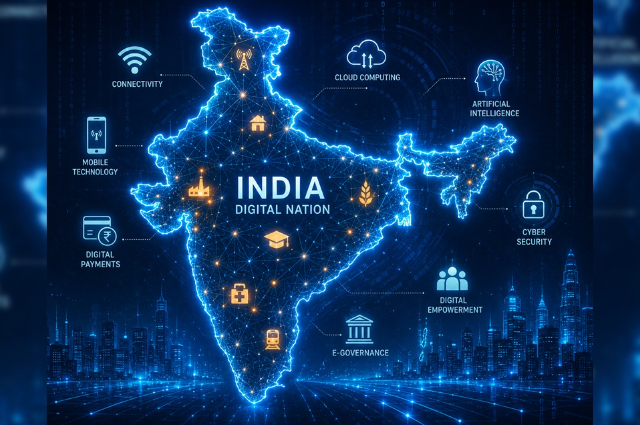
Viksit Bharat 2047 represents India's ambitious vision to transform into a fully developed nation by the centenary of its independence, economically prosperous, socially equitable, technologically advanced, and globally influential. With a projected population exceeding 1.5 billion and aspirations for a $30+ trillion economy, achieving this goal requires leveraging transformative technologies such as Artificial Intelligence (AI) as a core enabler. AI is not merely a tool for efficiency but a catalyst for inclusive growth, bridging urban-rural divides, empowering the workforce, revolutionising governance, and addressing complex challenges in agriculture, healthcare, education, and sustainability.
This article draws on key discussions, including the panel on "Building the Workforce: AI for Viksit Bharat 2047" at the India AI Impact Summit and related forums, synthesising insights into capacity building, ethical deployment, sectoral applications, and strategic pathways. It expands into a comprehensive exploration, structured across introduction, workforce development, sectoral transformations, governance and ethics, challenges, global positioning, and a roadmap ahead.
AI as the Cornerstone of Viksit Bharat
Prime Minister Narendra Modi has emphasised AI's transformative role in Viksit Bharat, positioning India among the top three global AI superpowers. AI addresses deep developmental challenges while creating new economic opportunities, enabling inclusive growth, and bridging divides.
India's strengths are its vast youth demographic (the world's largest), robust Digital Public Infrastructure (DPI) like Aadhaar, UPI, and Data Empowerment and Protection Architecture (DEPA), and a thriving IT/services sector with millions of professionals, providing a unique foundation. Unlike binary global models (market-led in the US or state-led in China), India can pioneer a "third way": human-centric, inclusive, and trust-based AI that augments its labour-intensive economy rather than displacing workers.
AI's potential mirrors electricity's historical impact: not just optimising tasks but reimagining possibilities in education, healthcare, agriculture, and governance. Small, context-specific language models and agentic AI (autonomous systems) will be key for decentralised, sectoral applications tailored to India's diversity.
Building the AI Workforce: Capacity Building Imperative
A central theme from discussions is skilling millions for an AI-driven future. India's workforce must evolve from traditional roles to AI-augmented ones. The Capacity Building Commission and Mission Karmayogi highlight humanistic capacity, intellect, diligence, and values as foundational, layered with AI competencies.
Key Strategies:
- Personalised Learning Pathways: Use AI for competency gap analysis and adaptive training via platforms like iGOT Karmayogi. Continuous feedback loops refine programs.
- Sector-Specific Competency Frameworks: Develop customised models for public services, agriculture, healthcare, etc. Focus on "tiny" embedded AI in devices for grassroots users (farmers' phones, ASHA workers' tools).
- Scale and Inclusion: Target rural youth, women, and marginalised groups. Examples include Tata's AI Sakhi, empowering rural women artisans.
- Public Servant Training: Equip bureaucrats and frontline workers with AI literacy for ethical deployment, data governance, and agentic AI use with guardrails.
Projections suggest AI could add trillions to India's GDP by enhancing productivity. Initiatives like IndiaAI Mission aim to democratize access to compute, datasets, and innovation. Education 4.0 reforms integrate AI curricula, fostering problem-solving, creativity, and ethics alongside technical skills.
Challenges include the digital divide and the quality of foundational education. Solutions involve multilingual AI tools, offline-capable models, and public-private partnerships for widespread skilling.
Sectoral Transformations: AI Across Key Domains
Agriculture and Rural Economy
India's agrarian base needs AI for precision farming, yield prediction, pest detection, and supply chain optimisation. AI-powered advisories in local languages, drone imagery, and IoT sensors can boost productivity, reduce waste, and support climate resilience critical for food security in a Viksit Bharat.
Decentralised AI agents can provide hyperlocal insights, integrating traditional knowledge with data analytics.
Healthcare
AI enables early diagnostics, personalised medicine, predictive epidemiology, and assistive tools for frontline workers. Diagnostic assistants process vast data; chatbots and virtual health aides expand access in remote areas. Combined with DPI, this supports universal healthcare goals while managing costs.
Ethical AI ensures privacy and equity, avoiding biases in diverse populations.
Education
Personalised learning assistants adapt to individual paces and languages. AI enhances teacher training, automates administrative tasks, and creates immersive content. For Viksit Bharat, this means equipping 250+ million students with 21st-century skills, bridging quality gaps between urban and rural institutions.
Manufacturing and Industry 4.0
AI drives smart factories, predictive maintenance, quality control, and supply chain resilience. It complements labour, upskilling workers for higher-value roles. Initiatives in advanced manufacturing align with "Make in India" for global competitiveness.
Sustainability and Smart Cities
AI optimises energy use, traffic, waste management, and disaster response (e.g., GeoAI). Greener cities and climate modelling support sustainable development goals.
Governance and Public Services
AI transforms e-governance: predictive policing, grievance redressal, policy simulation, and citizen services. Agentic AI handles routine tasks, freeing humans for complex decisions. DPI integration ensures scalability and trust.
Ethics, Inclusion, and Human-Centric AI
India's approach emphasises "AI with a human touch." Key principles:
- Trust and Ethics: Guardrails on data use, bias mitigation, and transparency. Humanistic frameworks rooted in Indian values (e.g., Vasudhaiva Kutumbakam).
- Inclusivity: Multilingual, accessible AI for Bharat (rural India). Address job displacement through reskilling.
- Data Sovereignty: Leverage DEPA for secure, consent-based sharing.
- Global South Leadership: Share models for inclusive AI, positioning India as a responsible power.
Risks like misinformation, surveillance concerns, and unequal access require robust regulation, such as evolving the Digital India Act.
Challenges and Mitigation
- Infrastructure: Compute access, data quality, and last-mile connectivity.
- Talent Retention: Brain drain vs. building domestic R&D.
- Regulation vs. Innovation: Balanced frameworks without stifling growth.
- Equity: Prevent AI from widening divides; proactive inclusion policies.
Public-private-academia collaborations, investments in foundational research, and international partnerships (e.g., with Google Cloud, others) are vital.
Global Positioning and Geopolitics
India can lead in responsible AI governance, offering an alternative to US-China dominance. Its IT legacy, democratic ethos, and scale enable "AI for Good" to export solutions for developing nations in agriculture, health, and education.
Strategic focus: Sovereign AI capabilities, open innovation ecosystems, and contributions to global standards.
Roadmap to 2047: Actionable Steps
- National AI Strategy 2.0: Update with clear milestones for workforce (100 million AI-skilled by 2035?), compute infrastructure, and sectoral missions.
- Mass Skilling: Expand Mission Karmayogi and Skill India with AI integration; vernacular content at scale.
- Innovation Ecosystem: Fund startups, research labs, and DPI extensions (e.g., AI marketplaces).
- Ethical Governance: Establish oversight bodies and standards for explainable AI.
- Monitoring and Adaptation: Dynamic KPIs, citizen feedback, agile policy.
- International Collaboration: Partnerships for talent, data, and standards while safeguarding interests.
Success stories like AI in crop advisory or telemedicine pilots must scale nationwide.
Conclusion: AI as Enabler of Atmanirbhar and Inclusive Growth
AI is pivotal for Viksit Bharat: amplifying human potential, fostering self-reliance, and ensuring no one is left behind. By investing in people, ethics, and innovation, India can realise a developed nation that is prosperous, equitable, and a beacon for the world.
The journey demands collective action from government, industry, academia, and citizens. As one panellist noted, it's about building bridges for shared progress. With visionary leadership and grassroots empowerment, AI will help script India's golden chapter by 2047.
Expansion: Detailed Workforce Development and Education
Building on the foundational insights from the panel discussion "Building the Workforce: AI for Viksit Bharat 2047," the capacity-building imperative emerges as non-negotiable. The session, part of the India AI Impact Summit pre-events, brought together experts, including representatives from the Capacity Building Commission, Mission Karmayogi, Google Cloud, and global public service networks. They emphasised that AI's success in India hinges not on technology alone but on empowering millions with the right competencies, ethics, and humanistic values.
Humanistic Capacity as the Bedrock: As highlighted by the Capacity Building Commission chairperson, every AI deployment must be layered on intellect, diligence, and values. Public servants from ASHA workers to policymakers need training that blends domain expertise with AI literacy. Agentic AI (autonomous, decision-making systems) will dominate, but in decentralised, context-specific forms: small language models tailored to local languages, sectors, and challenges rather than massive monolithic ones. This allows hyper-local solutions, such as AI agents advising farmers on crop cycles based on soil, weather, and market data in regional dialects.
iGOT Karmayogi and Personalised Pathways: The iGOT platform exemplifies scalable learning. It uses AI for competency gap analysis, delivering adaptive courses with real-time feedback. By 2047, this must scale to cover not just government employees (millions strong) but the broader workforce. Integration with NEP 2020 ensures school and higher education curricula embed AI fundamentals, coding, data ethics, and critical thinking from early stages. Vernacular content and offline modes address the digital divide affecting rural Bharat.
Case Studies and Inclusion:
- Tata AI Sakhi: Empowers rural women artisans with AI tools for design, marketing, and e-commerce, turning traditional crafts into viable livelihoods.
- Google Cloud Engagements: Public sector solutions focus on AI for governance, with training for officials on secure, ethical deployment. Emphasis on "tiny AI" embedded in everyday devices (phones, tractors, clinics) ensures the next billion users benefit without needing high-end infrastructure.
- Youth and Women Focus: Programs targeting 50%+ of the population. Initiatives like Skill India + AI modules aim to skill 100 million+ youth. Women-centric AI tools in healthcare and entrepreneurship reduce gender gaps.
- Metrics for Success: Track not just certifications but outcomes, productivity gains, service delivery improvements, and citizen satisfaction. Continuous feedback loops, as practised in Mission Karmayogi, refine programs dynamically. Public-private partnerships (e.g., with Google, Tata, startups) provide compute access, datasets via AIKosh, and innovation sandboxes.
- Education Transformation: AI tutors personalise learning for 250 million+ students, adapting to pace, style, and language. Teachers gain AI assistants for lesson planning, grading, and identifying at-risk students. Immersive VR/AR with AI creates experiential learning in STEM. Higher education expands AI research hubs in Tier 2/3 cities, aligning with IndiaAI Mission's goal of training thousands of researchers and deploying 38,000+ GPUs for affordable compute.
This human-centric approach positions India to avoid job displacement pitfalls seen elsewhere, instead augmenting its massive informal workforce (490 million+) through AI tools for skilling, healthcare access, and financial inclusion.
Deep Dive: Sectoral Transformations
Agriculture: Feeding a Developed Nation Sustainably
Agriculture employs ~45% of India's workforce but contributes less to GDP. AI can reverse this through precision agriculture. Drone and satellite imagery with computer vision detect pests/diseases early; predictive analytics forecast yields and market prices; IoT sensors optimise irrigation and fertiliser use, reducing waste by 20-30%. AI advisories in 22+ languages reach smallholders via mobile apps.
Examples: Hyper-local models integrating indigenous knowledge with big data for climate-resilient farming. Supply chain AI minimises post-harvest losses (currently ~40%). By 2047, this supports food security for 1.5+ billion, boosts farmer incomes, and enables exports, aligning with Atmanirbhar Bharat.
Healthcare: Universal Access and Preventive Care
AI-powered diagnostics analyse X-rays, pathology slides, and genomics for early detection of diseases like TB, cancer, and diabetes prevalent in India. Predictive epidemiology models outbreaks using mobility and environmental data. Virtual assistants and chatbots extend reach to remote areas, supporting ASHA workers with decision-support tools.
IndiaAI Mission's Centres of Excellence in Healthcare focus on affordable, multilingual solutions. Combined with the Ayushman Bharat Digital Mission, AI ensures privacy-preserving data sharing. Ethical guardrails prevent bias in diverse populations. Projected impact: Reduced healthcare costs, longer lifespans, and a healthier workforce driving economic growth.
Manufacturing, MSMEs, and Industry 4.0
AI enables predictive maintenance (reducing downtime), quality control via vision systems, and supply chain optimisation. For MSMEs (backbone of the economy), low-cost AI tools enhance competitiveness under "Make in India." Robotics and cobots augment labour rather than replace it, upskilling workers for higher-value tasks like design and oversight.
Sustainability, Smart Cities, and Climate Action
AI optimises energy grids, traffic flow, waste management, and disaster prediction (e.g., floods via GeoAI). Smart cities leverage DPI for citizen-centric services. Climate models inform policy for net-zero goals, crucial for a Viksit Bharat resilient to environmental challenges.
Governance: Efficient, Transparent, Citizen-Centric
Agentic AI handles grievance redressal, policy simulation, and resource allocation. Predictive policing and fraud detection improve law enforcement. DPI integration (Aadhaar, UPI, DEPA) ensures secure, consent-based operations at a population scale. This transforms bureaucracy into a responsive, data-driven system.
Ethics, Inclusion, Challenges, and Global Positioning
India's "third way" emphasises trust-based, inclusive AI. Key pillars: bias mitigation in models trained on Indian datasets, transparency, accountability, and alignment with constitutional values. Regulations like the evolving Digital India Act balance innovation with safeguards against deepfakes, privacy breaches, and misuse.
Challenges:
- Infrastructure Gaps: Compute, high-quality Indian-language data, connectivity.
- Talent and Brain Drain: Retain top minds through research incentives and vibrant ecosystems.
- Equity and Jobs: Reskilling for millions; ensure AI benefits rural/marginalised groups.
- Geopolitical Risks: Data sovereignty, international standards. Mitigations include massive investments (IndiaAI Mission's ₹10,372 crore as foundation), academia-industry-government collaboration, and open innovation. International partnerships (while protecting sovereignty) accelerate progress.
- Global Leadership: India can export "AI for Good" solutions to the Global South, affordable agritech, healthtech, and edtech. Its democratic ethos and scale offer an ethical alternative to US/China models, influencing global governance.
Comprehensive Roadmap to 2047:
- Policy Evolution: National AI Strategy 2.0 with milestones (e.g., 100 million AI-literate by 2030).
- Compute and Data: Expand federated GPU networks; build sovereign datasets.
- Skilling at Scale: Integrate AI across education/skilling missions; focus on women, rural youth.
- Sectoral Missions: Dedicated CoEs with measurable KPIs.
- Ethics and Oversight: Independent bodies for audits, public dashboards.
- Monitoring: Agile adaptation via citizen feedback and tech audits.
- Ecosystem Building: Startup funding, IP protection, global collaborations.
AI is the multiplier for Viksit Bharat, a $30+ trillion economy that is equitable, sustainable, and innovative. As the panel underscored, it's about building bridges: between technology and humanity, urban and rural, present and future. With visionary leadership, collective will, and grounded execution, India will not only achieve developed nation status by 2047 but redefine what "developed" means for a prosperous, inclusive, and rooted in timeless values.