
A case study in superpower diplomacy, energy geopolitics, and the cascading consequences for the world’s most sanctioned economy
Two Powers, One Room, and a War in Between
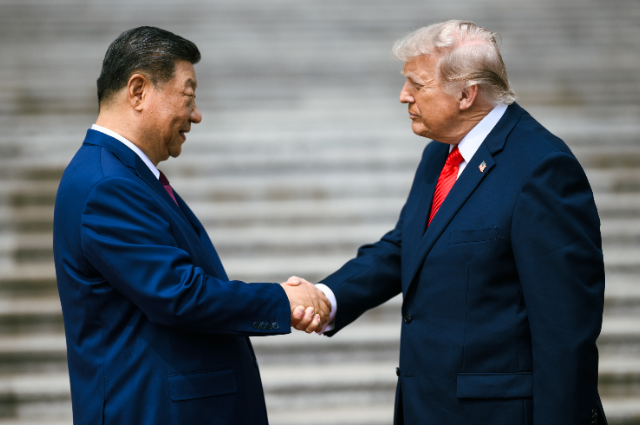
When Air Force One touched down at Beijing Capital International Airport on 13 May 2026, it carried not just a president but a signal: that the world’s two largest economies — together accounting for over 43% of global GDP — had chosen, at least for now, stabilisation over confrontation. The Trump–Xi summit in Beijing on 14–15 May 2026 was the most consequential bilateral meeting since the Cold War, and it arrived against one of the most turbulent geopolitical backdrops in modern history (CNBC, 2026a).
The summit had originally been scheduled for April 2026. It was delayed by six weeks following the launch of “Operation Epic Fury” — the joint US–Israeli military strikes on Iran beginning 28 February 2026, which triggered the closure of the Strait of Hormuz, a global energy crisis, and the single largest oil supply disruption in recorded history (Al Jazeera, 2026). That the war in Iran served as both an obstacle to the summit and a central item on its agenda reflects how deeply the fates of US–China relations and Middle East stability have become intertwined.
This article traces the road to Beijing, assesses what the summit actually produced, and examines a question that has received insufficient attention in Western analysis: what does a warming US–China relationship mean for Iran, an economy that has survived a decade of maximum-pressure sanctions almost entirely because China kept buying its oil?
The Road to Beijing: From Trade War to Strategic Truce
The Trump–Xi summit was not an isolated diplomatic event. It was the third significant engagement between the two leaders in less than eight months, and the product of a turbulent year in which both sides tested the limits of economic coercion.
In early 2025, Washington imposed tariffs of up to 145% on Chinese imports; Beijing retaliated with sweeping export controls on rare earth elements and critical minerals — materials essential to American defence manufacturing, semiconductors, and electric vehicles. The tit-for-tat escalation rattled global supply chains and briefly pushed both economies toward a scenario that analysts described as “decoupling by accident” (World Economic Forum, 2026a). Chinese exports to the US fell 11% year-on-year in early 2026. American farmers lost access to the Chinese soybean market for most of 2025. Manufacturers on both sides absorbed costs that had no clear endpoint (PBS News, 2026).
The turning point came at the APEC summit in Busan, South Korea, on 30 October 2025. Trump and Xi negotiated a one-year trade truce: US tariffs on Chinese goods were reduced from 57% to 47%; China suspended its rare earth export controls for twelve months; both sides agreed to resume agricultural trade and port access (Hogan Lovells, 2025). Trump rated the outcome “12 out of 10.” Xi described the two countries as “partners and friends.” The language was deliberately warm. The commitments were deliberately reversible — all provisions expire in November 2026, creating a structural incentive for both sides to maintain engagement before the clock runs out (World Economic Forum, 2026b).
The Beijing summit, delayed but not derailed by Iran, was intended to consolidate that truce and signal its extension into a longer strategic framework. Xi proposed a “constructive China-US relationship of strategic stability” as the governing concept for the next three years. Trump accepted it. The framework is not a treaty. It is an aspiration with a deadline — and that distinction matters enormously for every third party watching from the outside, including Tehran.
What the Summit Delivered: Deals, Frameworks, and Unresolved Tensions
In the days following the summit, both governments issued readouts that were positive in tone and sparse on detail — a familiar pattern in US–China diplomacy. The concrete deliverables that emerged were nonetheless significant (CNN, 2026).
China committed to purchasing at least $17 billion of US agricultural products annually through 2028, in addition to its existing commitment to buy 25 million metric tonnes of American soybeans per year — a combined value of approximately $27 billion annually (CNBC, 2026b). China agreed to an initial purchase of 200 Boeing aircraft, a major symbolic win for American manufacturing, though Trump had hoped for 500, and Boeing shares fell 4% when the lower figure was announced (Euronews, 2026). Both sides agreed to establish a “Board of Trade” and a “Board of Investment” — institutionalised bilateral forums that, if operational, would represent the most regularised mechanism for managing US–China economic friction since the pre-tariff era (Deseret News, 2026).
What the summit did not deliver is equally instructive. No agreement on Taiwan, where Xi warned Trump that mishandling the issue would put the relationship “in great jeopardy” (CNBC, 2026a). No resolution on semiconductor export controls or access to advanced AI chips. No formal position on the Iran war, despite it being “a backdrop” to every conversation (Council on Foreign Relations, 2026). Trump’s own assessment — that they “settled a lot of different problems” — was characteristic in its imprecision. The more calibrated verdict from analysts was that the summit produced stabilisation, not transformation (Deseret News, 2026). Beijing, for its part, described the outcomes as “preliminary.”
The Busan trade truce expires in November 2026. Xi has been invited to Washington in September. The real test of whether Beijing, 14–15 May 2026, produces durable change will be visible in what both governments do between now and then.
Iran Between Two Powers: The Economy at the Edge
No country watches the US–China relationship more nervously than Iran, and none has more to lose from its deepening. To understand why, the numbers are essential.
By 2024, China accounted for approximately 91% of Iran’s total oil exports (Statista, 2026). In 2025, Iran was exporting 1.38 million barrels per day to China, amounting to roughly 13–14% of China’s total seaborne crude imports (Modern Diplomacy, 2026). This trade is conducted almost entirely through “teapot” refineries — small, independent processors clustered in Shandong province — which by 2025 handled an estimated 90% of China’s Iranian crude purchases, giving Beijing’s state-owned companies a degree of plausible deniability with respect to US sanctions (Kharon, 2026). Iran’s non-oil exports to China added a further $8.23 billion in the first seven months of 2025 (Trend.az, 2025). For a country whose economy was already contracting under maximum-pressure sanctions — with inflation approaching 60% and the rial in freefall — China was not simply a trading partner. It was an economic lifeline.
The 2026 war shattered that lifeline’s operational infrastructure without eliminating the underlying dependency. When Iran closed the Strait of Hormuz on 4 March 2026, Brent crude surged past $120 per barrel; but Iranian tankers — unable to freely transit the very waterway they had closed — were stranded offshore, repurposed as floating storage. Chinese “teapot” refineries, suddenly unable to receive reliable deliveries, faced acute feedstock shortages. Iranian oil export revenues, already compressed by sanctions, were further squeezed by the blockade’s logistical costs (Discovery Alert, 2026). The World Bank had projected in October 2025 that Iran’s economy would shrink in both 2025 and 2026; analysts now estimate a contraction of 10% as a direct consequence of the war’s infrastructure damage, revenue losses, and disrupted grain imports (Wikipedia, 2026; House of Commons Library, 2026a).
China’s official position throughout the conflict was neutrality. Beijing condemned the US–Israeli strikes, called for compliance with international law, and declared itself a “force of peace”. In practice, certain ships carrying Iranian crude were reportedly permitted to transit, sustaining a revenue floor for Tehran even under blockade conditions (Kharon, 2026). Yet China also invested over $100 billion in Iranian energy and infrastructure through its Belt and Road Initiative — investments now at risk from continued fighting, secondary sanctions, and potential regime instability (Wikipedia, 2026).
The Triangular Trap: What US–China Détente Means for Tehran
The Beijing summit places Iran in what analysts of great-power competition call a triangular trap: a position in which the improvement of relations between two larger powers simultaneously reduces each one’s incentive to protect the interests of the smaller third party.
From Washington’s perspective, Iran featured in Beijing as both a pressure point and a potential bargaining chip. The US Treasury’s National Security Presidential Memorandum 2 — issued February 2025 — explicitly directed US officials to “drive Iran’s export of oil to zero, including exports of Iranian crude to the People’s Republic of China” (Congress.gov, 2026). In May 2026, the Treasury sanctioned 10 individuals and entities — including several in China and Hong Kong — for facilitating Iranian drone component supply chains, and issued explicit warnings regarding secondary sanctions on Chinese teapot refineries (Discovery Alert, 2026). The message was unambiguous: US–China trade stabilisation is conditional, in part, on Beijing curtailing its Iranian oil imports.
From Beijing’s perspective, Iran is a strategic asset whose value must be weighed against the cost of jeopardising the far larger US–China economic relationship. China–US bilateral trade, even after two years of tariff wars, dwarfs China–Iran trade by a factor of approximately 25 to 1. As the Busan truce and the Beijing summit demonstrate, Beijing values the stability of its relationship with Washington — and that stability has a price tag that Tehran cannot match. The structural imbalance in the Iran–China relationship — Iran sells raw commodities, China sells high-value manufactured goods and provides credit — gives Beijing asymmetric leverage: it can tighten or loosen the valve on Iranian crude imports as a diplomatic instrument without absorbing significant domestic economic pain (Centre for Strategic and Contemporary Research, 2026).
The Iran war has, paradoxically, both deepened Iran’s dependence on China and reduced China’s ability to act as Iran’s protector. The closure of the Strait disrupted China’s own energy imports, damaged its Belt and Road infrastructure in the region, and created inflationary pressures in the Chinese economy at a moment when Beijing had already softened its GDP growth target to 4.5–5% — the lowest since 1991 (CSIS China Power, 2026). A warmer US–China relationship, purchased partly through reduced support for Tehran, may prove to be the rational choice for Beijing even if it accelerates Iran’s economic deterioration.
Stability for Two, Uncertainty for One
The Beijing summit of May 2026 is a landmark in the history of great-power diplomacy — not because it resolved the US–China rivalry, but because it demonstrated that both sides have concluded, at least temporarily, that managed competition serves their interests better than unmanaged conflict. The framework of “constructive strategic stability,” the agricultural purchase agreements, the Boeing order, and the proposed boards of trade and investment are all instruments of that management. Their durability will be tested before 2026 is over.
For Iran, the implications are sobering. A country whose economic survival has depended on China’s willingness to absorb its sanctioned oil — and to absorb the diplomatic friction that came with it — now confronts a Beijing that is increasingly calculating the cost of that absorption against the value of a stable relationship with Washington. The US Treasury’s explicit warnings about secondary sanctions on Chinese teapot refineries, delivered in the same week as the Beijing summit, are not coincidental. These are the prices being asked.
Iran’s economy was already contracting before the first US–Israeli strike. The war has compressed oil revenues, destroyed infrastructure, disrupted grain imports, and driven inflation toward 60%. The World Bank and independent analysts now project a 10% GDP contraction in 2026. If the US–China rapprochement leads to even a partial reduction in Chinese teapot refinery purchases of Iranian crude — through secondary sanctions enforcement or Beijing’s own compliance decisions — Tehran loses the one economic relationship that made its isolation survivable.
The real story of the Beijing summit is not only what Trump and Xi agreed to. It is what their agreement, and its underlying logic, signals to every smaller economy that has built its survival strategy around the assumption of permanent superpower competition. For Iran, that assumption may no longer hold.
References
- Al Jazeera. (2026, May 12). Trump-Xi meeting: Could China, US form a ‘G2’? https://www.aljazeera.com
- Centre for Strategic and Contemporary Research. (2026, April). Yuanization of Iran–China oil trade. https://cscr.pk
- CNBC. (2026a, May 14). Five takeaways from the Trump-Xi summit in Beijing. https://www.cnbc.com
- CNBC. (2026b, May 18). White House touts deals on soybeans and rare earths after Trump-Xi summit. https://www.cnbc.com
- CNN. (2026, May 18). From a ‘board of trade’ to Boeing planes, what did Xi and Trump actually agree to? https://www.cnn.com
- Congress.gov / Congressional Research Service. (2026, March 26). U.S. conflict with Iran. https://www.congress.gov
- Council on Foreign Relations. (2026, May 18). At the Trump-Xi summit, China will have the upper hand. https://www.cfr.org
- CSIS China Power Project. (2026, May 16). How is the Iran war impacting China’s economy? https://chinapower.csis.org
- Deseret News. (2026, May 15). What really happened at the Trump-Xi summit? An expert appraisal. https://www.deseret.com
- Discovery Alert. (2026, May 12). CIA report: Iran’s naval blockade endurance window revealed. https://discoveryalert.com.au
- Euronews. (2026, May 15). Underwhelming summit outcome in China brings Trump back to reality. https://www.euronews.com
- Hogan Lovells. (2025, November 13). Trump–Xi meeting calmed US–China trade tensions with initial agreements. https://www.hoganlovells.com
- House of Commons Library. (2026a). Iran: What challenges does the country face in 2026? https://commonslibrary.parliament.uk
- House of Commons Library. (2026b). Israel/US-Iran conflict 2026: Reopening the Strait of Hormuz. https://commonslibrary.parliament.uk
- Kharon. (2026, March 31). Behind Iran’s war chest, an oil ‘lifeline’ from China. https://www.kharon.com
- Modern Diplomacy. (2026, January 13). China’s dependence on Iranian oil: Strategic leverage and exposure. https://moderndiplomacy.eu
- PBS News. (2026, May 13). US and China seek to repair damage from tariff war that sent trade into a freefall. https://www.pbs.org
- Statista. (2026, March 9). China is the biggest buyer of Iranian oil. https://www.statista.com
- The Diplomat. (2025, December 31). What will 2026 bring for China-US relations? https://thediplomat.com
- Trend.az. (2025). Iran shares key figures on non-oil trade with China. https://www.trend.az
- Wikipedia. (2026). Economic impact of the 2026 Iran war. https://en.wikipedia.org
- World Economic Forum. (2026a, May 5). What to expect from the Trump-Xi summit. https://www.weforum.org
- World Economic Forum. (2026b, April 28). What’s next for US–China relations? https://www.weforum.org