
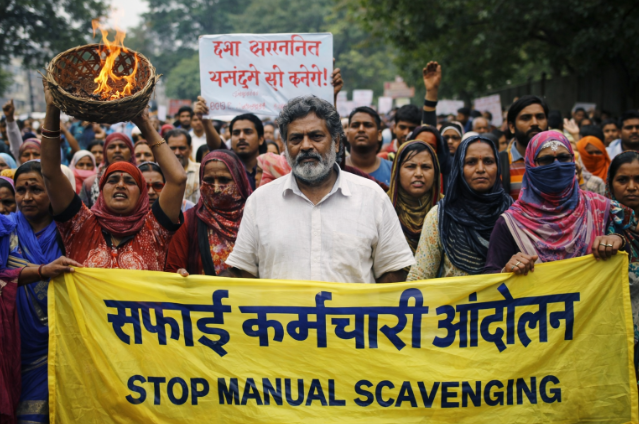
Bezwada Wilson (born 1966) is an Indian Dalit activist whose life has become synonymous with the struggle to eradicate manual scavenging in India. Born into the Madiga community in Karnataka – a caste traditionally assigned the dehumanising work of handling human waste – Wilson grew up acutely aware of caste-based stigma. His father and eldest brother worked as safai karamcharis (sanitation workers), personally removing excreta from dry latrines. When Wilson learned his family’s occupation, he felt intense shame and even contemplated suicide. Yet, rather than accept this “degrading servitude, he chose to break the silence. He later recalled vividly forcing himself to recognize the injustice: as a young man, “I wept” when he first understood what it meant to be a scavenger. This personal awakening led Wilson to dedicate himself to helping others escape the generational bondage of manual scavenging.
Manual Scavenging in India: History, Prevalence, and Laws
The term manual scavenging refers to the practice of cleaning, carrying, or disposing of human excreta from dry latrines, open drains, sewers, or railway tracks by hand or with rudimentary tools. It is an ancient practice linked to India’s caste hierarchy: for centuries, members of the lowest castes (Dalits) were forced into this odious occupation as a hereditary “duty”. A 2014 Supreme Court judgment noted that over 95% of India’s manual scavengers are Dalits. Historically, this work was viewed so pervasively as an “untouchable” task that manual scavengers were ostracised even by other Dalits.
Despite technological advances, manual scavenging persists in modern India as a stark relic of social inequality. Even today, millions of India’s poor rely on human labor to empty dry latrines and unclog sewers. According to official surveys and NGO estimates, there were well over half a million (5–12 lakh) people engaged in manual scavenging as recently as the early 2000s. For example, one study cites some 676,000 identified scavengers in 2002–03. Women constitute about 90% of this workforce. The vast scale is illustrated by sanitation statistics: there are on the order of tens of thousands of public dry latrines in India and millions of individual dry latrines at private homes, all regularly cleaned by human hands. The Safai Karmachari Andolan (SKA) estimates roughly 2.6 million community latrines and over 700,000 sewer segments cleaned manually. Railway tracks are also notoriously unsanitary; for instance, India’s 8,000+ stations require human workers to clear the waste from train toilets every day, in fields of flying excrement.
This practice is undeniably dangerous. Scavengers inhale lethal gases (methane, hydrogen sulfide) and risk infections (leptospirosis, hepatitis, cholera) and even death. One advocacy report notes that “many manual scavengers lose their lives each year due to accidents in septic tanks and sewers. The very existence of manual scavenging – in an age when machine technology could eliminate it – reflects deep social inequity. It forces Dalits to carry human waste on their heads or backs as part of “work” that no one else will do, reinforcing their status as “untouchable”. In the words of human rights campaigners, manual scavenging is not an occupation but “an injustice akin to slavery”.
Historical Origins
The roots of manual scavenging lie in the caste-based notions of purity and pollution. Centuries ago, higher castes considered dealing with human waste to be ritually polluting and relegated it to the lowest social groups. During the British colonial era, the practice was upheld under sanitary codes but never mechanised. Many dry latrines (so-called “night-soil” pits) proliferated, requiring daily human emptying. After independence, India’s constitution explicitly aimed to abolish untouchability. Article 17 declares that “‘Untouchability’ is abolished and its practice in any form is forbidden. The enforcement of any disability arising out of ‘Untouchability’ shall be an offence punishable in accordance with law. In practice, however, caste prejudices persisted, and the stigma around manual scavenging remained entrenched.
Present-Day Prevalence
Today, manual scavenging remains widespread in rural and urban India alike, despite being outlawed on paper. Large surveys show that manual cleaning of community latrines, drains, and railway tracks continues in many states. For example, formal railway data from 2019 indicate over 8 billion passengers travel by train annually, all depositing waste into tracks; sanitation workers routinely enter open drains at stations. On an everyday scale, trains’ 7,000+ coaches require manual cleaning along 67,000+ km of track. The SKA website summarizes the indignity: “the excreta falls on the railway tracks ... and the tracks [become] monuments of untouchability”. In slums and poor neighborhoods, municipal dry toilets (sometimes with hundreds of seats) still rely on human waste collectors. A WaterAid report notes that India’s commitment to clean water and sanitation (SDG 6) is undermined by the persistence of manual scavenging and that the survivors of this practice face multi-dimensional deprivation.
Legal Status and Prohibitions
Legally, manual scavenging has been criminalised for decades, but implementation has lagged. Key laws and policies include:
- Article 17 of the Constitution (1950) – Abolishes untouchability outright. It makes enforcing any disabilities from untouchability a punishable offence. This foundational norm underlies all anti-caste efforts.
- The Protection of Civil Rights Act (1955) – Punishes enforcing “untouchability” in any form.
- Employment of Manual Scavengers Act (1993) – The Employment of Manual Scavengers and Construction of Dry Latrines (Prohibition) Act, 1993, formally outlawed the construction of any new dry latrine and declared the hiring of manual scavengers to clear existing ones an offence. Its preamble notes the “dehumanizing practice of manual scavenging” and the need for uniform legislation banning it. In other words, it made manual disposal of excreta a criminal act.
- Prohibition of Employment as Manual Scavengers Act (2013) – Also known as the Manual Scavengers Act 2013, this updated law expanded the ban to all forms of manual cleaning of human waste, not just from dry latrines. Its preamble explicitly ties manual scavenging to caste injustice (“a highly iniquitous caste system”) and calls for “correcting the historical injustice and indignity suffered by the manual scavengers, and to rehabilitate them to a life of dignity”. The Act raised the penalties for violation and mandates the demolition of dry latrines.
In addition, caste discrimination more broadly is addressed by laws such as the Scheduled Castes and Tribes (Prevention of Atrocities) Act, 1989. Judicial rulings have reinforced Article 17: for example, the Supreme Court likened caste oppression to “a form of slavery” and held that the state must actively prevent private caste discrimination. Nevertheless, the mere existence of laws has not stopped the practice. As Wilson and others note, “There is a ban, but there is no enforcement of it. State inaction, corruption, and social bias allow scavenging to continue under cover. Government surveys still list hundreds of thousands of manual scavengers long after the ban.
The Emergence of the Safai Karmachari Andolan
In this context, Bezwada Wilson’s activism took shape. By the mid-1980s, he had begun to organise fellow scavengers and their families into a rights movement. With encouragement from reformers like S. R. Sankaran (a retired IAS officer) and Paul Diwakar, Wilson started by breaking the silence. He crisscrossed districts on public buses, talking to scavenger families in labor camps, village hamlets, and church groups. Initially, many manual scavengers were ashamed or fearful to acknowledge their condition. Wilson’s first task was simply to say to them: “I was born into the same community as you… I know your anguish and your shame, and I want to help you. Only when they saw a fellow Dalit openly speak of their plight did more join the cause.
In 1994, Wilson helped found the Safai Karmachari Andolan (SKA) – literally, “Cleanliness Workers Movement” – as a national NGO mobilising manual scavengers and their allies. SKA’s aim is “to end the practice of manual scavenging and help those engaged in it find dignified work. SKA’s strategy combines grassroots organising, media advocacy, and legal action. It conducted documentary surveys (photographing latrines and laborers), public campaigns, and training. For example, in Karnataka and Andhra Pradesh, SKA volunteers systematically documented every dry latrine and scavenger as proof of ongoing violation of the law. In 2001–2003, SKA mobilised over 500 youth volunteers to convert thousands of community latrines into flush toilets, linking them to piped water and non-scavenging jobs. By 2003, Wilson and SKA filed a landmark Public Interest Litigation in the Supreme Court (Safai Karamchari Andolan vs. Union of India), represented by 18 co-petitioners, including manual scavengers and dozens of NGOs. The petition named every state and multiple central ministries as violators of the anti-scavenging laws. The Court’s hearings forced state chief secretaries and ministers to report on their enforcement efforts. In 2010, the Court even held a contempt hearing and ordered 16 people jailed for employing scavengers.
Beyond legal challenges, SKA initiated powerful symbolic campaigns. One famous tactic was the basket-burning ritual. Despondent families literally burned the bamboo baskets they used to carry human waste, declaring, “We will not work as scavengers anymore.” This act of renunciation helped galvanize social acceptance and media attention. As a Guardian profile noted, SKA “has worked to liberate thousands of manual scavengers, helping them find the courage to burn their baskets and refuse to work. The campaign also cultivated allies among students, lawyers, and journalists. SKA volunteers supported education for children of scavenger families, vocational training, and micro-credit schemes to set them up in alternative trades (as in the water-carrier-turned-weaver case highlighted by The Guardian).
Legal and Constitutional Safeguards
The fight against manual scavenging is also fought in the courts and the Constitution. Besides the Acts mentioned above, key constitutional guarantees empower this struggle:
- Article 15(2) prohibits discrimination “on grounds only of religion, race, caste, sex, place of birth or any of them.” It explicitly forbids forbidding the entry of Dalits into places of worship.
- Article 46 directs the state to promote the educational and economic interests of weaker sections, including the Scheduled Castes, by special means.
- Article 21 (right to life and dignity) has been interpreted to include the right against degrading labor and forced manual scavenging.
- Article 14 (equality before law) underlies the PIL filed by Wilson’s movement.
Many Supreme Court judgments have applied these provisions to caste and sanitation issues. In the SKA PIL of 2014, the Court noted that untouchability practices “reduce a person to a living non-person” and that manual scavenging violates fundamental rights. The Court invoked Article 17 and Article 21 to insist on strict enforcement of the 1993 ban. Nevertheless, even the Supreme Court has acknowledged that, despite laws, India still has a “vortex of severe social and economic exploitation” of scavengers. As Wilson puts it, legislative proclamations alone are not enough: “The struggle is at the ground level… The real heroes are the women who organized themselves and understood that no one is born into such forms of exploitation.
Key legal provisions addressing manual scavenging include:
- Article 17, Constitution of India (1950): “Untouchability is abolished, and its practice in any form is forbidden… [Enforcement] of any disability arising out of ‘Untouchability’ shall be an offence”.
- Employment of Manual Scavengers and Construction of Dry Latrines (Prohibition) Act (1993): Criminalises employment in the removal of human excreta, and bans building new dry toilets. Its enactment explicitly recognized the “dehumanizing practice of manual scavenging” and the need for a national ban.
- Prohibition of Employment as Manual Scavengers and their Rehabilitation Act (2013): Extends the ban to all aspects of manual cleaning of waste, and mandates the demolition of all remaining dry latrines. Its preamble notes that manual scavenging arises from “insanitary latrines and a highly iniquitous caste system” and calls for correcting “the historical injustice and indignity suffered by the manual scavengers”. This law also provides for rehabilitation schemes to economically uplift survivors.
These laws, plus provisions like the Prevention of Atrocities Act, aim to provide a framework of accountability. In practice, however, enforcement has been uneven. As Wilson told the media, “There is a ban, but there is no enforcement of it. Even when violations are discovered, prosecutions are rare, and follow-up is weak. A 2014 review by India’s National Commission for Safai Karamcharis noted that states often did not even monitor where manual scavenging continued. In 2019, the Indian government announced new regulations (Manual Scavenging Rules) ostensibly to implement the 2013 law more effectively, including registering all remaining dry latrines. Civil society experts praised the step but warned that monitoring and political will would determine its success.
Wilson’s Impact and Recognition
Bezwada Wilson’s personal impact has been widely acknowledged. In 2016, the Ramon Magsaysay Award Foundation (Asia’s equivalent of the Nobel) honored Wilson, praising his “moral energy and prodigious skill in leading a grassroots movement to eradicate the degrading servitude of manual scavenging in India. The Thomson Reuters Foundation reported that Wilson accepted the award on behalf of the women manual scavengers who had “said no to scavenging. Wilson himself humbly credited the “real heroes” – the affected women – and emphasized that the battle is local and hard-fought.
Journalists and fellow activists highlight concrete changes associated with Wilson’s work. The Grassroots History Project called SKA “the largest movement against caste discrimination in post-Independence India, noting that Wilson’s nonviolent campaign has “eroded centuries of the most disgraceful forms of caste oppression. A Guardian profile described how SKA helped thousands of scavengers demand alternative livelihoods: for example, persuading employers to retrain Dalit youth as welders and craftsmen instead of drain-workers, often through court orders. The article recounts one emancipated worker, Vinod Ram, who burned his manual-scavenging basket and used a small loan to start a bamboo-arts business, raising his income fourfold. Many such anecdotes (of families breaking the taboo, children going to school, dignity restored) have accompanied SKA’s campaigns.
Wilson himself has spoken movingly about the transformation he has witnessed. In the early days, the community “didn’t want to talk about the problem, but now they have come out and started shouting” – demanding justice instead of hiding in shame. He believes that once scavenging is abolished, Dalits will be able to “participate in the economic growth of the country… India will grow faster and will become a more democratic place”. His strategy of visibility was exemplified by a famous act in 2009: during a UN human rights meeting in Geneva, Wilson presented UN High Commissioner Navi Pillay with a symbolic brick from a broken dry latrine, representing the global fight against manual scavenging. This gesture underlined that the issue is both deeply local and of international concern.
Global Human Rights Context
Wilson’s crusade resonates with global human rights and development agendas. The United Nations has repeatedly called attention to caste-based exclusion as a human rights issue. The UN Special Rapporteur on contemporary forms of racism has equated caste prejudice with racial discrimination and urged measures to eliminate it. In fact, in 2009, India’s UN delegation described caste discrimination as the “hidden apartheid” of South Asia. Human Rights Watch, in its 2014 report “Hidden Apartheid, explicitly linked caste oppression to systemic inequality and spoke of the “grotesque violation of basic human rights and dignity” that manual scavenging represents. These international voices amplify the view that human waste carriers in India deserve the same rights and protections as any others.
Within the Sustainable Development Goals (SDGs) framework, manual scavenging contravenes several targets. SDG 6 calls for clean water and sanitation for all by 2030; this implicitly requires eliminating hazardous sanitation jobs and ensuring safe sewer-cleaning practices. A WaterAid policy brief notes that India’s SDG commitments on clean water/sanitation (Goal 6), decent work (Goal 8), and reduced inequalities (Goal 10) are all undermined by the persistence of manual scavenging. Likewise, SDG 10 aims to “empower and promote the inclusion of all, irrespective of…status,” and to “eliminate discriminatory laws, policies and practices. That goal’s indicators touch on promoting social and economic inclusion – precisely what the abolition of caste-based occupations would achieve. Indeed, a civil-society analysis emphasizes that caste-linked sanitation work is a glaring inequality: forced into “indecent forms of employment” with no access to basic rights, Dalit manual scavengers epitomize the inequalities SDG 10 seeks to reduce.
Globally, parallels can be drawn between Wilson’s movement and other campaigns against caste or slave-like labor. Activists around the world cite manual scavenging when fighting contemporary forms of bonded labor or sanitation worker rights (for example, the struggle of hygiene workers in Bangladesh or Nepal). Like Wilson, many international figures (from Ambedkar himself to UN rapporteurs) stress that any notion of democracy or justice must include the dignity of waste workers. By framing manual scavenging as modern slavery and a caste violation, Wilson and his allies have linked India’s struggle to international human rights norms. As one campaigner put it: “The manual carrying of human faeces is not a form of employment, but an injustice akin to slavery.” This language ties the issue to universal moral values: every human’s right to live without degrading work.
Ethics of Dignity and Ongoing Challenges
At its core, the fight against manual scavenging is a fight for human dignity. It embodies the Indian Constitution’s promise of fraternity and equality: the 1993 and 2013 Acts themselves invoked the Preamble’s ideal of dignity of the individual. As Wilson’s experience shows, manual scavenging inflicts not only physical harm but deep psychological injuries: people are treated as “untouchable” objects, denied normal social relations. The eradication of this practice, therefore, is an ethical imperative in a society that prides itself on secular democracy.
Yet even after 75 years of independence, caste-based exclusions persist. Wilson often notes that the real challenge is social attitude. He urges not only law enforcement but a transformation of mindsets. Thousands of families still weigh “dignity versus livelihood, often choosing the latter out of poverty, as Harsh Mander vividly documents. Ending manual scavenging thus requires not only legislation (which there is) but effective welfare measures (rehabilitation, education, economic opportunity) so that former scavenger communities can thrive. Politicians have sometimes wavered: the 2013 Act promised rehabilitation funds, but budget allocations have lagged. The outbreak of illnesses and caste-based attacks on sanitation workers during the COVID-19 pandemic reminded the country how urgently this issue must be addressed.
In democratic India, any lingering de facto “untouchability” is a travesty of its founding values. Bezwada Wilson’s life illustrates both the grim reality of caste injustice and the powerful counter-narrative of human rights. His journey – from the son of scavengers to a global award-winner – shows that grassroots struggle can link to universal rights. As the UN High Commissioner remarked, caste discrimination “exists all over” and must be confronted as part of the global agenda. Wilson himself puts it simply: once manual scavenging is ended, not only will thousands gain dignity, but India itself will “grow faster” and become more truly democratic.
In sum, Wilson’s story is one of moral conviction applied to law and policy. The symbolism of “from slavery to human rights icon” is apt: he has turned a generational trauma into a righteous movement. His work exemplifies how protecting marginalised communities and upholding universal dignity are inseparable. The path ahead remains long – many districts still have silent scavengers – but Wilson’s impact has shifted the discourse. His movement demands that every Indian, and indeed the world, reckon with the simple ethical truth that no human being should ever touch or carry another’s waste with bare hands. By fighting for that right, Wilson aligns India’s destiny with the ideals of justice and equality celebrated in international law and human rights charters.
. . .
References:
- The above draws on legal texts and studies (e.g., Constitution Art. 17; Manual Scavengers Prohibition Acts), reports and articles on caste and sanitation, and journalistic accounts of Bezwada Wilson’s life and work, among others.